
No period published by Québec.ca
Québec.ca publishes no hunting or trapping period for this species. Check the official regulations.
Wikipedia
Ibis à face blanche
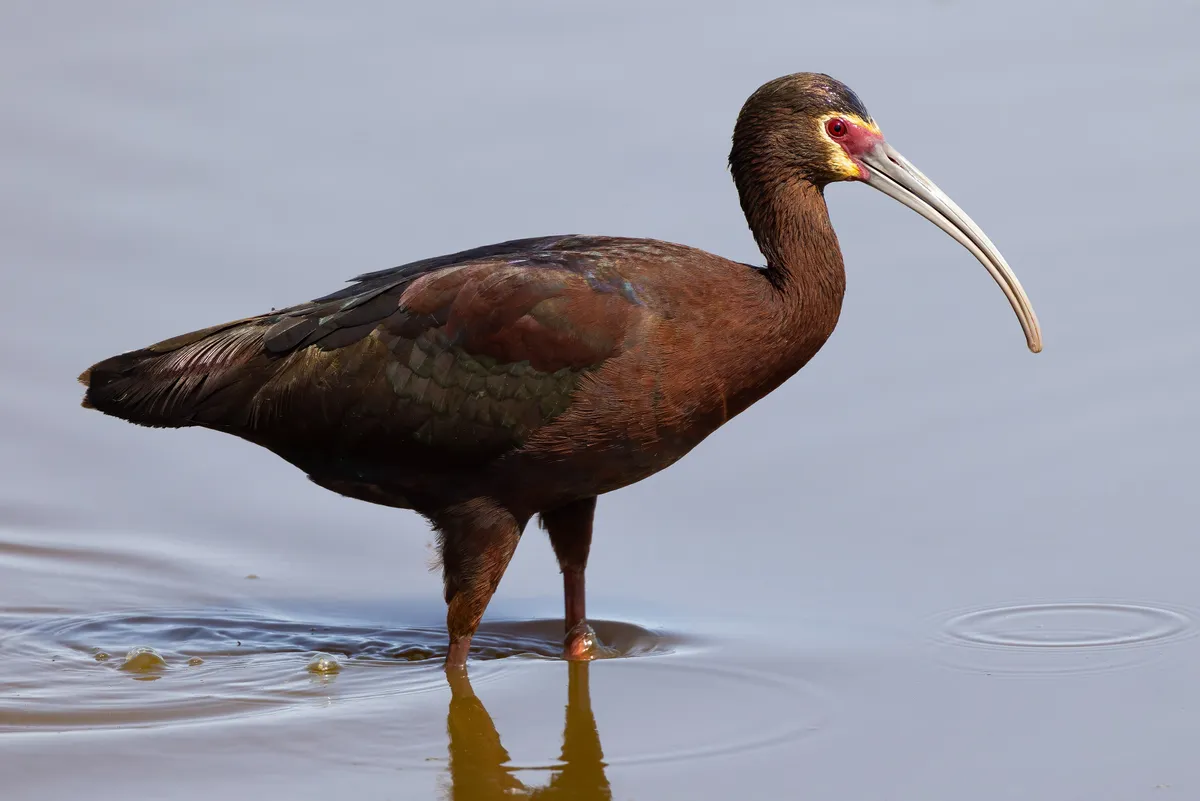
The white-faced ibis (Plegadis chihi) is a wading bird in the ibis family, Threskiornithidae. This species breeds colonially in marshes, usually nesting in bushes or low trees. Its breeding range extends from southwestern Canada and the western United States south through Mexico, as well as from southeastern Brazil and southeastern Bolivia south to central Argentina, and along the coast of central Chile. Its winter range extends from southern California and Louisiana south to include the rest of its breeding range.
Description
In its non-breeding plumage, the white-faced ibis is very similar to the glossy ibis except that it tends to be slightly smaller and its plumage has a somewhat warmer color. Breeding adults have a pink, bare face bordered with white feathers (rather than a bluish bare face with no bordering feathers), a grey bill, and brighter-colored, redder legs. Adults have red eyes year-round, whereas glossy ibises have dark eyes. Juveniles of the two species are nearly identical. Measurements: Length: 18.1–22.1 in (46–56 cm) Weight: 15.9–18.5 oz (450–525 g) Wingspan: 35.4–36.6 in (90–93 cm)
Habitat and range
The white-faced ibis occurs in Canada, the United States, and Central America, and a second subspecies inhabits the southern half of South America, east of the Andes Mountains. In 2012, the total population size was estimated to be 1.2 million individuals, and increasing. The IUCN rates it as being of Least Concern. Migration and interchange between North and South American subspecies does not occur. Within North America, birds breeding in northern areas of the range move south to wintering areas. For example, breeders in northern California and southern Oregon move to wintering areas in southern California and México or Central America. Some birds breeding in Yellowstone in Wyoming will overwinter in areas such as Texas and coastal Gulf of Mexico regions.
Diet
The white-faced ibis eats a variety of organisms, including many invertebrates such as insects, leeches, snails, crayfish and earthworms. It may also eat vertebrates such as fish, newts, and frogs. Its feeding style is to use its bill to probe for prey.
Text from Wikipedia — White-faced ibis, revision 1370185387, CC BY-SA 4.0, retrieved 2026-09-04. Encyclopedic text reused under CC BY-SA 4.0. Sentences about hunting or regulation are removed: on this site, the rule comes from Québec.ca.
Presence in Quebec
- Origin
- Indigène
- Occurrence
- Accidentel/non régulier
- Population status
- Migrateur
- Certainty
- Confirmé
Conservation
Québec.ca
Official periods
Source: Québec.ca — tables reproduced as published (retrieved 2026-08-30).
Regulations change. Always check Québec.ca before hunting or trapping.
Where this data comes from
This species is listed in an official government dataset. The identification and status shown in the data sheet are reproduced from it.
Source: List of Quebec’s vertebrate wildlife (LFVQ) — Ministère de l’Environnement, de la Lutte contre les changements climatiques, de la Faune et des Parcs. File LFVQ_25_03_2026.csv, retrieved 2026-08-30 · CC BY 4.0.
Measurements, habitat, diet and reproduction are not shown: no official source is attached to them yet.