Ibis blanc— Quebec wildlife
Eudocimus albus
ThreskiornithidaeNo period published by Québec.ca
Québec.ca publishes no hunting or trapping period for this species. Check the official regulations.
Wikipedia
Ibis blanc
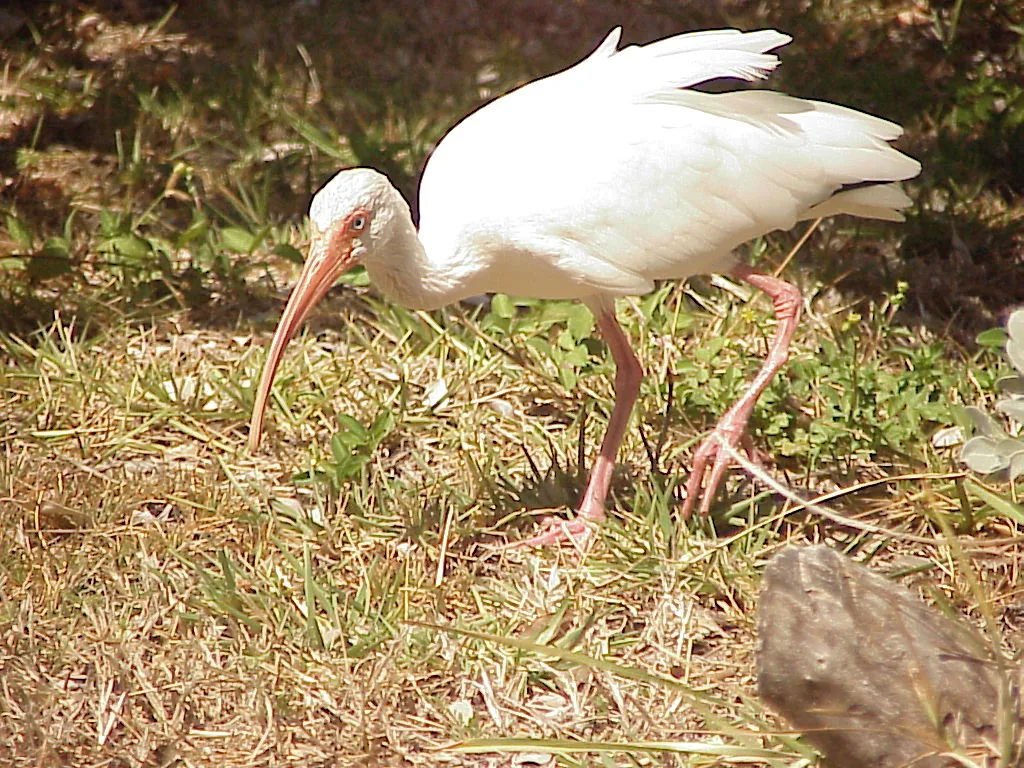
The American white ibis (Eudocimus albus) is a species of bird in the ibis family, Threskiornithidae. It is found from the southern half of the US East Coast (from southern New Jersey to Georgia), along the Gulf Coast states (Florida, Alabama, Mississippi, Louisiana and Texas) and south through most of the Caribbean coastal regions of Central America. This particular ibis species is a medium-sized wading bird, possessing an overall white plumage with black wing-tips (usually only visible in flight), and having the typical downward-curving bill of the ibises, though of a bright red-orange color, the same hue as its long legs. Males are larger and have longer bills than females. The breeding range runs along the Gulf and Atlantic Coast, and the coasts of Mexico and Central America. Outside the breeding period, the range extends further inland in North America and also includes the Caribbean. It is also found along the northwestern South American coastline in Colombia and Venezuela. Populations in central Venezuela overlap and interbreed with the scarlet ibis. The two have been classified by some authorities as a single species. Their diet consists primarily of small aquatic prey, such as insects and small fishes. Crayfish are its preferred food in most regions, but it can adjust its diet according to the habitat and prey abundance. Its main foraging behavior is probing with its beak at the bottom of shallow water to feel for and capture its prey. It does not see the prey. During the breeding season, the American white ibis gathers in huge colonies near water. Pairs are predominantly monogamous and both parents care for the young, although males tend to engage in extra-pair copulation with other females to increase their reproductive success. Males have also been found to pirate food from unmated females and juveniles during the breeding season. Human pollution has affected the behavior of the American white ibis via an increase in the concentrations of methylmercury, which is released into the environment from untreated waste. Exposure to methylmercury alters the hormone levels of American white ibis, affecting their mating and nesting behavior and leading to lower reproduction rates.
Description
The white plumage and pink facial skin of adult American white ibises are distinctive. Adults have black wingtips that are usually only visible in flight. In non-breeding condition the long downcurved bill and long legs are bright red-orange. During the first ten days of the breeding season, the skin darkens to a deep pink on the bill and an almost purple-tinted red on the legs. It then fades to a paler pink, and the tip of the bill becomes blackish. It is difficult to determine the sex of an adult American white ibis from its external appearance, since the sexes have similar plumage. However, there is sexual dimorphism in size and proportion as males are significantly larger and heavier than females and have longer and stouter bills.
Text from Wikipedia — American white ibis, revision 1368876767, CC BY-SA 4.0, retrieved 2026-09-04. Encyclopedic text reused under CC BY-SA 4.0. Sentences about hunting or regulation are removed: on this site, the rule comes from Québec.ca.
Other names
French
English
Presence in Quebec
- Origin
- Indigène
- Occurrence
- Accidentel/non régulier
- Population status
- Migrateur
- Certainty
- Confirmé
Conservation
Québec.ca
Official periods
Source: Québec.ca — tables reproduced as published (retrieved 2026-08-30).
Regulations change. Always check Québec.ca before hunting or trapping.
Where this data comes from
This species is listed in an official government dataset. The identification and status shown in the data sheet are reproduced from it.
Source: List of Quebec’s vertebrate wildlife (LFVQ) — Ministère de l’Environnement, de la Lutte contre les changements climatiques, de la Faune et des Parcs. File LFVQ_25_03_2026.csv, retrieved 2026-08-30 · CC BY 4.0.
Measurements, habitat, diet and reproduction are not shown: no official source is attached to them yet.