
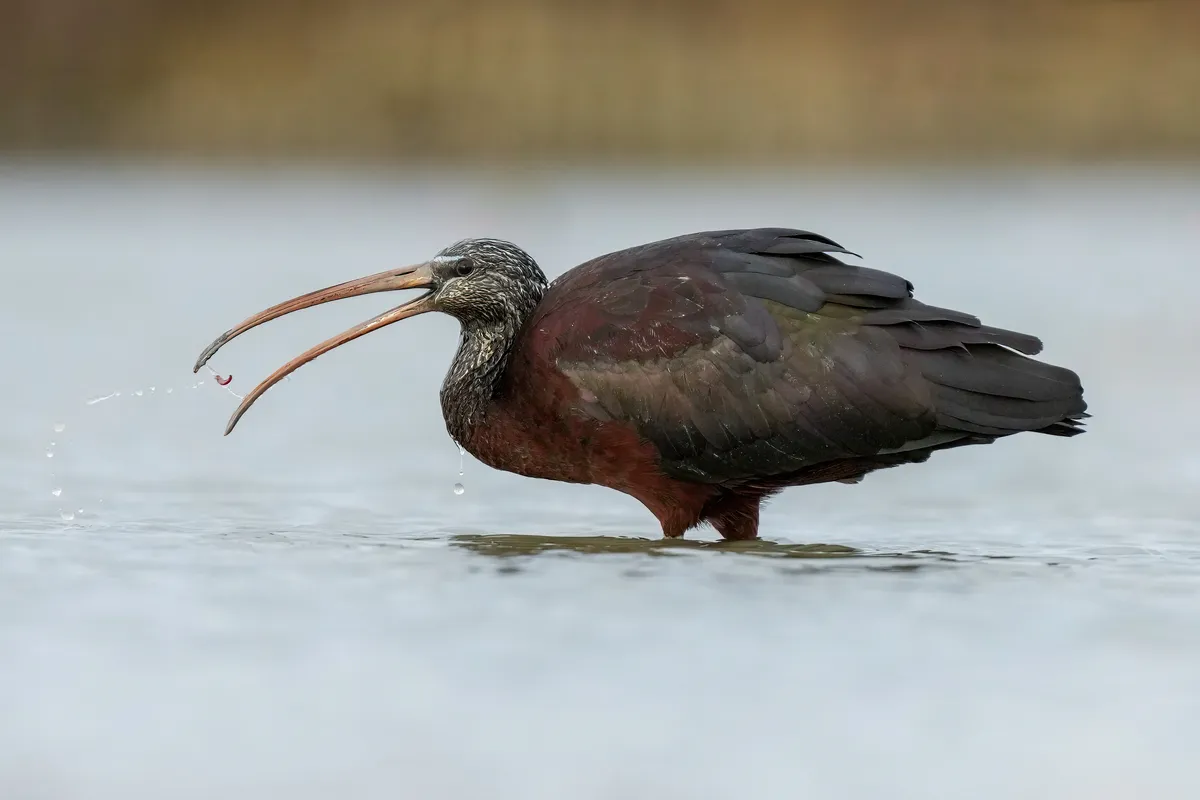
Ibis falcinelle— Quebec wildlife
Plegadis falcinellus
ThreskiornithidaeNo period published by Québec.ca
Québec.ca publishes no hunting or trapping period for this species. Check the official regulations.
Wikipedia
Ibis falcinelle
The glossy ibis (Plegadis falcinellus) is a water bird in the order Pelecaniformes and the ibis and spoonbill family Threskiornithidae. The scientific name derives from Ancient Greek plegados and Latin, falcis, both meaning "sickle" and referring to the distinctive shape of the bill. The historical name black curlew was used for the glossy ibis in Norfolk at least until the early 19th century, and this name also appears in Anglo-Saxon literature. Yalden and Albarella do not mention this species as occurring in medieval England.
Description
This species is a mid-sized ibis. It is 48–66 cm (19–26 in) long, averaging around 59.4 cm (23.4 in) with an 80–105 cm (31–41 in) wingspan. The culmen measures 9.7 to 14.4 cm (3.8 to 5.7 in) in length, each wing measures 24.8–30.6 cm (9.8–12.0 in), the tail is 9–11.2 cm (3.5–4.4 in) and the tarsus measures 6.8–11.3 cm (2.7–4.4 in). The weight can range from 485 to 970 g (1.069 to 2.138 lb). Breeding adults have reddish-brown bodies and strongly iridescent wing feathers, bottle-green to bronzed or purple depending on the light angle. Adult breeding birds have a narrow white facial band above and below the bill, much less obvious than in the closely related and otherwise very similar white-faced ibis. Non-breeders and juveniles have duller bodies, with the dark brown head and neck finely streaked with white. It has a brownish bill, dark facial skin bordered above and below in blue-grey (non-breeding) to cobalt blue (breeding), and red-brown legs. Unlike herons, ibises fly with necks outstretched, their flight being graceful and often in V formation. Sounds made by this rather quiet ibis include a variety of croaks and grunts, including a hoarse grrrr made when breeding.
Habitat and range
This is the most widespread ibis species, breeding in scattered sites in warm regions of Europe, Asia, Africa, Australia, and the Atlantic and Caribbean regions of the Americas. It is thought to have originated in the Old World and spread naturally from Africa to northern South America in the 19th century, from where it spread to North America. The glossy ibis was first documented in the New World in 1817 (New Jersey). Audubon saw the species just once in Florida in 1832. It expanded its range substantially northwards in the 1940s and to the west in the 1980s. This species is migratory; most European birds winter in Africa, and in North America birds from north of the Carolinas winter farther south. Though generally suspected to be a migratory species in India, the glossy ibis is resident in western India. Birds from other populations may disperse widely outside the breeding season. Birds which arrived in Great Britain and Ireland were routinely shot as trophies until the 1920s, when attitudes started to change. It disappeared as a regular breeding bird in Spain in the early 20th century, but with legal protection re-established itself in 1993 and has since rapidly increased with thousands of pairs in several colonies.
Text from Wikipedia — Glossy ibis, revision 1347581152, CC BY-SA 4.0, retrieved 2026-09-04. Encyclopedic text reused under CC BY-SA 4.0. Sentences about hunting or regulation are removed: on this site, the rule comes from Québec.ca.
Other names
French
English
Presence in Quebec
- Origin
- Indigène
- Occurrence
- Régulier
- Population status
- Migrateur
- Certainty
- Confirmé
Conservation
Québec.ca
Official periods
Source: Québec.ca — tables reproduced as published (retrieved 2026-08-30).
Regulations change. Always check Québec.ca before hunting or trapping.
Where this data comes from
This species is listed in an official government dataset. The identification and status shown in the data sheet are reproduced from it.
Source: List of Quebec’s vertebrate wildlife (LFVQ) — Ministère de l’Environnement, de la Lutte contre les changements climatiques, de la Faune et des Parcs. File LFVQ_25_03_2026.csv, retrieved 2026-08-30 · CC BY 4.0.
Measurements, habitat, diet and reproduction are not shown: no official source is attached to them yet.