
No period published by Québec.ca
Québec.ca publishes no hunting or trapping period for this species. Check the official regulations.
Wikipedia
Jaseur boréal
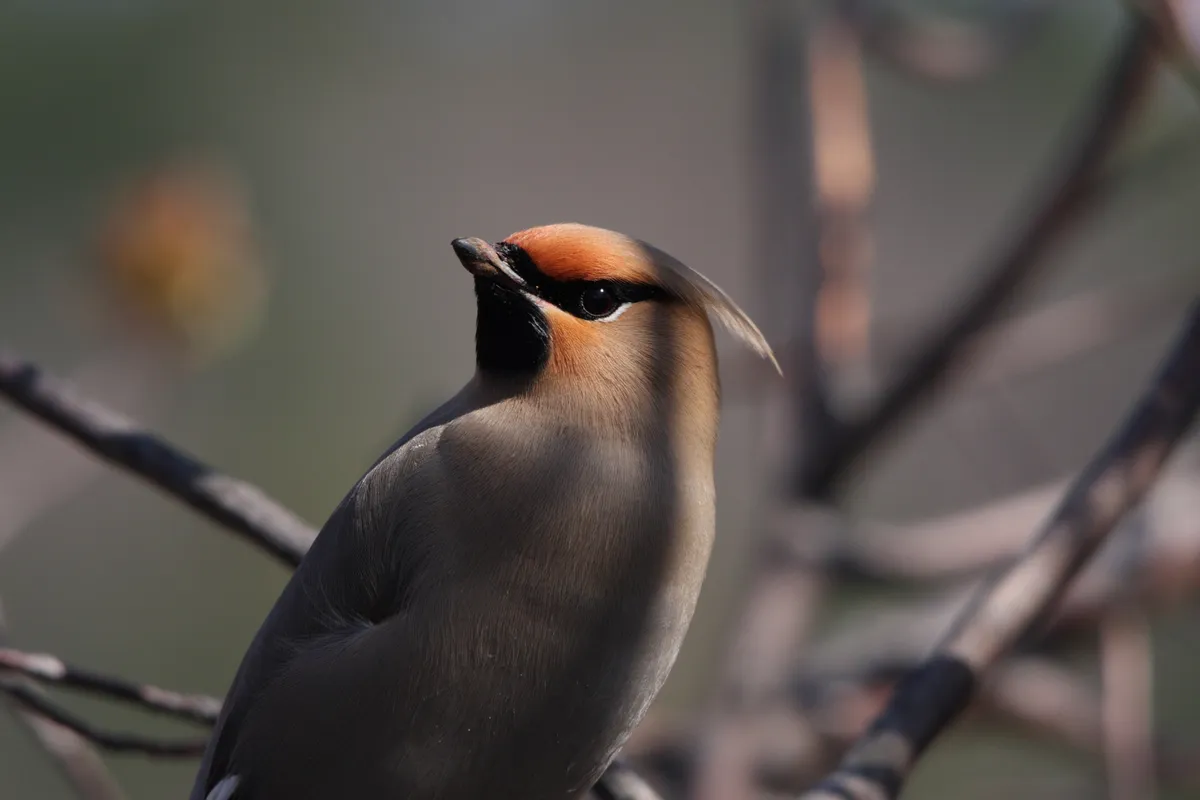
The Bohemian waxwing (Bombycilla garrulus) is a starling-sized passerine bird that breeds in the northern forests of the Palearctic and North America. It has mainly buff-grey plumage, black face markings and a pointed crest. Its wings are patterned with white and bright yellow, and some of the wing feathers have red tips, the resemblance of which to sealing wax gives these birds their common name. The two or three subspecies show only minor differences in appearance. Females are similar to males, although young birds are less well-marked and have few or no waxy wingtips. Although the Bohemian waxwing's range overlaps those of the cedar and Japanese waxwings, it is easily distinguished from them by size and plumage differences. The breeding habitat is coniferous forests, usually near water. The pair build a lined cup-shaped nest in a tree or bush, often close to the trunk. The clutch of 3–7 eggs is incubated by the female alone for 13–14 days to hatching. The chicks are altricial and naked, and are fed by both parents, initially mostly with insects, but thereafter mainly fruit. They fledge about 14–16 days after leaving the egg. Many birds desert their nesting range in winter and migrate farther south. In some years, large numbers of Bohemian waxwings irrupt well beyond their normal winter range in search of the fruit that makes up most of their diet. Waxwings can be very tame in winter, entering towns and gardens in search of food, rowan berries being a particular favourite. They can metabolise alcohol produced in fermenting fruit, but can still become intoxicated, sometimes fatally. Other hazards include predation by birds of prey, infestation by parasites, and collisions with cars or windows. The large numbers and very large breeding area mean that it is classified as being of least concern by the International Union for Conservation of Nature.
Description
The Bohemian waxwing is a starling-sized bird 19–23 cm (7.5–9.1 in) in length with a 32–35.5 cm (12.6–14.0 in) wingspan, and an average weight of 55 g (1.9 oz). It is short-tailed, mainly brownish-grey, and has a conspicuous crest on its head. The male of the nominate subspecies has a black mask through the eye and a black throat. There is a white streak behind the bill and a white curve below the eye. The lower belly is a rich chestnut colour and there are cinnamon-coloured areas around the mask. The rump is grey and the tail ends in a bright yellow band with a broad black border above it. The wings are very distinctive; the flight feathers are black and the primaries in adults have markings that produce a yellow stripe and white "fishhooks" on the closed wing. The adult's secondaries end in long red appendages with the sealing wax appearance that gives the bird its English name. The eyes are dark brown, the bill is mainly black, and the legs are dark grey or black.
Text from Wikipedia — Bohemian waxwing, revision 1365151915, CC BY-SA 4.0, retrieved 2026-09-04. Encyclopedic text reused under CC BY-SA 4.0. Sentences about hunting or regulation are removed: on this site, the rule comes from Québec.ca.
Other names
French
English
Presence in Quebec
- Origin
- Indigène
- Occurrence
- Régulier
- Population status
- Toute l'année
- Certainty
- Confirmé
Conservation
Québec.ca
Official periods
Source: Québec.ca — tables reproduced as published (retrieved 2026-08-30).
Regulations change. Always check Québec.ca before hunting or trapping.
Where this data comes from
This species is listed in an official government dataset. The identification and status shown in the data sheet are reproduced from it.
Source: List of Quebec’s vertebrate wildlife (LFVQ) — Ministère de l’Environnement, de la Lutte contre les changements climatiques, de la Faune et des Parcs. File LFVQ_25_03_2026.csv, retrieved 2026-08-30 · CC BY 4.0.
Measurements, habitat, diet and reproduction are not shown: no official source is attached to them yet.