
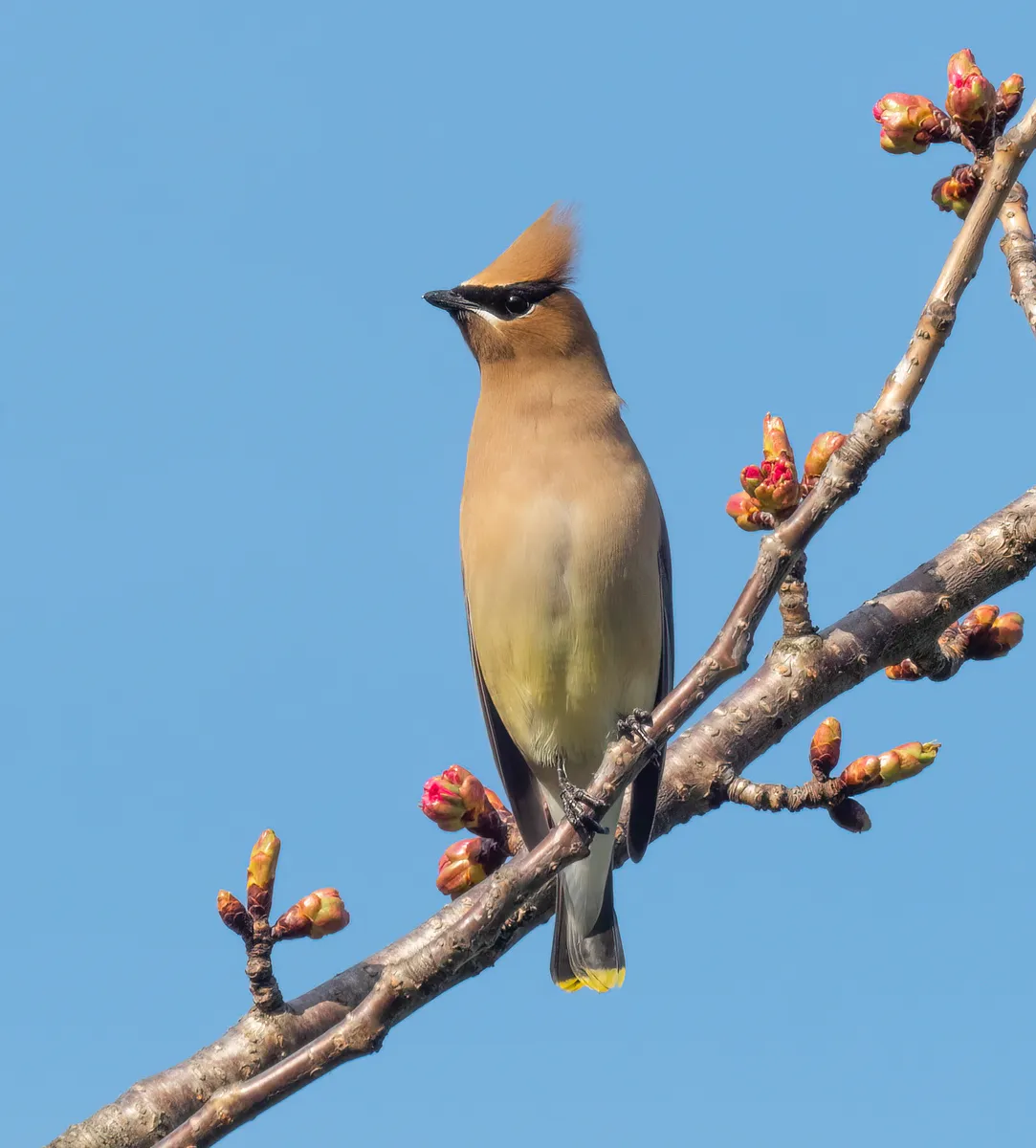
Jaseur d'Amérique— Quebec wildlife
Bombycilla cedrorum
BombycillidaeNo period published by Québec.ca
Québec.ca publishes no hunting or trapping period for this species. Check the official regulations.
Wikipedia
Jaseur d'Amérique
The cedar waxwing (Bombycilla cedrorum) is a member of the family Bombycillidae or waxwing family of passerine birds. It is a medium-sized bird that is mainly brown, gray, and yellow. Some of the wing feathers have red tips, which resemble sealing wax, giving the bird its common name. It is a native of North and Central America, breeding in open wooded areas in southern Canada and wintering in the southern half of the United States, Central America, and the far northwest of South America. Its diet includes cedar cones, fruit, holly berries, and insects. The cedar waxwing is listed as least concern on the IUCN Red List.
Description
Cedar waxwings are medium-sized birds around 6–7 in (15–18 cm) long and weighing roughly 30 g (1 oz). Wingspan ranges from 8.7 to 11.8 in (22 to 30 cm). They are smaller and browner than their close relative, the Bohemian waxwing (which breeds farther to the north and west). Their markings are a "silky, shiny collection of brown, gray, and lemon-yellow, accented with a subdued crest, rakish black mask, and brilliant-red wax droplets on the wing feathers." These droplets may be the same colour as the madrone berries they are known to eat. These birds' most prominent feature is this small cluster of red, wax-like droplets on tips of secondary flight feathers on the wings, a feature they share with the Bohemian waxwing (but not the Japanese waxwing). These wax-like droplets are attributed to the pigmented and medullary layers of the secondary tip being surrounded by a transparent cuticle. The wings are "broad and pointed, like a starling's." The tail is typically yellow or orange depending on diet. Birds that have fed on berries of introduced Eurasian honeysuckles while growing tail feathers have darker orange-tipped tail feathers. The tail is somewhat short and square-tipped. Adults have a pale yellow belly. The waxwing's crest often "lies flat and droops over the back of the head." It has a short and wide bill. The waxwing's black mask has a thin, white border. Immature birds are streaked on the throat and flanks and often do not have the black mask of the adults. Males and females look alike. The flight of waxwings is strong and direct, and the movement of the flock in flight resembles that of a flock of small, pale European starlings. Cedar waxwings fly at 40 km/h (25 mph) at an altitude up to 610 m (2,000 ft). Cedar waxwings are also known as the southern waxwing, Canada robin, cedar bird, cherry bird, or recellet. The oldest observed cedar waxwing was eight years and two months old.
Text from Wikipedia — Cedar waxwing, revision 1368540499, CC BY-SA 4.0, retrieved 2026-09-04. Encyclopedic text reused under CC BY-SA 4.0. Sentences about hunting or regulation are removed: on this site, the rule comes from Québec.ca.
Other names
French
English
Presence in Quebec
- Origin
- Indigène
- Occurrence
- Régulier
- Population status
- Reproducteur
- Certainty
- Confirmé
Conservation
Québec.ca
Official periods
Source: Québec.ca — tables reproduced as published (retrieved 2026-08-30).
Regulations change. Always check Québec.ca before hunting or trapping.
SIT Québec register
Outfitters hunting this species
403 outfitters list this species among the game they hunt.
Where this data comes from
This species is listed in an official government dataset. The identification and status shown in the data sheet are reproduced from it.
Source: List of Quebec’s vertebrate wildlife (LFVQ) — Ministère de l’Environnement, de la Lutte contre les changements climatiques, de la Faune et des Parcs. File LFVQ_25_03_2026.csv, retrieved 2026-08-30 · CC BY 4.0.
Measurements, habitat, diet and reproduction are not shown: no official source is attached to them yet.