
No period published by Québec.ca
Québec.ca publishes no hunting or trapping period for this species. Check the official regulations.
Wikipedia
Junco ardoisé
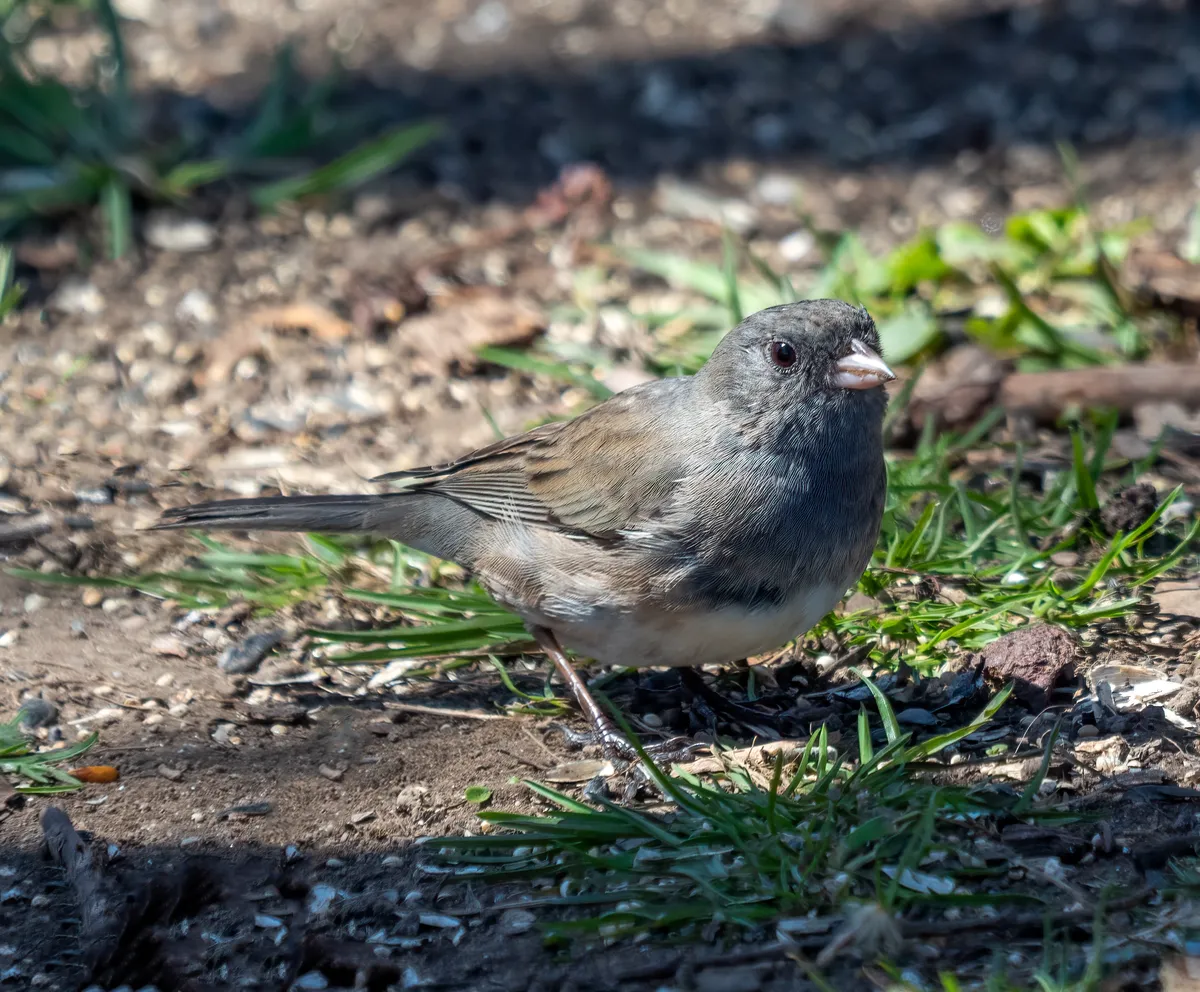
The dark-eyed junco (Junco hyemalis) is a species of junco, a group of small, grayish New World sparrows. The species is common across much of temperate North America and in summer it ranges far into the Arctic. It is a variable species, much like the related fox sparrow (Passerella iliaca), and its systematics are still not completely resolved.
Description
Adult dark-eyed juncos generally have gray heads, necks, and breasts, gray or brown backs and wings, and a white belly, but show a confusing amount of variation in plumage details. The white outer tail feathers flash distinctively in flight and while hopping on the ground. The bill is usually pale pinkish. Males tend to have darker, more conspicuous markings than females. The dark-eyed junco is 13 to 17.5 cm (5.1 to 6.9 in) long and has a wingspan of 18 to 25 cm (7.1 to 9.8 in). Body mass can vary from 18 to 30 g (0.63 to 1.06 oz). Among standard measurements, the wing chord is 6.6 to 9.3 cm (2.6 to 3.7 in), the tail is 6.1 to 7.3 cm (2.4 to 2.9 in), the bill is 0.9 to 1.3 cm (0.35 to 0.51 in) and the tarsus is 1.9 to 2.3 cm (0.75 to 0.91 in). Juveniles often have pale streaks on their underparts and may even be mistaken for vesper sparrows (Pooecetes gramineus) until they acquire adult plumage at two to three months, but dark-eyed junco fledglings' heads are generally quite uniform in color already, and initially their bills still have conspicuous yellowish edges to the gape, remains of the fleshy wattles that guide the parents when they feed the nestlings. The song is a trill similar to the chipping sparrow's (Spizella passerina), except that the red-backed dark-eyed junco's (see above) song is more complex, similar to that of the yellow-eyed junco (Junco phaeonotus). The call also resembles that of the black-throated blue warbler (Setophaga caerulescens) which is a member of the New World warbler family. Calls include tick sounds and very high-pitched tinkling chips. It is known among bird song practitioners as an excellent bird to study for learning "bird language".
Text from Wikipedia — Dark-eyed junco, revision 1369028591, CC BY-SA 4.0, retrieved 2026-09-04. Encyclopedic text reused under CC BY-SA 4.0. Sentences about hunting or regulation are removed: on this site, the rule comes from Québec.ca.
Other names
French
English
Presence in Quebec
- Origin
- Indigène
- Occurrence
- Régulier
- Population status
- Reproducteur
- Certainty
- Confirmé
Conservation
Québec.ca
Official periods
Source: Québec.ca — tables reproduced as published (retrieved 2026-08-30).
Regulations change. Always check Québec.ca before hunting or trapping.
Where this data comes from
This species is listed in an official government dataset. The identification and status shown in the data sheet are reproduced from it.
Source: List of Quebec’s vertebrate wildlife (LFVQ) — Ministère de l’Environnement, de la Lutte contre les changements climatiques, de la Faune et des Parcs. File LFVQ_25_03_2026.csv, retrieved 2026-08-30 · CC BY 4.0.
Measurements, habitat, diet and reproduction are not shown: no official source is attached to them yet.