
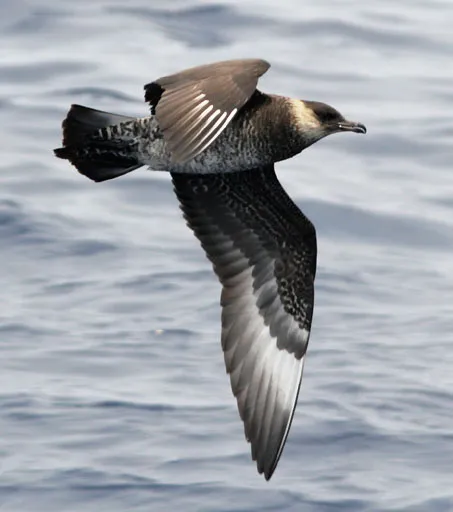
Labbe pomarin— Quebec wildlife
Stercorarius pomarinus
StercorariidaeNo period published by Québec.ca
Québec.ca publishes no hunting or trapping period for this species. Check the official regulations.
Wikipedia
Labbe pomarin
The pomarine jaeger (Stercorarius pomarinus), pomarine skua, or pomatorhine skua, is a seabird in the skua family Stercorariidae. It is a migrant, wintering at sea in the tropical oceans.
Description
This species ranges from 46 to 67 cm (18 to 26 in) in length, 110 to 138 cm (43 to 54 in) in wingspan and 540–920 g (1.19–2.03 lb) in weight. The upper limit of the length includes the elongated tail streamer of breeding adults, which is about 10 cm (3.9 in) in length. Identification of this jaeger is complicated by its similarities to parasitic jaeger and the existence of three morphs. Pomarine jaegers are larger than common gulls. They are much bulkier, broader-winged and less falcon-like than the parasitic jaeger, but show the same wide range of plumage variation. The flight is more measured than that of the smaller species. It has many harsh chattering calls and others which sounds like which-yew. Light-morph adult pomarine jaegers have a brown back, mainly white underparts and dark primary wing feathers with a white "flash". The head and neck are yellowish-white with a black cap. Dark morph adults are dark brown, and intermediate morph birds are dark with somewhat paler underparts, head and neck. All morphs have the white wing flash, which appears as a diagnostic double flash on the underwing. In breeding adults of all morphs, the two central tail feathers are much longer than the others, spoon-shaped, and twisted from the horizontal. Juveniles are even more problematic to identify, and are difficult to separate from parasitic jaegers at a distance on plumage alone.
Text from Wikipedia — Pomarine jaeger, revision 1359093613, CC BY-SA 4.0, retrieved 2026-09-04. Encyclopedic text reused under CC BY-SA 4.0. Sentences about hunting or regulation are removed: on this site, the rule comes from Québec.ca.
Other names
French
English
Presence in Quebec
- Origin
- Indigène
- Occurrence
- Régulier
- Population status
- Reproducteur
- Certainty
- Confirmé
Conservation
Québec.ca
Official periods
Source: Québec.ca — tables reproduced as published (retrieved 2026-08-30).
Regulations change. Always check Québec.ca before hunting or trapping.
Where this data comes from
This species is listed in an official government dataset. The identification and status shown in the data sheet are reproduced from it.
Source: List of Quebec’s vertebrate wildlife (LFVQ) — Ministère de l’Environnement, de la Lutte contre les changements climatiques, de la Faune et des Parcs. File LFVQ_25_03_2026.csv, retrieved 2026-08-30 · CC BY 4.0.
Measurements, habitat, diet and reproduction are not shown: no official source is attached to them yet.