
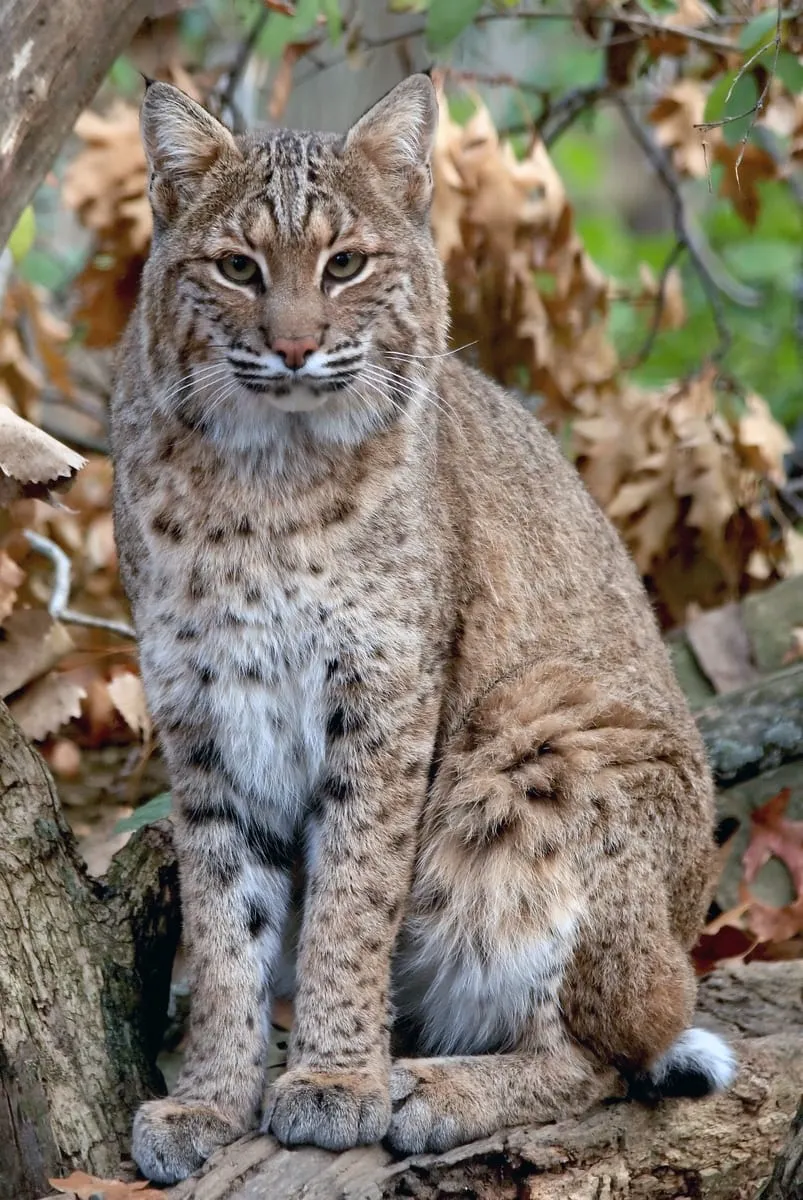
Lynx roux— species and hunting in Quebec
Lynx rufus
FelidaeTrapping periods published by Québec.ca
Official tables below — trapping units (UGAF) and dates.
Wikipedia
Lynx roux
The bobcat (Lynx rufus), also known as the wildcat, bay lynx, or red lynx, is one of the four extant species within the medium-sized wild cat genus Lynx. Native to North America, it ranges from southern Canada through most of the contiguous United States to Oaxaca in Mexico. It is listed as Least Concern on the IUCN Red List since 2002, due to its wide distribution and large population. It has distinctive black bars on its forelegs and a black-tipped, stubby (or "bobbed") tail, from which it derives its name. It reaches a total length (including the tail) of up to 125 cm (50 in). It is an adaptable predator inhabiting wooded areas, semidesert, urban edge, forest edge, and swampland environments. It remains in some of its original range, but populations are vulnerable to extirpation by coyotes and domestic animals. Prey selection depends on location and habitat, season, and abundance. Like most cats, the bobcat is territorial and largely solitary, although with some overlap in home ranges. It uses several methods to mark its territorial boundaries, including claw marks and deposits of urine or feces. The bobcat breeds from winter into spring and has a gestation period of about two months. Two subspecies are recognized: one east of the Great Plains, and the other west of the Great Plains. It is featured in some stories of the indigenous peoples of North and Central America, and in the folklore of European-descended inhabitants of the Americas.
Description
The bobcat resembles other species of the midsize genus Lynx, but is on average the smallest of the four. Its coat is variable, though generally tan to grayish-brown, with black streaks on the body and dark bars on the forelegs and tail. Its spotted patterning acts as camouflage. The ears are black-tipped and pointed, with short, black tufts. Generally, an off-white color is seen on the lips, chin, and underparts. Bobcats in the desert regions of the southwest have the lightest-colored coats, while those in the northern, forested regions are darkest. Kittens are born well-furred and already have their spots. A few melanistic bobcats have been sighted and captured in Florida, USA, and New Brunswick, Canada. They appear black, but may still exhibit a spot pattern. The face appears wide due to ruffs of extended hair beneath the ears. Bobcat eyes are yellow with black slit pupils. The nose of the bobcat is pinkish-red, and it has a base color of gray or yellowish- or brownish-red on its face, sides, and back. The pupils widen during nocturnal activity to maximize light reception. The bobcat has sharp hearing and vision, and a good sense of smell. It is an excellent climber and swims when it needs to, but normally avoids water.
Text from Wikipedia — Bobcat, revision 1372901438, CC BY-SA 4.0, retrieved 2026-09-04. Encyclopedic text reused under CC BY-SA 4.0. Sentences about hunting or regulation are removed: on this site, the rule comes from Québec.ca.
Other names
French
Presence in Quebec
- Origin
- Indigène
- Occurrence
- Régulier
- Population status
- Toute l'année
- Certainty
- Confirmé
Conservation
Québec.ca
Official periods
Source: Québec.ca — tables reproduced as published (retrieved 2026-08-30).
Trapping
Canada lynx and bobcat
| UGAF | Periods |
|---|---|
| 1, 2, 3, 4, 5, 6, 7, 11, 13, 17, 20, 21, 29, 30, 31, 32, 33, 34, 35, 38, 39, 41, 42, 43, 44, 45, 46, 47, 48, 49, 50, 51, 52, 53 | From October 18 to March 1 |
| 8, 9, 10, 12, 14, 15, 16, 18, 19, 22, 23, 24, 25, 26, 27, 28, 36, 37, 40, 70, 71, 72, 73, 74, 75, 76, 77, 78, 79, 80, 81, 82, 83, 84, 85, 86 | From October 25 to March 1 |
| 54, 55, 56, 57, 58, 59, 60, 61, 62, 63, 64, 65, 66, 68 | From October 18 to March 15 |
| 69 | From December 15 to December 31 |
Regulations change. Always check Québec.ca before hunting or trapping.
Where this data comes from
This species is listed in an official government dataset. The identification and status shown in the data sheet are reproduced from it.
Source: List of Quebec’s vertebrate wildlife (LFVQ) — Ministère de l’Environnement, de la Lutte contre les changements climatiques, de la Faune et des Parcs. File LFVQ_25_03_2026.csv, retrieved 2026-08-30 · CC BY 4.0.
Measurements, habitat, diet and reproduction are not shown: no official source is attached to them yet.