
No period published by Québec.ca
Québec.ca publishes no hunting or trapping period for this species. Check the official regulations.
Wikipedia
Macareux moine
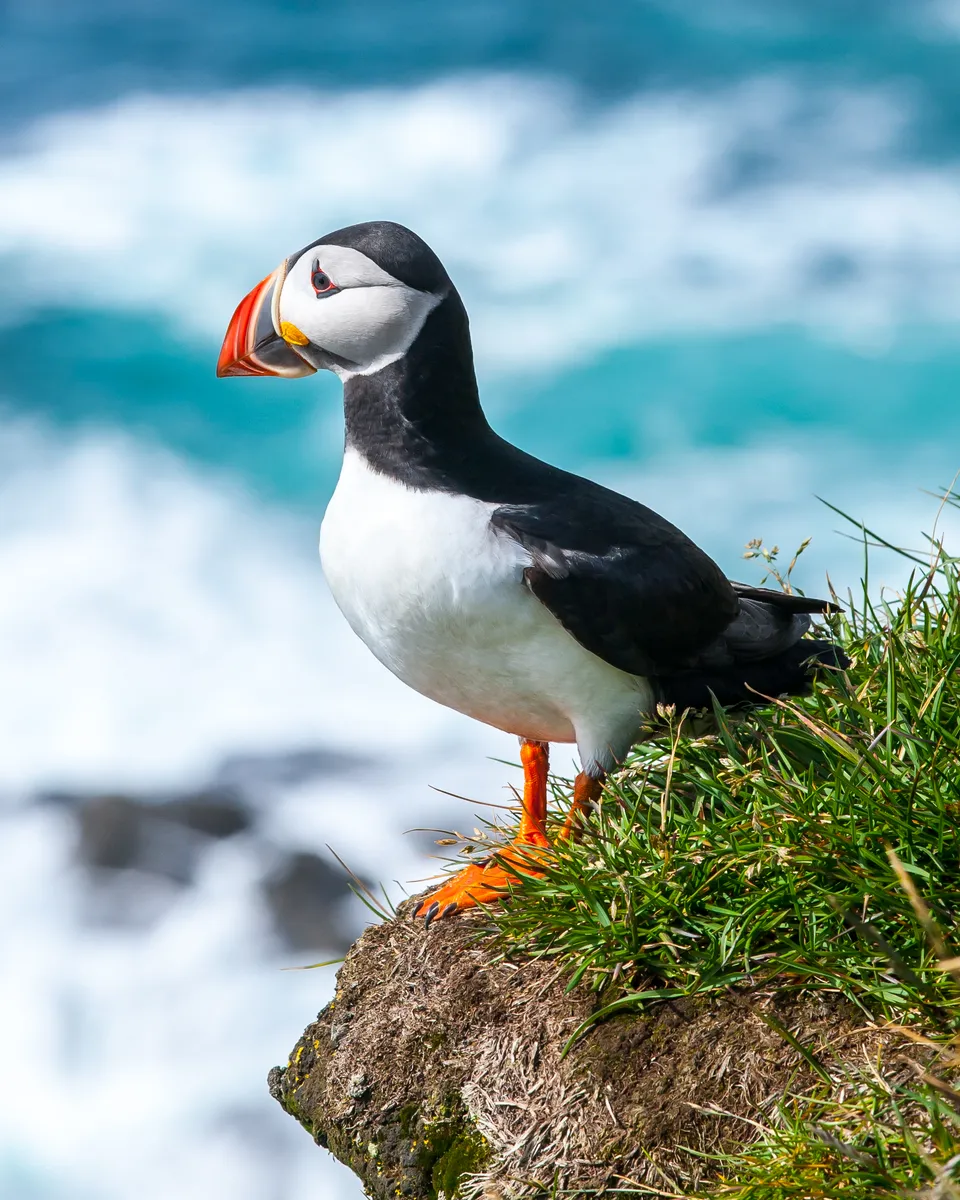
The Atlantic puffin (Fratercula arctica), also known as the common puffin, is a species of seabird in the auk family. It is the only puffin native to the Atlantic Ocean; two related species, the tufted puffin and the horned puffin, are found in the northeastern Pacific. The Atlantic puffin breeds in Russia, Iceland, Ireland, Britain, Norway, Greenland, Newfoundland and Labrador, Nova Scotia, and the Faroe Islands, and as far south as Maine in the west and France in the east. It is most commonly found in the Westman Islands, Iceland. Although it has a large population and a wide range, the species has declined rapidly, at least in parts of its range, resulting in it being rated as vulnerable by the IUCN. On land, it has the typical upright stance of an auk. At sea, it swims on the surface and feeds on zooplankton, small fish, and crabs, which it catches by diving underwater, using its wings for propulsion. This puffin has a black crown and back, light grey cheek patches, and a white body and underparts. Its broad, boldly marked red-and-black beak and orange legs contrast with its plumage. It moults while at sea in the winter, and some of the brightly coloured facial characteristics are lost, with colour returning during the spring. The external appearances of the adult male and female are identical, though the male is usually slightly larger. The juvenile has similar plumage, but its cheek patches are dark grey. The juvenile does not have brightly coloured head ornamentation, its bill is narrower and is dark grey with a yellowish-brown tip, and its legs and feet are also dark. Puffins from northern populations are typically larger than those in the south, and these populations are generally considered to be a different subspecies. Spending the autumn and winter in the open ocean of the cold northern seas, the Atlantic puffin returns to coastal areas at the start of the breeding season in late spring. It nests in clifftop colonies, digging a burrow in which a single white egg is laid. Chicks mostly feed on whole fish and grow rapidly. After about 6 weeks, they are fully fledged and make their way at night to the sea. They swim away from the shore and do not return to land for several years. Colonies are mostly on islands with no terrestrial predators, but adult birds and newly fledged chicks are at risk of attacks from the air by gulls and skuas. The puffin's striking appearance, large, colourful bill, waddling gait, and behaviour have given rise to nicknames such as "clown of the sea" or "sea parrot". It is the official bird of the Canadian province of Newfoundland and Labrador.
Description
The Atlantic puffin is sturdily built with a thick-set neck and short wings and tail. It is 28 to 30 cm (11 to 12 in) in length from the tip of its stout bill to its blunt-ended tail. Its wingspan is 47 to 63 cm (19 to 25 in) and on land it stands about 20 cm (8 in) high. The male is generally slightly larger than the female, but they are coloured alike.
Text from Wikipedia — Atlantic puffin, revision 1370624697, CC BY-SA 4.0, retrieved 2026-09-04. Encyclopedic text reused under CC BY-SA 4.0. Sentences about hunting or regulation are removed: on this site, the rule comes from Québec.ca.
Other names
French
English
Presence in Quebec
- Origin
- Indigène
- Occurrence
- Régulier
- Population status
- Reproducteur
- Certainty
- Confirmé
Conservation
Québec.ca
Official periods
Source: Québec.ca — tables reproduced as published (retrieved 2026-08-30).
Regulations change. Always check Québec.ca before hunting or trapping.
Where this data comes from
This species is listed in an official government dataset. The identification and status shown in the data sheet are reproduced from it.
Source: List of Quebec’s vertebrate wildlife (LFVQ) — Ministère de l’Environnement, de la Lutte contre les changements climatiques, de la Faune et des Parcs. File LFVQ_25_03_2026.csv, retrieved 2026-08-30 · CC BY 4.0.
Measurements, habitat, diet and reproduction are not shown: no official source is attached to them yet.