
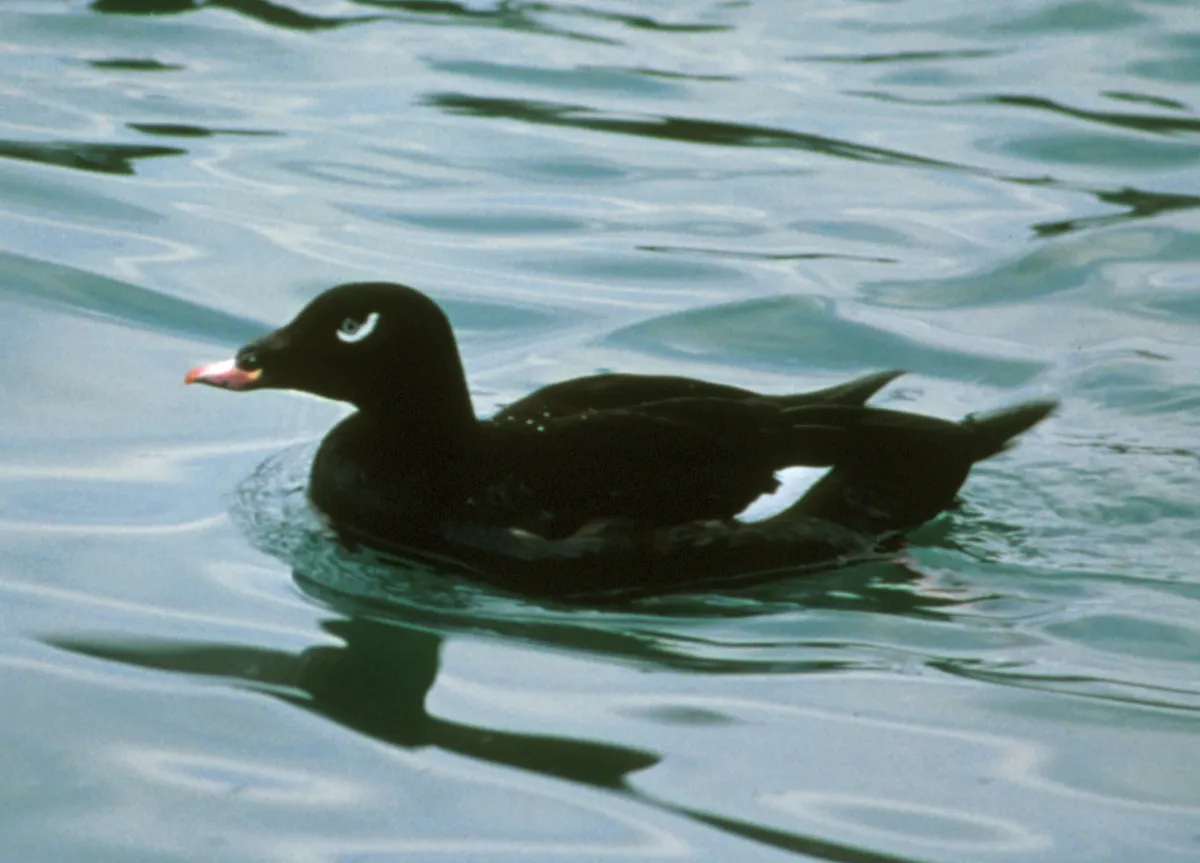
Macreuse à ailes blanches— Quebec wildlife
Melanitta deglandi
AnatidaeNo period published by Québec.ca
Québec.ca publishes no hunting or trapping period for this species. Check the official regulations.
Wikipedia
Macreuse à ailes blanches
The white-winged scoter (Melanitta deglandi) is a large sea duck. The genus name is derived from Ancient Greek melas "black" and netta "duck". The species name commemorates French ornithologist Côme-Damien Degland.
Description
The white-winged scoter is one of three North American scoter species and the largest species of scoter. Females range from 950 to 1,950 g (2.09 to 4.30 lb) and 48 to 56 cm (19 to 22 in), averaging 1,180 g (2.60 lb) and 52.3 cm (20.6 in). The male ranges from 1,360 to 2,128 g (2.998 to 4.691 lb) and from 53 to 60 cm (21 to 24 in), averaging 1,380 g (3.04 lb) and 55 cm (22 in). The white-winged scoter has a wingspan of 31.5 in (80 cm). This species is characterized by its bulky shape and large bill, which is feathered at the gape unlike the blocky bill base of the surf scoter. The white secondary flight feathers by which the species is named is visible in flight, but may be concealed when swimming. The male is all black, except for white around the eye and a white speculum. The bill is orange and red with a large black knob at the base. It takes three years for definitive (adult) plumage to be attained – second-year males resemble adult males but exhibit reduced eye markings and have browner flanks. Females are brownish overall and best distinguished from other scoters by the feathered gape and body shape. The facial pattern in female-type birds is highly variable – younger individuals have conspicuous white spots in front and behind the eye, while adults may lack these patches and appear entirely chocolate brown in winter. Juveniles resemble females but have more distinct facial patches and a mottled white belly. The greater secondary coverts of juvenile males have more extensive white than juvenile females which exhibit little to no white fringing. There are a number of differing characteristics of the Stejneger's scoter and the white-winged scoter. Males of the white-winged scoter have browner flanks, dark yellow coloration of most of the bill and a less tall bill knob, approaching the velvet scoter. The male Stejneger's scoter has a very tall knob at the base of its mostly orange-yellow bill. Female of both species are very similar and best distinguished by head shape; White-winged Scoters tend to have "two-stepped" profile between the bill and the head, compared to the long "Roman nose" profile of Stejneger's Scoter similar to that of a common eider. Additionally, the feathering along the base of the upper mandible forms a right angle on the White-winged scoter, compared to the acute angle on the Stejneger's Scoter. The Latin binomial commemorates the French zoologist Dr. Côme-Damien Degland (1787–1856).
Habitat and range
White-winged Scoters have the largest breeding range among North American scoters. They mainly breed in boreal forest from Alaska to Western Canada and are less common east towards the Hudson Bay and south towards the Canadian Prairies.
Text from Wikipedia — White-winged scoter, revision 1367541893, CC BY-SA 4.0, retrieved 2026-09-04. Encyclopedic text reused under CC BY-SA 4.0. Sentences about hunting or regulation are removed: on this site, the rule comes from Québec.ca.
Other names
French
Presence in Quebec
- Origin
- Indigène
- Occurrence
- Régulier
- Population status
- Reproducteur
- Certainty
- Confirmé
Conservation
Québec.ca
Official periods
Source: Québec.ca — tables reproduced as published (retrieved 2026-08-30).
Regulations change. Always check Québec.ca before hunting or trapping.
SIT Québec register
Outfitters hunting this species
90 outfitters list this species among the game they hunt.
Where this data comes from
This species is listed in an official government dataset. The identification and status shown in the data sheet are reproduced from it.
Source: List of Quebec’s vertebrate wildlife (LFVQ) — Ministère de l’Environnement, de la Lutte contre les changements climatiques, de la Faune et des Parcs. File LFVQ_25_03_2026.csv, retrieved 2026-08-30 · CC BY 4.0.
Measurements, habitat, diet and reproduction are not shown: no official source is attached to them yet.