
No period published by Québec.ca
Québec.ca publishes no hunting or trapping period for this species. Check the official regulations.
Wikipedia
Macreuse à bec jaune
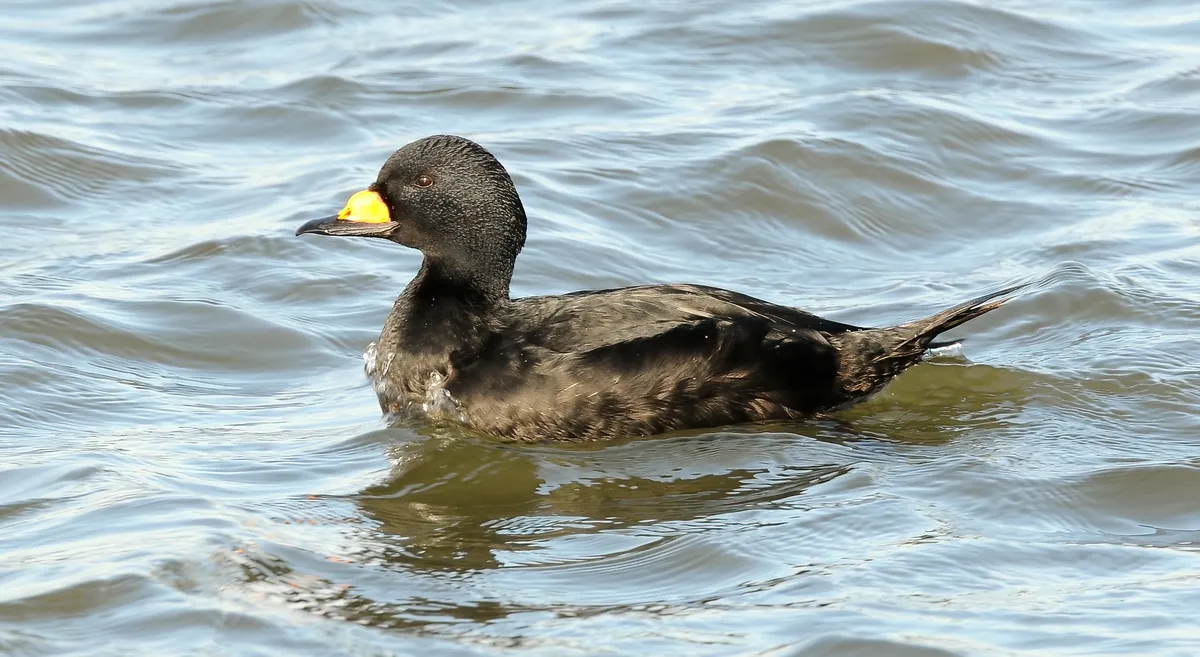
The black scoter or American scoter (Melanitta americana) is a large sea duck, 43 to 49 cm (17 to 19 in) in length. The genus name is derived from Ancient Greek melas "black" and netta "duck". The species name is from the Latin for "American". Together with the common scoter M. nigra, it forms the subgenus Oidemia; the two are sometimes considered conspecific, the black scoter then being referred to as M. nigra americana. Its French name, used in parts of its Canadian range, is macreuse noire (also meaning "black scoter"). The species is listed as Near Threatened by the IUCN.
Description
This large sea duck is characterised by its bulky shape and large bill. The adult male is all black with a very bulbous bill which is mostly yellow. The female is a brown bird with pale cheeks, very similar to female common scoter. The adult female averages about 980 g (2.16 lb) and 45 cm (18 in) in length, while the adult male is on average 1,100 g (2.4 lb) and 49 cm (19 in) in length. This species can be distinguished from other scoters, apart from common scoter, by the lack of white anywhere on the drake, and the more extensive pale areas on the female.
Text from Wikipedia — Black scoter, revision 1356841228, CC BY-SA 4.0, retrieved 2026-09-04. Encyclopedic text reused under CC BY-SA 4.0. Sentences about hunting or regulation are removed: on this site, the rule comes from Québec.ca.
Other names
French
Presence in Quebec
- Origin
- Indigène
- Occurrence
- Régulier
- Population status
- Reproducteur
- Certainty
- Confirmé
Conservation
Québec.ca
Official periods
Source: Québec.ca — tables reproduced as published (retrieved 2026-08-30).
Regulations change. Always check Québec.ca before hunting or trapping.
Where this data comes from
This species is listed in an official government dataset. The identification and status shown in the data sheet are reproduced from it.
Source: List of Quebec’s vertebrate wildlife (LFVQ) — Ministère de l’Environnement, de la Lutte contre les changements climatiques, de la Faune et des Parcs. File LFVQ_25_03_2026.csv, retrieved 2026-08-30 · CC BY 4.0.
Measurements, habitat, diet and reproduction are not shown: no official source is attached to them yet.