
No period published by Québec.ca
Québec.ca publishes no hunting or trapping period for this species. Check the official regulations.
Wikipedia
Macreuse à front blanc
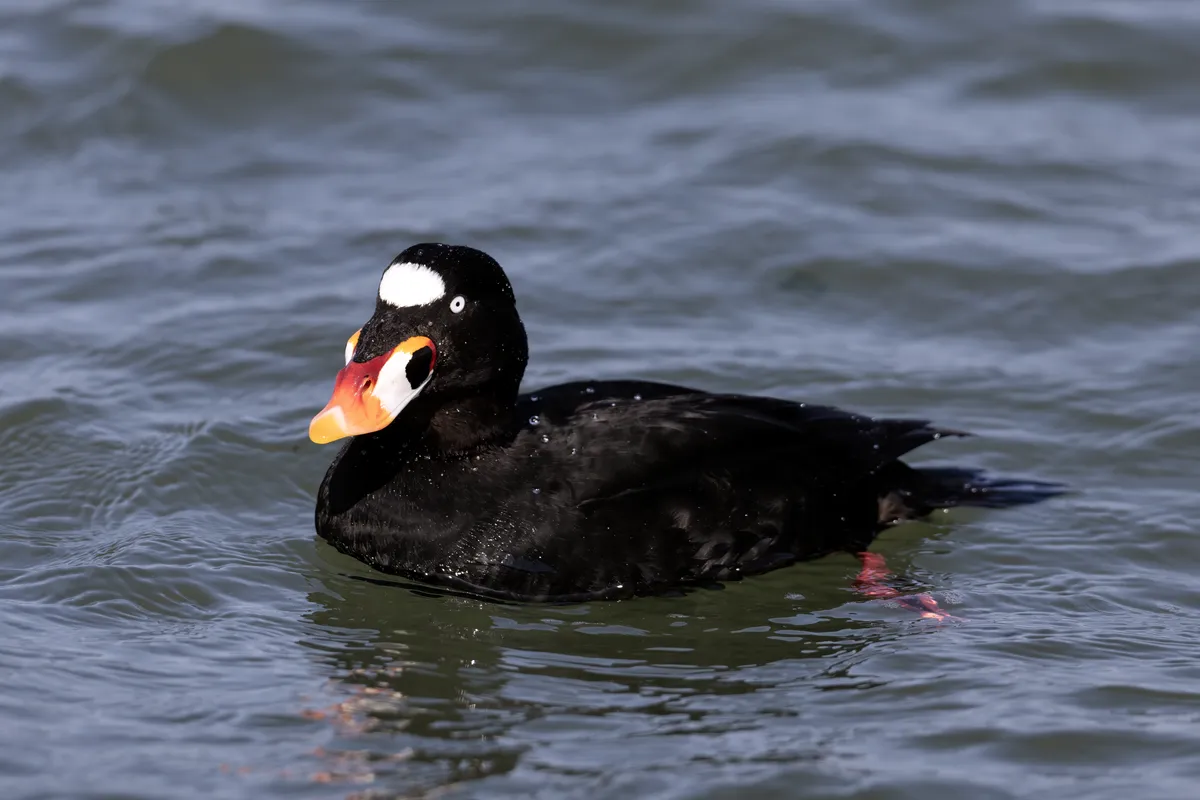
The surf scoter (Melanitta perspicillata) is a large sea duck native to North America. Adult males are almost entirely black with characteristic white patches on the forehead and the nape and adult females are slightly smaller and browner. Surf scoters breed in Northern Canada and Alaska and winter along the Pacific and Atlantic coasts of North America. They are diving ducks and mainly feed on benthic invertebrates, mussels representing an important part of their diet.
Description
The surf scoter reaches sexual maturity after 3 years. The adult male is on average 1,050 g (2.31 lb) and 48 cm (19 in) in length while the adult female averages about 900 g (2.0 lb) and 44 cm (17 in) in length, making this the smallest species of scoter on average. The surf scoter has a wingspan of 29.9–30.3 in (76–77 cm). The male is completely velvety black except for white patches on the forehead and the nape. It has a swollen bill, appearing orange at a distance but patterned with white, red and yellow, and a black spot near the base. The female is browner than the male, with a fairly uniform plumage, slightly darker above than below. Indistinct paler patches are present on the cheeks below the eye and sometimes a whitish patch is on the nape, a unique trait among scoters. The bill is black with green or blue colorations The juvenile has a plumage similar to the female, but mainly paler and browner, and the breast and belly are whitish. The surf scoter is easily distinguishable from other scoters by the white patch on the head of the adult male and its unique bill pattern. Females and immatures have a bulkier bill with a squarish base and a more flattened head profile than other scoters. The black and the white-winged scoters are physically very similar to the surf scoter but in flight, the surf scoter is the only one with completely dark wings. Like all sea ducks, the surf scoter becomes flightless during the simultaneous molt of its flight feathers. This vulnerable period happens usually in late July through early August and lasts for about four weeks. This wing molt is the start of a complete body or prebasic molt which is completed in the fall producing the next basic or breeding plumage. Before the prebasic molt, many duck species undergo a partial prealternate molt replacing the bright colors of the basic plumage of males by the duller alternate or eclipse plumage but the prealternate molt is believed to be limited or absent such that males appear similar in both basic and alternate plumage, but may have a browner belly and duller or "messier" appearance in summer. The plumage is a good indicator of the age for male surf scoters, but not for females. Second-year males are similar to adults but may have brownish feathers and/or lack the white forehead patch.
Text from Wikipedia — Surf scoter, revision 1358333352, CC BY-SA 4.0, retrieved 2026-09-04. Encyclopedic text reused under CC BY-SA 4.0. Sentences about hunting or regulation are removed: on this site, the rule comes from Québec.ca.
Other names
French
English
Presence in Quebec
- Origin
- Indigène
- Occurrence
- Régulier
- Population status
- Reproducteur
- Certainty
- Confirmé
Conservation
Québec.ca
Official periods
Source: Québec.ca — tables reproduced as published (retrieved 2026-08-30).
Regulations change. Always check Québec.ca before hunting or trapping.
SIT Québec register
Outfitters hunting this species
90 outfitters list this species among the game they hunt.
Where this data comes from
This species is listed in an official government dataset. The identification and status shown in the data sheet are reproduced from it.
Source: List of Quebec’s vertebrate wildlife (LFVQ) — Ministère de l’Environnement, de la Lutte contre les changements climatiques, de la Faune et des Parcs. File LFVQ_25_03_2026.csv, retrieved 2026-08-30 · CC BY 4.0.
Measurements, habitat, diet and reproduction are not shown: no official source is attached to them yet.