
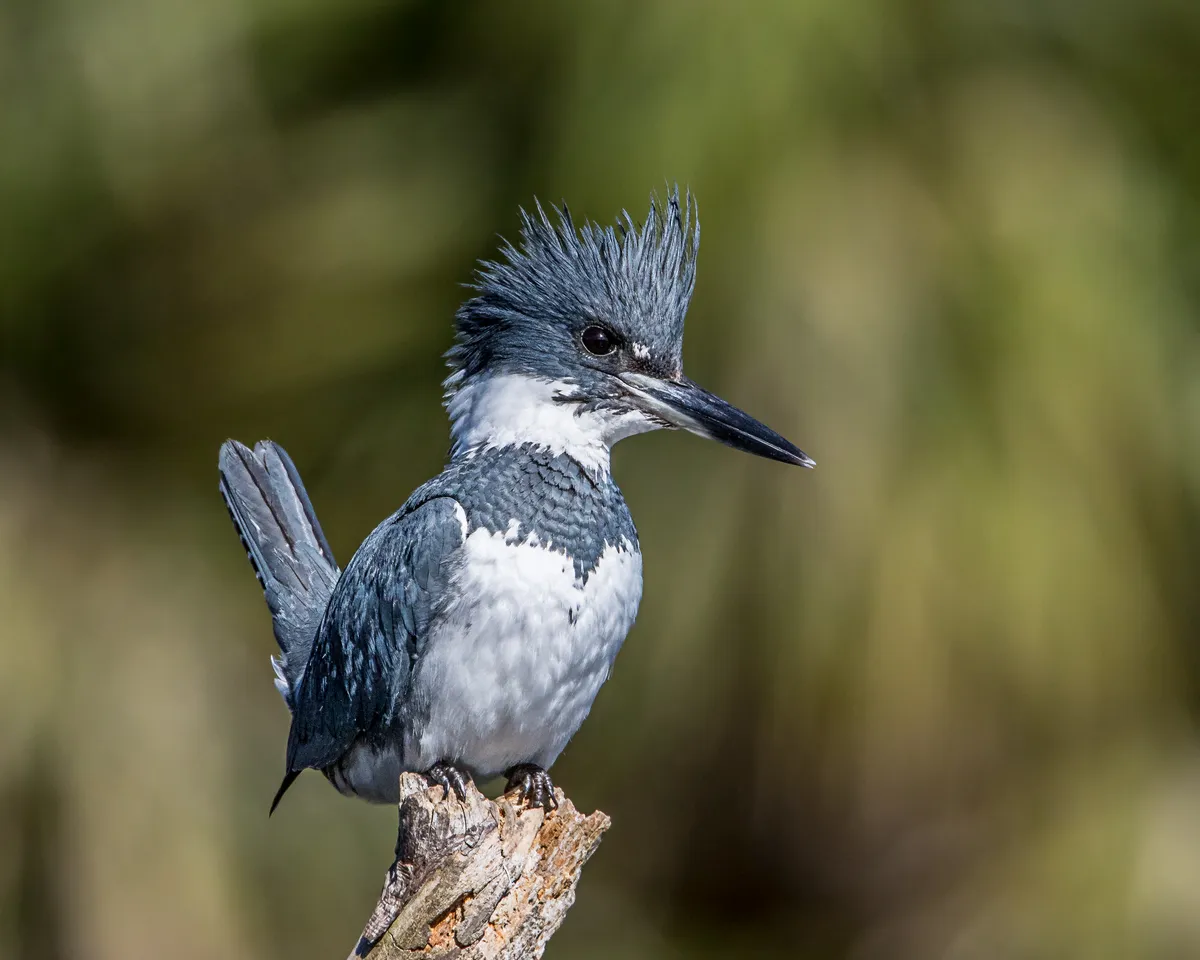
Martin-pêcheur d'Amérique— Quebec wildlife
Megaceryle alcyon
AlcedinidaeNo period published by Québec.ca
Québec.ca publishes no hunting or trapping period for this species. Check the official regulations.
Wikipedia
Martin-pêcheur d'Amérique
The belted kingfisher (Megaceryle alcyon) is a large, conspicuous water kingfisher, native to North America.
Description
The belted kingfisher is a stocky, medium-sized bird that measures from 28–35 cm (11–14 in) in length with a wingspan from 48–58 cm (19–23 in). It can weigh from 113–178 g (4.0–6.3 oz). The adult female is typically slightly larger than the adult male. This species has a large head with a shaggy crest. Its long, heavy bill is black with a grey base. These features are common in many kingfisher species. Both sexes have a slate blue head, large white collar, large blue band on the breast, and white underparts. The back and wings are slate blue with black feather tips with little white dots. The female features a rufous band across the upper belly that extends down the flanks. Juveniles of this species are similar to adults, but both sexes feature the rufous band on the upper belly. Juvenile males have a rufous band that is somewhat mottled, while the band on juvenile females is much thinner than that of an adult female.
Text from Wikipedia — Belted kingfisher, revision 1370818999, CC BY-SA 4.0, retrieved 2026-09-04. Encyclopedic text reused under CC BY-SA 4.0. Sentences about hunting or regulation are removed: on this site, the rule comes from Québec.ca.
Other names
French
English
Former scientific names
Presence in Quebec
- Origin
- Indigène
- Occurrence
- Régulier
- Population status
- Reproducteur
- Certainty
- Confirmé
Conservation
Québec.ca
Official periods
Source: Québec.ca — tables reproduced as published (retrieved 2026-08-30).
Regulations change. Always check Québec.ca before hunting or trapping.
Where this data comes from
This species is listed in an official government dataset. The identification and status shown in the data sheet are reproduced from it.
Source: List of Quebec’s vertebrate wildlife (LFVQ) — Ministère de l’Environnement, de la Lutte contre les changements climatiques, de la Faune et des Parcs. File LFVQ_25_03_2026.csv, retrieved 2026-08-30 · CC BY 4.0.
Measurements, habitat, diet and reproduction are not shown: no official source is attached to them yet.