
No period published by Québec.ca
Québec.ca publishes no hunting or trapping period for this species. Check the official regulations.
Wikipedia
Martinet ramoneur
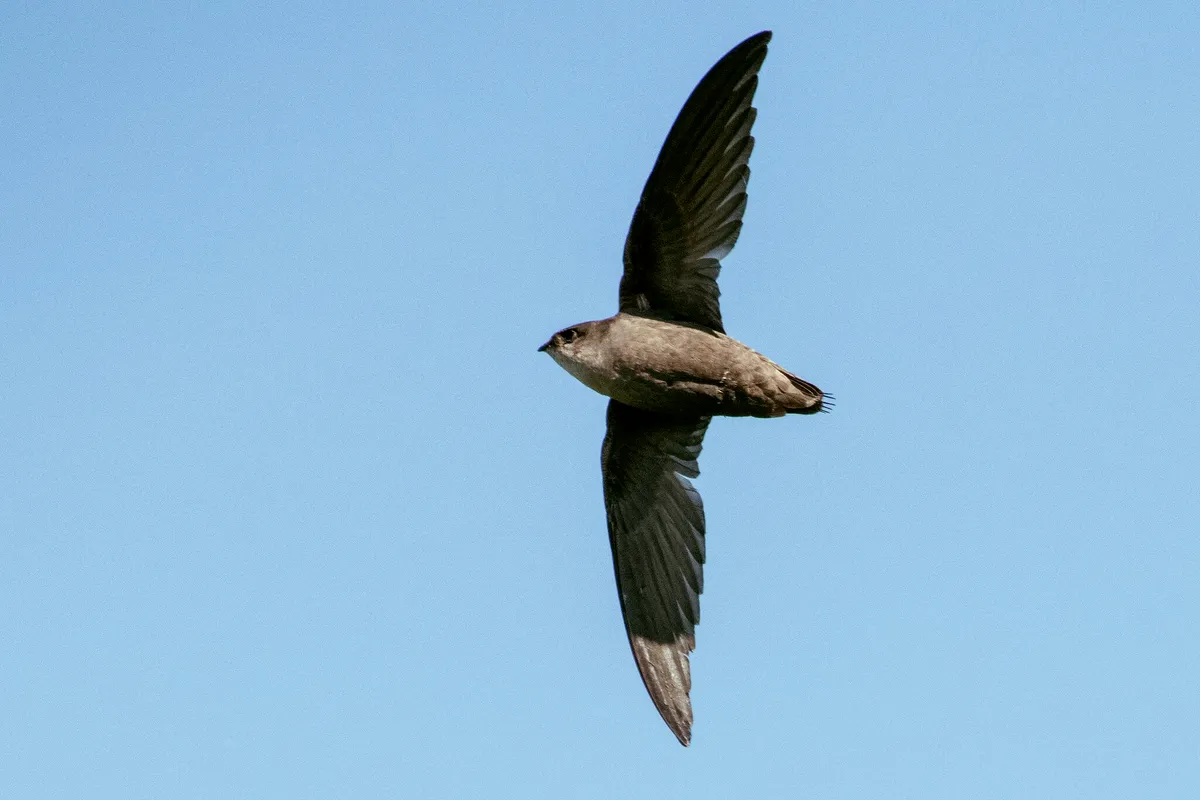
The chimney swift (Chaetura pelagica) is a bird belonging to the swift family Apodidae. A member of the genus Chaetura, it is closely related to both Vaux's swift and Chapman's swift; in the past, the three were sometimes considered to be conspecific. It has no subspecies. The chimney swift is a medium-sized, sooty gray bird with very long, slender wings and very short legs. Like all swifts, it is incapable of perching on flat surfaces, and can only perch on vertical surfaces. Many fly around all day and only come down at night when roosting. The chimney swift feeds primarily on flying insects, but also on airborne spiders. It generally mates for life. It builds a bracket nest of twigs and saliva stuck to a vertical surface, which is almost always a human-built structure, typically a chimney; historically (before European colonists built chimneys), they nested in hollow trees (including old pileated woodpecker nest holes), a few still do so, though only rarely. The female lays 4–5 white eggs. The altricial young hatch after 19 days and fledge a month later. The average chimney swift lives 4.6 years.
Description
This is a medium-sized swift, measuring from 12 to 15 cm (4.7 to 5.9 in) in length, with a wingspan of 27 to 30 cm (11 to 12 in) and a weight ranging from 17 to 30 g (0.60 to 1.06 oz). The sexes are identical in plumage, though males average slightly heavier than females. The adult's plumage is a dark sooty olive above and grayish brown below, with a slightly paler rump and uppertail covert feathers, and a significantly paler throat. Its upperparts are the most uniformly colored of all the Chaetura swifts, showing little contrast between back and rump. Its beak is black, as are its feet and legs. Its iris is dark brown. The juvenile plumage (held by young birds for their first few months after fledging) is very similar to that of adults, but with whitish tips to the outer webs of the secondaries and tertials. The chimney swift's wings are slender, curved and long, extending as much as 1.5 in (3.8 cm) beyond the bird's tail when folded. Its wingtips are pointed, which helps to decrease air turbulence (and therefore drag) during flight. Its humerus (the bone in the inner part of the wing) is quite short, while the bones farther out (more distally) along the wing are elongated, a combination which allows the bird to flap very quickly. In flight, it holds its wings stiffly, alternating between rapid, quivering flaps and longer glides. Its flight profile is widely described as a "cigar with wings"—a description first used by Roger Tory Peterson. Although the bird often appears to beat its wings asynchronously during flight, photographic and stroboscopic studies have shown that it beats them in unison. The illusion that it does otherwise is heightened by its very fast and highly erratic flight, with many rapid changes of direction. The legs of the chimney swift, like those of all swifts, are very short.
Text from Wikipedia — Chimney swift, revision 1325656283, CC BY-SA 4.0, retrieved 2026-09-04. Encyclopedic text reused under CC BY-SA 4.0. Sentences about hunting or regulation are removed: on this site, the rule comes from Québec.ca.
Other names
French
English
Presence in Quebec
- Origin
- Indigène
- Occurrence
- Régulier
- Population status
- Reproducteur
- Certainty
- Confirmé
Conservation
Québec.ca
Official periods
Source: Québec.ca — tables reproduced as published (retrieved 2026-08-30).
Regulations change. Always check Québec.ca before hunting or trapping.
Where this data comes from
This species is listed in an official government dataset. The identification and status shown in the data sheet are reproduced from it.
Source: List of Quebec’s vertebrate wildlife (LFVQ) — Ministère de l’Environnement, de la Lutte contre les changements climatiques, de la Faune et des Parcs. File LFVQ_25_03_2026.csv, retrieved 2026-08-30 · CC BY 4.0.
Measurements, habitat, diet and reproduction are not shown: no official source is attached to them yet.