
Trapping periods published by Québec.ca
Official tables below — trapping units (UGAF) and dates.
Wikipedia
Martre d'Amérique
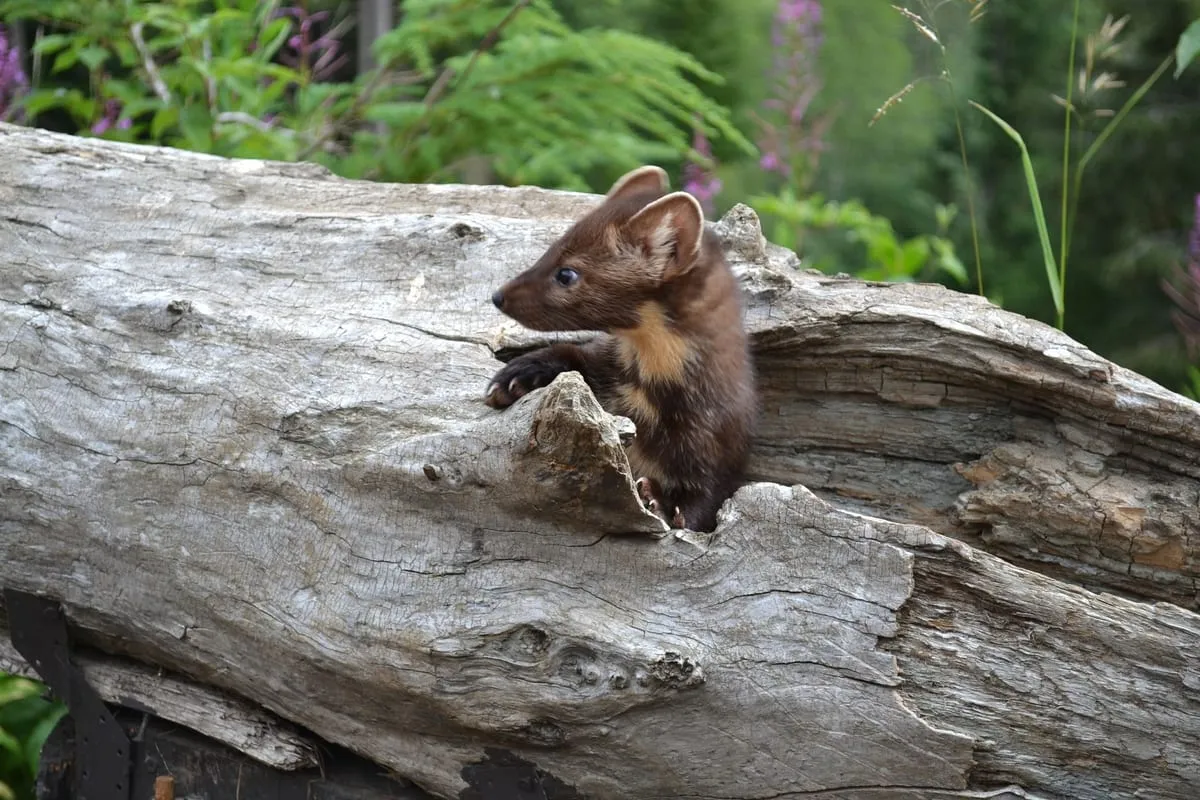
The American marten (Martes americana), also known as the American pine marten, is a species of North American mammal, a member of the family Mustelidae. The species is sometimes referred to as simply the pine marten. The name "pine marten" is derived from the common name of the related but distinct Eurasian species, Martes martes. Martes americana is found throughout Canada and parts of the northern United States including Alaska. It is a long, slender-bodied marten, with fur ranging from yellowish to brown to near black. It may be confused with the fisher (Pekania pennanti), but the marten is lighter in color and smaller. Identification of the marten is further eased by a characteristic bib that is a distinctly different color from the body. Sexual dimorphism is pronounced, with males being much larger. These martens are omnivorous and their diet varies by season, but they rely chiefly on small mammals, such as voles. They are solitary except during the midsummer breeding season. Embryonic implantation is delayed until late winter, however, with a litter of one to five kits born the following spring. Young stay with the mother in a constructed den until the fall, and they reach sexual maturity by one year old. Populations have rebounded since, with them being considered a species of least concern by the IUCN, but they remain extirpated from some areas of the Northeast, and of the seven subspecies, one is threatened.
Description
The American marten is a long, slender-bodied weasel about the size of a mink, with relatively large, rounded ears, short limbs, and a bushy tail. It has a roughly triangular head and sharp nose. Its long, silky fur ranges in color from pale yellowish buff to tawny brown to almost black. The head is usually lighter than the rest of its body, while the tail and legs are darker. The American marten usually has a characteristic throat and chest bib ranging in color from pale straw to vivid orange. Sexual dimorphism is pronounced, with males averaging about 15% larger than females in length and as much as 65% larger in body weight. Total length ranges from 1.5 to 2.2 ft (0.5–0.7 m), with a tail length of 5.4 to 6.4 in (135–160 mm), Adult weight ranges from 1.1 to 3.1 lb (0.5–1.4 kg) and varies by age and location. Other than size, sexes are similar in appearance. American martens have limited body-fat reserves, experience high mass-specific heat loss, and have limited fasting endurance. In winter, individuals may go into shallow torpor daily to reduce heat loss.
Text from Wikipedia — American marten, revision 1361125174, CC BY-SA 4.0, retrieved 2026-09-04. Encyclopedic text reused under CC BY-SA 4.0. Sentences about hunting or regulation are removed: on this site, the rule comes from Québec.ca.
Other names
English
Presence in Quebec
- Origin
- Indigène
- Occurrence
- Régulier
- Population status
- Toute l'année
- Certainty
- Confirmé
Conservation
Québec.ca
Official periods
Source: Québec.ca — tables reproduced as published (retrieved 2026-08-30).
Trapping
Long-tailed weasel, least weasel, Eastern grey squirrel, red squirrel, ermine, American marten and fisher
| UGAF | Periods |
|---|---|
| 1, 2, 3, 4, 5, 6, 7, 11, 13, 17, 31, 32, 39, 41, 42, 43, 44, 45, 46, 47, 48, 49, 50, 51, 52, 53 | From October 18 to March 1 |
| 8, 9, 10, 12, 14, 15, 18, 19, 20, 21, 22, 23, 26, 27, 28, 29, 30, 33, 34, 35, 36, 37, 38, 40 | From October 25 to February 15 |
| 16, 70, 71, 72, 73, 74, 75, 76, 77, 78, 79, 80, 81, 82 | From October 25 to February 1 |
| 24, 25, 83, 84, 85, 86 | From October 25 to March 1 |
| 54, 55, 56, 57, 58, 59, 60, 61, 62, 63, 64, 65, 66 | From October 18 to March 15 |
Regulations change. Always check Québec.ca before hunting or trapping.
Where this data comes from
This species is listed in an official government dataset. The identification and status shown in the data sheet are reproduced from it.
Source: List of Quebec’s vertebrate wildlife (LFVQ) — Ministère de l’Environnement, de la Lutte contre les changements climatiques, de la Faune et des Parcs. File LFVQ_25_03_2026.csv, retrieved 2026-08-30 · CC BY 4.0.
Measurements, habitat, diet and reproduction are not shown: no official source is attached to them yet.