
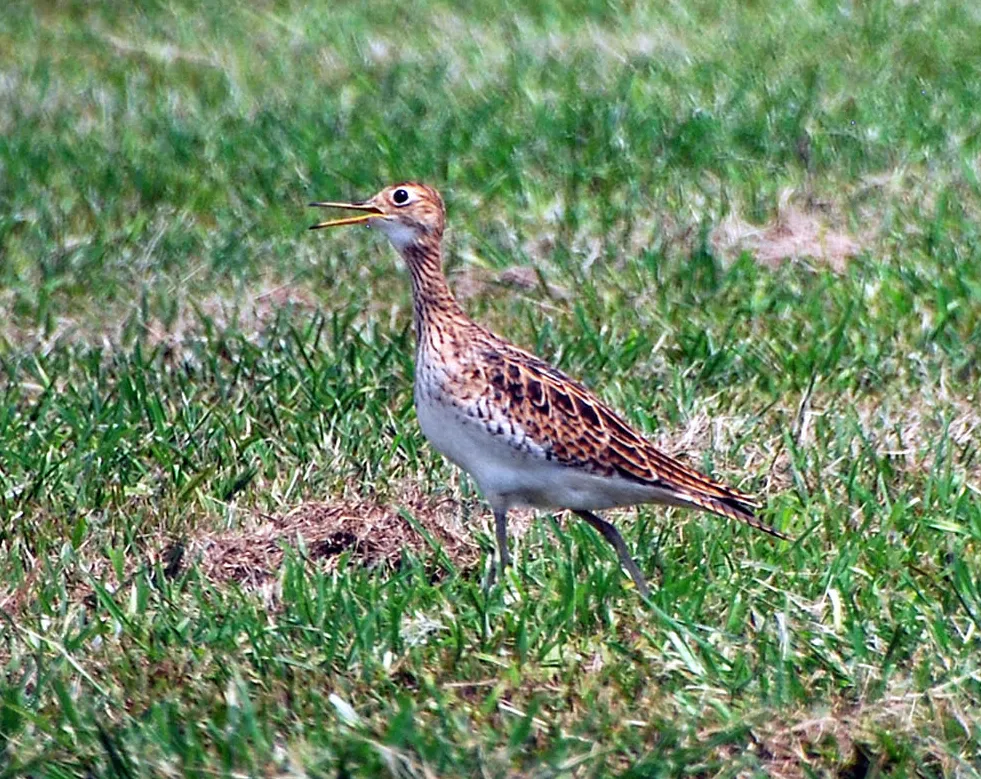
Maubèche des champs— Quebec wildlife
Bartramia longicauda
ScolopacidaeNo period published by Québec.ca
Québec.ca publishes no hunting or trapping period for this species. Check the official regulations.
Wikipedia
Maubèche des champs
The upland sandpiper (Bartramia longicauda) is a large sandpiper, closely related to the curlews. Older names are the upland plover and Bartram's sandpiper. In Louisiana, it is also colloquially known as the papabotte. It is the sole extant member of the genus Bartramia. The genus name and the old common name Bartram's sandpiper commemorate the American naturalist William Bartram. The species name longicauda is from Latin longus, "long" and caudus, "tail". The name "Bartram's sandpiper" was made popular by Alexander Wilson, who was taught ornithology and natural history illustration by Bartram.
Description
An adult is roughly 30 cm (12 in) long with a 66 cm (26 in) wingspan. The average weight is 170 g (6 oz). This odd bird has a small dove-like head on a long neck. It is heavily marbled black and brown on the back and wings. The neck is streaked with dark brown which continues down to the breast and on to the flanks. The belly and undertail coverts are white, and the tail is quite long for a sandpiper. The upland sandpiper also has a white eye-ring and long yellow legs.
Habitat and range
Even though they are sandpipers, they prefer open country with tall grasses to coastal habitat. They are also found at airports, blueberry farms and abandoned strip mines in the east. Their true core range and habitat is in the northern midwest United States.
Text from Wikipedia — Upland sandpiper, revision 1369072805, CC BY-SA 4.0, retrieved 2026-09-04. Encyclopedic text reused under CC BY-SA 4.0. Sentences about hunting or regulation are removed: on this site, the rule comes from Québec.ca.
Other names
French
English
Presence in Quebec
- Origin
- Indigène
- Occurrence
- Régulier
- Population status
- Reproducteur
- Certainty
- Confirmé
Conservation
Québec.ca
Official periods
Source: Québec.ca — tables reproduced as published (retrieved 2026-08-30).
Regulations change. Always check Québec.ca before hunting or trapping.
Where this data comes from
This species is listed in an official government dataset. The identification and status shown in the data sheet are reproduced from it.
Source: List of Quebec’s vertebrate wildlife (LFVQ) — Ministère de l’Environnement, de la Lutte contre les changements climatiques, de la Faune et des Parcs. File LFVQ_25_03_2026.csv, retrieved 2026-08-30 · CC BY 4.0.
Measurements, habitat, diet and reproduction are not shown: no official source is attached to them yet.