
No period published by Québec.ca
Québec.ca publishes no hunting or trapping period for this species. Check the official regulations.
Wikipedia
Merlebleu azuré
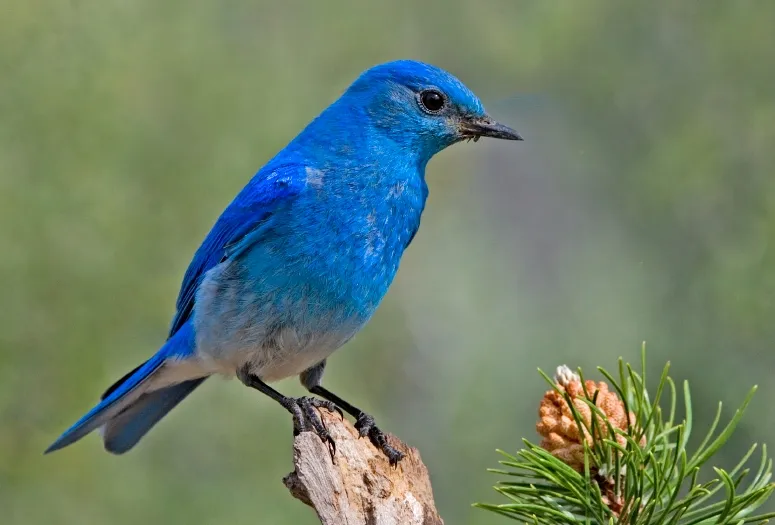
The mountain bluebird (Sialia currucoides) is a migratory small thrush that is found in mountainous districts of western North America. It has a light underbelly and black eyes. Adult males have thin bills and are bright turquoise-blue and somewhat lighter underneath. Adult females have duller blue wings and tail, grey breast, grey crown, throat and back. In fresh fall plumage, the female's throat and breast are tinged with red-orange which is brownish near the flank, contrasting with white tail underparts. Their call is a thin 'few' while their song is a warbled high 'chur chur'. The mountain bluebird is the state bird of Idaho and Nevada. This bird is an omnivore and it can live 6 to 10 years in the wild. It eats spiders, grasshoppers, flies and other insects, and small fruits. The mountain bluebird is a relative of the eastern and western bluebirds.
Description
The mountain bluebird is 15.5–18 cm (6.1–7.1 in) in length, weighs 24–37 g (0.85–1.31 oz), and has a wingspan of 11.0-14.2 in (28-36 cm). It is sexually dimorphic in the color of the plumage but the sexes are similar in size. An adult male is bright turquoise-blue above and somewhat lighter blue underneath but with a white lower belly. An adult female has duller blue wings and tail, grey breast, grey crown, throat and back. In fresh fall plumage, the female's throat and breast are brownish near the flank, contrasting with white tail underparts. Their call is a thin 'few', while their song is warbled high 'chur chur'.
Text from Wikipedia — Mountain bluebird, revision 1369115786, CC BY-SA 4.0, retrieved 2026-09-04. Encyclopedic text reused under CC BY-SA 4.0. Sentences about hunting or regulation are removed: on this site, the rule comes from Québec.ca.
Other names
French
Presence in Quebec
- Origin
- Indigène
- Occurrence
- Accidentel/non régulier
- Population status
- Migrateur
- Certainty
- Confirmé
Conservation
Québec.ca
Official periods
Source: Québec.ca — tables reproduced as published (retrieved 2026-08-30).
Regulations change. Always check Québec.ca before hunting or trapping.
Where this data comes from
This species is listed in an official government dataset. The identification and status shown in the data sheet are reproduced from it.
Source: List of Quebec’s vertebrate wildlife (LFVQ) — Ministère de l’Environnement, de la Lutte contre les changements climatiques, de la Faune et des Parcs. File LFVQ_25_03_2026.csv, retrieved 2026-08-30 · CC BY 4.0.
Measurements, habitat, diet and reproduction are not shown: no official source is attached to them yet.