
No period published by Québec.ca
Québec.ca publishes no hunting or trapping period for this species. Check the official regulations.
Wikipedia
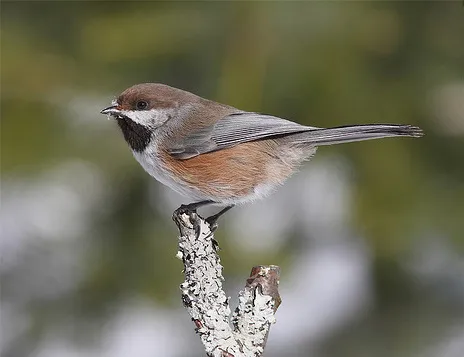
Mésange à tête brune
The boreal chickadee (Poecile hudsonicus) is a small passerine songbird in the tit family Paridae. It is found in the boreal forests of Alaska, Canada and the northern United States and remains within this range all year. This bird is known for its high pitched trill patterns used in communication with other birds and food storage habits in preparation for winter months.
Description
Adults are 12.5–14.5 cm (4.9–5.7 in) long with a weight of 7–12.4 g (0.25–0.44 oz). They have grey-brown upperparts with a brown cap and greyish wings and tail; their face is mainly grey with white on the sides. Their underparts are white with brown on the flanks and a black throat. They have a short dark bill, short wings and a long notched tail. Their flight consists of brief gliding patterns followed by fast and bouncy wing beats as they travel through the air.
Text from Wikipedia — Boreal chickadee, revision 1364439091, CC BY-SA 4.0, retrieved 2026-09-04. Encyclopedic text reused under CC BY-SA 4.0. Sentences about hunting or regulation are removed: on this site, the rule comes from Québec.ca.
Other names
French
English
Former scientific names
Presence in Quebec
- Origin
- Indigène
- Occurrence
- Régulier
- Population status
- Toute l'année
- Certainty
- Confirmé
Conservation
Québec.ca
Official periods
Source: Québec.ca — tables reproduced as published (retrieved 2026-08-30).
Regulations change. Always check Québec.ca before hunting or trapping.
Where this data comes from
This species is listed in an official government dataset. The identification and status shown in the data sheet are reproduced from it.
Source: List of Quebec’s vertebrate wildlife (LFVQ) — Ministère de l’Environnement, de la Lutte contre les changements climatiques, de la Faune et des Parcs. File LFVQ_25_03_2026.csv, retrieved 2026-08-30 · CC BY 4.0.
Measurements, habitat, diet and reproduction are not shown: no official source is attached to them yet.