
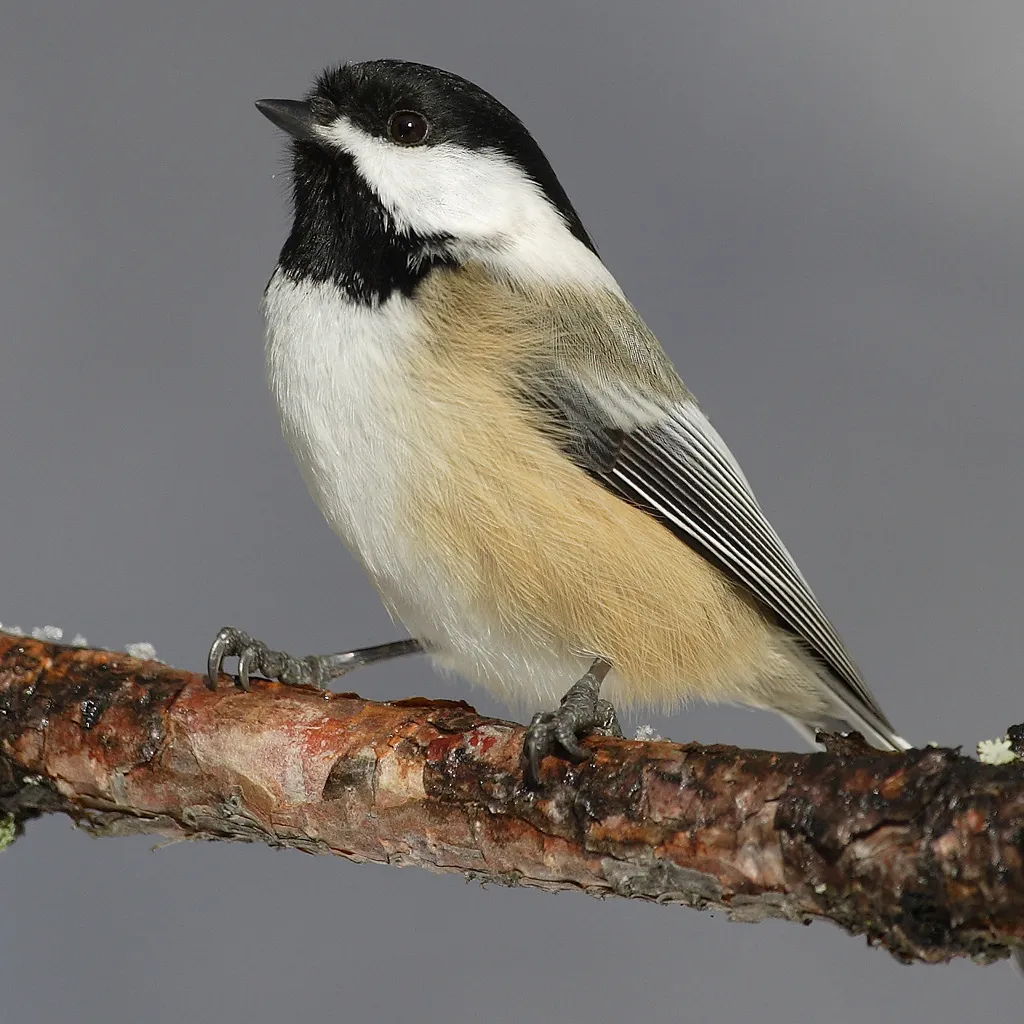
Mésange à tête noire— Quebec wildlife
Poecile atricapillus
ParidaeNo period published by Québec.ca
Québec.ca publishes no hunting or trapping period for this species. Check the official regulations.
Wikipedia
Mésange à tête noire
The black-capped chickadee (Poecile atricapillus) is a small, nonmigratory, North American passerine bird that lives in deciduous and mixed forests. It is a member of the Paridae family, also known as tits. It has a distinct black cap on its head, a black bib underneath, and white cheeks. It has a white belly, buff sides, and grey wings, back, and tail. The bird is well known for its vocalizations, including its fee-bee song and its chick-a-dee-dee-dee call, from which it derives its name. The black-capped chickadee is widely distributed throughout North America, ranging from the northern United States to southern Canada and all the way up to Alaska and Yukon. It feeds primarily on insects and seeds, and is known for its ability to cache food for use during the winter. The hippocampus of the black-capped chickadee grows during the caching season, which is believed to help it better remember its cache locations. The black-capped chickadee is a social bird and forms strict dominance hierarchies within its flock. During the winter, these flocks include other bird species. It has the ability to lower its body temperature during cold winter nights, allowing it to conserve energy. Black-capped chickadees build nests in tree cavities, with the nesting season starting in late April and lasting until late June. They lay on average 6–8 eggs, which hatch after 11–14 days. Juveniles fledge 12–16 days after hatching. The population of black-capped chickadees is thought to be increasing, and they are considered a species of least concern by the International Union for Conservation of Nature (IUCN). It is the state bird of both Massachusetts and Maine in the United States, and the provincial bird of New Brunswick in Canada.
Description
The black-capped chickadee has a black cap and "bib" with white cheeks. Its underparts are white with buff-coloured flanks. Its back is unstreaked and greenish grey, and the tail and wings are slate grey. It has a black beak and legs, and dark brown irises. Males and females are generally similar, although males have a larger bib. They can also be distinguished based on a combination of weight and tail length. Tarsus length does not significantly differentiate sexes. Males have a wing length of 63.5–67.5 mm (2.50–2.66 in), a tail length of 58–63 mm (2.3–2.5 in), a bill length of 8–9.5 mm (0.31–0.37 in), and a tarsus length of 16–17 mm (0.63–0.67 in). Females are on average slightly smaller, with a wing length of 60.5–66.5 mm (2.38–2.62 in), a tail length of 56.3–63 mm (2.22–2.48 in), a bill length of 9–9.5 mm (0.35–0.37 in), and a tarsus length of 16–17 mm (0.63–0.67 in). Both sexes weigh 10–14 g (0.35–0.49 oz). Juveniles are visually similar to adults but with fluffier plumage. Although range can generally be used to separate them, the black-capped chickadee is very similar in appearance to the Carolina chickadee.
Text from Wikipedia — Black-capped chickadee, revision 1363117893, CC BY-SA 4.0, retrieved 2026-09-04. Encyclopedic text reused under CC BY-SA 4.0. Sentences about hunting or regulation are removed: on this site, the rule comes from Québec.ca.
Other names
French
English
Former scientific names
Presence in Quebec
- Origin
- Indigène
- Occurrence
- Régulier
- Population status
- Toute l'année
- Certainty
- Confirmé
Conservation
Québec.ca
Official periods
Source: Québec.ca — tables reproduced as published (retrieved 2026-08-30).
Regulations change. Always check Québec.ca before hunting or trapping.
Where this data comes from
This species is listed in an official government dataset. The identification and status shown in the data sheet are reproduced from it.
Source: List of Quebec’s vertebrate wildlife (LFVQ) — Ministère de l’Environnement, de la Lutte contre les changements climatiques, de la Faune et des Parcs. File LFVQ_25_03_2026.csv, retrieved 2026-08-30 · CC BY 4.0.
Measurements, habitat, diet and reproduction are not shown: no official source is attached to them yet.