
No period published by Québec.ca
Québec.ca publishes no hunting or trapping period for this species. Check the official regulations.
Wikipedia
Mésange bicolore
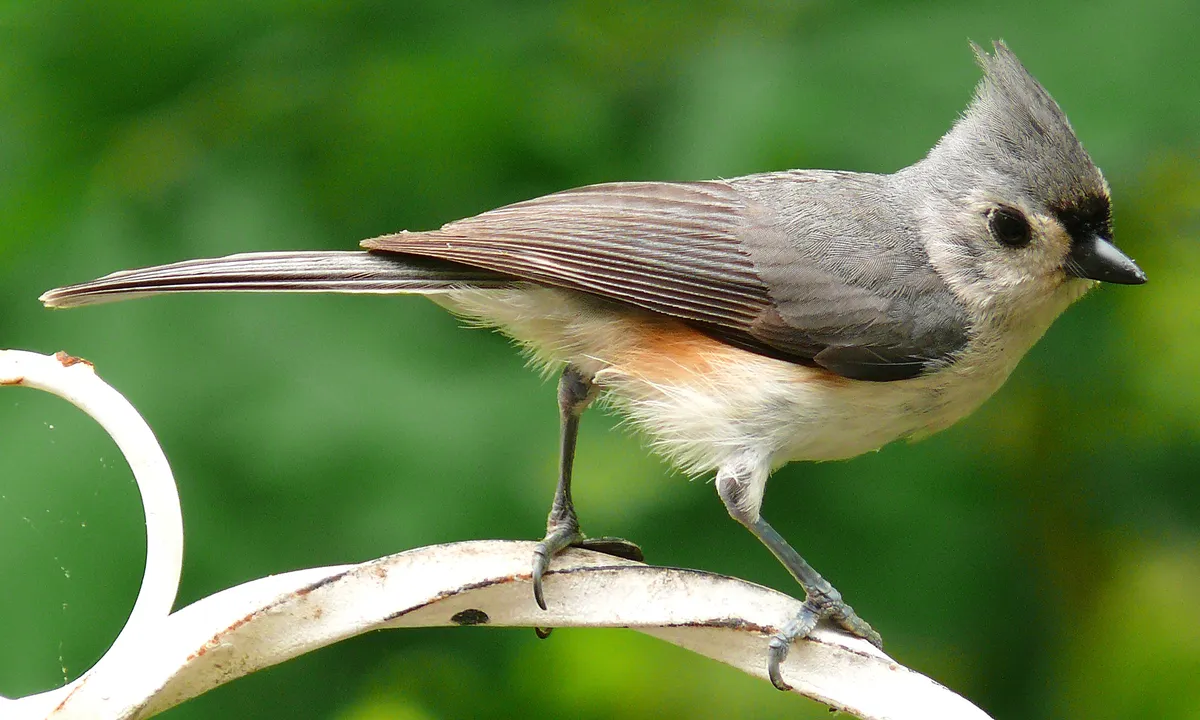
The tufted titmouse (Baeolophus bicolor) is a small songbird native to eastern North America. The species belongs to the tit and chickadee family (Paridae). The black-crested titmouse, found from central and southern Texas southward, was originally included as a subspecies but now is considered a separate species, Baeolophus atricristatus.
Description
Measurements: Length: 14–16 cm (5.5–6.3 in) Weight: 18–26 g (0.63–0.92 oz) Wingspan: 20–26 cm (7.9–10.2 in) A small bird, the tufted titmouse has a white front and gray upper body outlined with rust-colored flanks. Other characteristics include its black forehead and the tufted gray crest on its head. In juveniles, the black forehead is greatly diminished such that it may be confused with the oak titmouse, although their ranges do not overlap. Males tend to be larger than females. The song of the tufted titmouse is usually described as a whistled peter-peter-peter, although this song can vary in about 20 notable ways.
Text from Wikipedia — Tufted titmouse, revision 1364850219, CC BY-SA 4.0, retrieved 2026-09-04. Encyclopedic text reused under CC BY-SA 4.0. Sentences about hunting or regulation are removed: on this site, the rule comes from Québec.ca.
Other names
French
English
Former scientific names
Presence in Quebec
- Origin
- Indigène
- Occurrence
- Régulier
- Population status
- Toute l'année
- Certainty
- Confirmé
Conservation
Québec.ca
Official periods
Source: Québec.ca — tables reproduced as published (retrieved 2026-08-30).
Regulations change. Always check Québec.ca before hunting or trapping.
Where this data comes from
This species is listed in an official government dataset. The identification and status shown in the data sheet are reproduced from it.
Source: List of Quebec’s vertebrate wildlife (LFVQ) — Ministère de l’Environnement, de la Lutte contre les changements climatiques, de la Faune et des Parcs. File LFVQ_25_03_2026.csv, retrieved 2026-08-30 · CC BY 4.0.
Measurements, habitat, diet and reproduction are not shown: no official source is attached to them yet.