
No period published by Québec.ca
Québec.ca publishes no hunting or trapping period for this species. Check the official regulations.
Wikipedia
Mésangeai du Canada
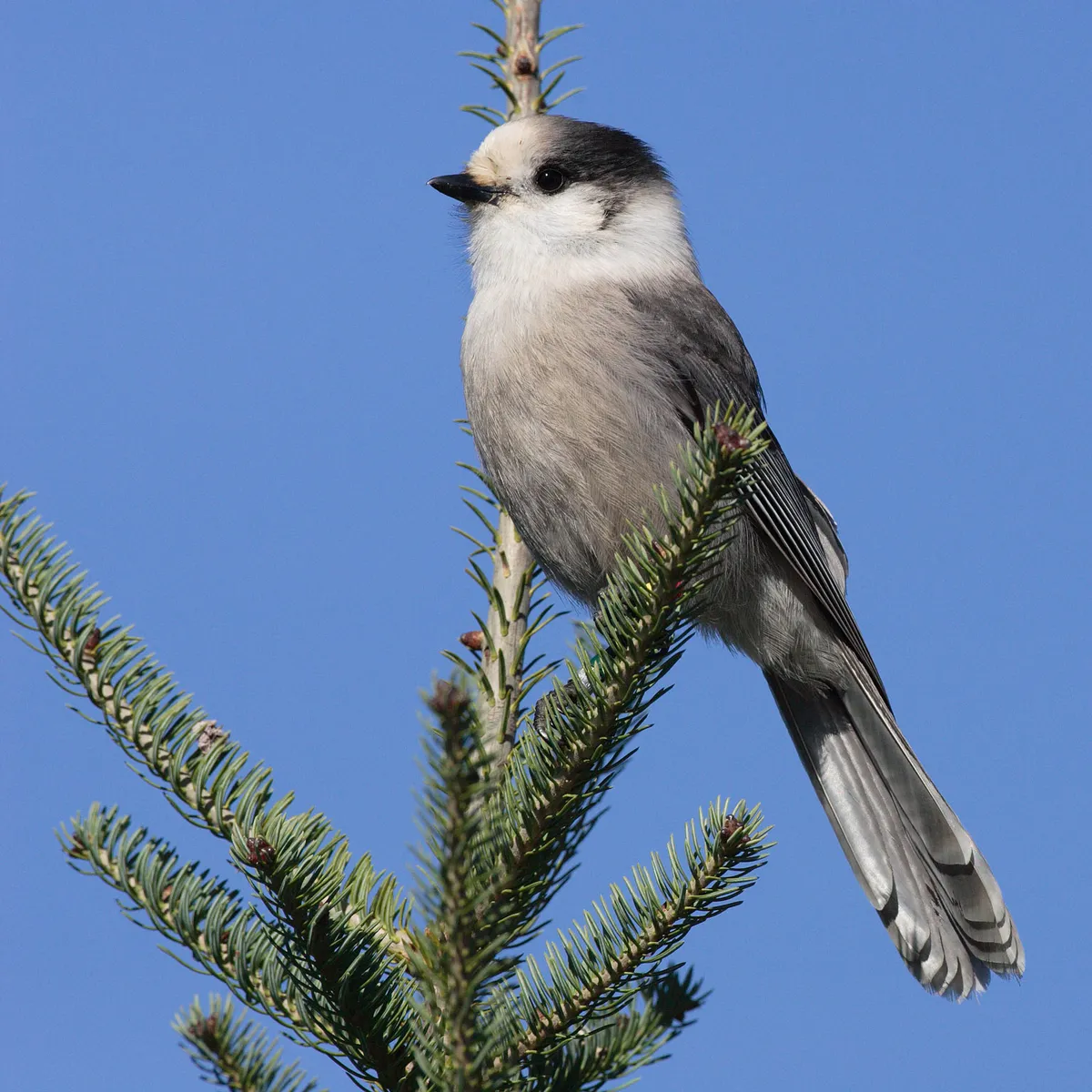
The Canada jay (Perisoreus canadensis), also known as the grey jay, gray jay, camp robber, moose bird, gorby, or whisky jack, is a passerine bird of the family Corvidae. It is found in boreal forests of North America, north to the tree line, and in the Rocky Mountains subalpine zone south to New Mexico and Arizona. A fairly large songbird, the Canada jay has pale grey underparts, darker grey upperparts, and a grey-white head with a darker grey nape. It is one of three members of the genus Perisoreus, a genus more closely related to the magpie genus Cyanopica than to other birds known as jays. The Canada jay itself has nine recognized subspecies. Canada jays live year-round on permanent territories in coniferous forests, surviving in winter months on food cached throughout their territory in warmer periods. The birds form monogamous mating pairs, with pairs accompanied on their territories by a third juvenile from the previous season. Canada jays adapt to human activity in their territories and are known to approach humans for food, inspiring a list of colloquial names including "lumberjack", "camp robber", and "venison-hawk". The International Union for Conservation of Nature (IUCN) considers the Canada jay a least-concern species, but populations in southern ranges may be affected adversely by global warming. The species is associated with mythological figures of several First Nations cultures, including Wisakedjak, a benevolent figure whose name was anglicized to Whiskyjack. In 2016, an online poll and expert panel conducted by Canadian Geographic magazine selected the Canada jay as the national bird of Canada, although the designation is not formally recognized.
Description
The Canada jay is a relatively large songbird, though smaller than other jays. A typical adult Canada jay is between 25 and 33 cm (9.8 and 13.0 in) long. Its wingspan is around 45 cm (18 in). It weighs about 65 to 70 g (2.3 to 2.5 oz). Adults have medium grey back feathers with a lighter grey underside. Its head is mostly white with a dark grey or black nape and hood, with a short black beak and dark eyes. The long tail is medium grey with lighter tips. The legs and feet are black. The plumage is thick, providing insulation in the bird's cold native habitat. Like most corvids, Canada jays are not sexually dimorphic, but males are slightly larger than females. Juveniles are initially coloured very dark grey all over, gaining adult plumage after a first moult in July or August. The average lifespan of territory-owning Canada jays is eight years; the oldest known Canada jay banded and recaptured in the wild was at least 17 years old. A variety of vocalizations are used and, like other corvids, Canada jays may mimic other bird species, especially predators. A survey of Canada Jay recordings found that they can mimic the vocalizations of at least 40 species of birds, as well those of red squirrels and domestic cats. Calls include a whistled quee-oo, and various clicks and chuckles.
Text from Wikipedia — Canada jay, revision 1371061426, CC BY-SA 4.0, retrieved 2026-09-04. Encyclopedic text reused under CC BY-SA 4.0. Sentences about hunting or regulation are removed: on this site, the rule comes from Québec.ca.
Other names
French
English
Presence in Quebec
- Origin
- Indigène
- Occurrence
- Régulier
- Population status
- Toute l'année
- Certainty
- Confirmé
Conservation
Québec.ca
Official periods
Source: Québec.ca — tables reproduced as published (retrieved 2026-08-30).
Regulations change. Always check Québec.ca before hunting or trapping.
Where this data comes from
This species is listed in an official government dataset. The identification and status shown in the data sheet are reproduced from it.
Source: List of Quebec’s vertebrate wildlife (LFVQ) — Ministère de l’Environnement, de la Lutte contre les changements climatiques, de la Faune et des Parcs. File LFVQ_25_03_2026.csv, retrieved 2026-08-30 · CC BY 4.0.
Measurements, habitat, diet and reproduction are not shown: no official source is attached to them yet.