
No period published by Québec.ca
Québec.ca publishes no hunting or trapping period for this species. Check the official regulations.
Wikipedia
Moineau friquet
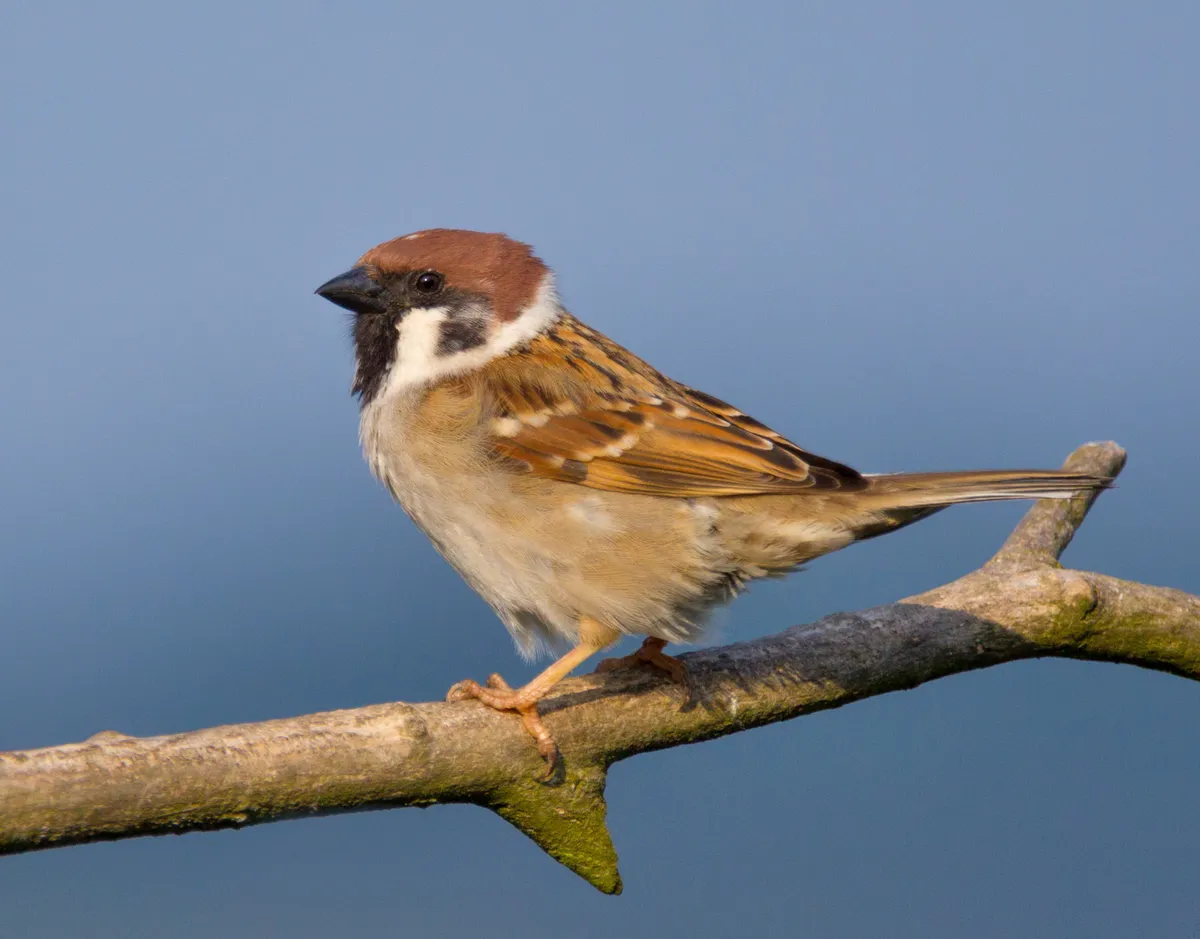
The tree sparrow (Passer montanus Latin pronunciation: [pas.ser mon.ta.nus]) is a passerine bird in the sparrow family with a rich chestnut crown and nape and a black patch on each pure white cheek. The sexes have similar plumage, and young birds are duller versions of the adult. This sparrow breeds across much of temperate Eurasia and Southeast Asia and has been introduced elsewhere, including the United States, where it is known as the Eurasian tree sparrow or German sparrow to differentiate it from the native American tree sparrow. Although several subspecies are recognised, the appearance of this bird varies little across its extensive range. The untidy nest of the tree sparrow is built in a natural cavity, a hole in a building, or the disused nest of a European magpie or white stork. The typical clutch is five or six eggs, which hatch in under two weeks. This sparrow mainly feeds on seeds, but also consumes invertebrates, particularly during the breeding season. As with other small birds, infection by parasites and diseases, as well as predation by birds of prey, take their toll, and the typical lifespan is about two years. The tree sparrow is widespread in the towns and cities of eastern Asia, but in Europe, it inhabits lightly wooded open countryside, while the house sparrow breeds in more urban areas. The tree sparrow's extensive range and large population mean it is not globally endangered, although there have been significant population declines in Western Europe, partly due to changes in farming practices involving increased use of herbicides and the loss of winter stubble fields. In eastern Asia and western Australia, this species is sometimes considered a pest, though it is also widely celebrated in oriental art.
Description
The tree sparrow is 12.5–14 cm (5–5+1⁄2 in) long, with a wingspan of about 21 cm (8.3 in) and a weight of 24 g (0.85 oz), making it roughly 10% smaller than the house sparrow. The adult's crown and nape are rich chestnut, and there is a kidney-shaped black ear patch on each pure white cheek; the chin, throat, and the area between the bill and throat are black. The upperparts are light brown, streaked with black, and the brown wings have two distinct narrow white bars. The legs are pale brown, and the bill is lead-blue in summer, becoming almost black in winter. This sparrow is distinctive within its genus because there are no plumage differences between the sexes. Juveniles also resemble adults, although their colours tend to be duller. Its contrasting face pattern makes this species easily identifiable in all plumages; the smaller size and brown, not grey, crown are additional differences from the male house sparrow. Both adult and juvenile tree sparrows undergo a slow, complete moult in autumn and experience an increase in body mass, despite a reduction in stored fat. This change in mass is due to an increase in blood volume to support active feather growth, as well as a higher overall body water content.
Text from Wikipedia — Eurasian tree sparrow, revision 1371443274, CC BY-SA 4.0, retrieved 2026-09-04. Encyclopedic text reused under CC BY-SA 4.0. Sentences about hunting or regulation are removed: on this site, the rule comes from Québec.ca.
Presence in Quebec
- Origin
- Exotique
- Occurrence
- Accidentel/non régulier
- Population status
- Migrateur
- Certainty
- Confirmé
Conservation
Official remark
Moineau friquet Passer montanus o MOFQ 2021-11 : 07/11-29/12/2021, St-Barthélémy. Mention acceptée (5-0). Documentation avec photos.
Québec.ca
Official periods
Source: Québec.ca — tables reproduced as published (retrieved 2026-08-30).
Regulations change. Always check Québec.ca before hunting or trapping.
Where this data comes from
This species is listed in an official government dataset. The identification and status shown in the data sheet are reproduced from it.
Source: List of Quebec’s vertebrate wildlife (LFVQ) — Ministère de l’Environnement, de la Lutte contre les changements climatiques, de la Faune et des Parcs. File LFVQ_25_03_2026.csv, retrieved 2026-08-30 · CC BY 4.0.
Measurements, habitat, diet and reproduction are not shown: no official source is attached to them yet.