
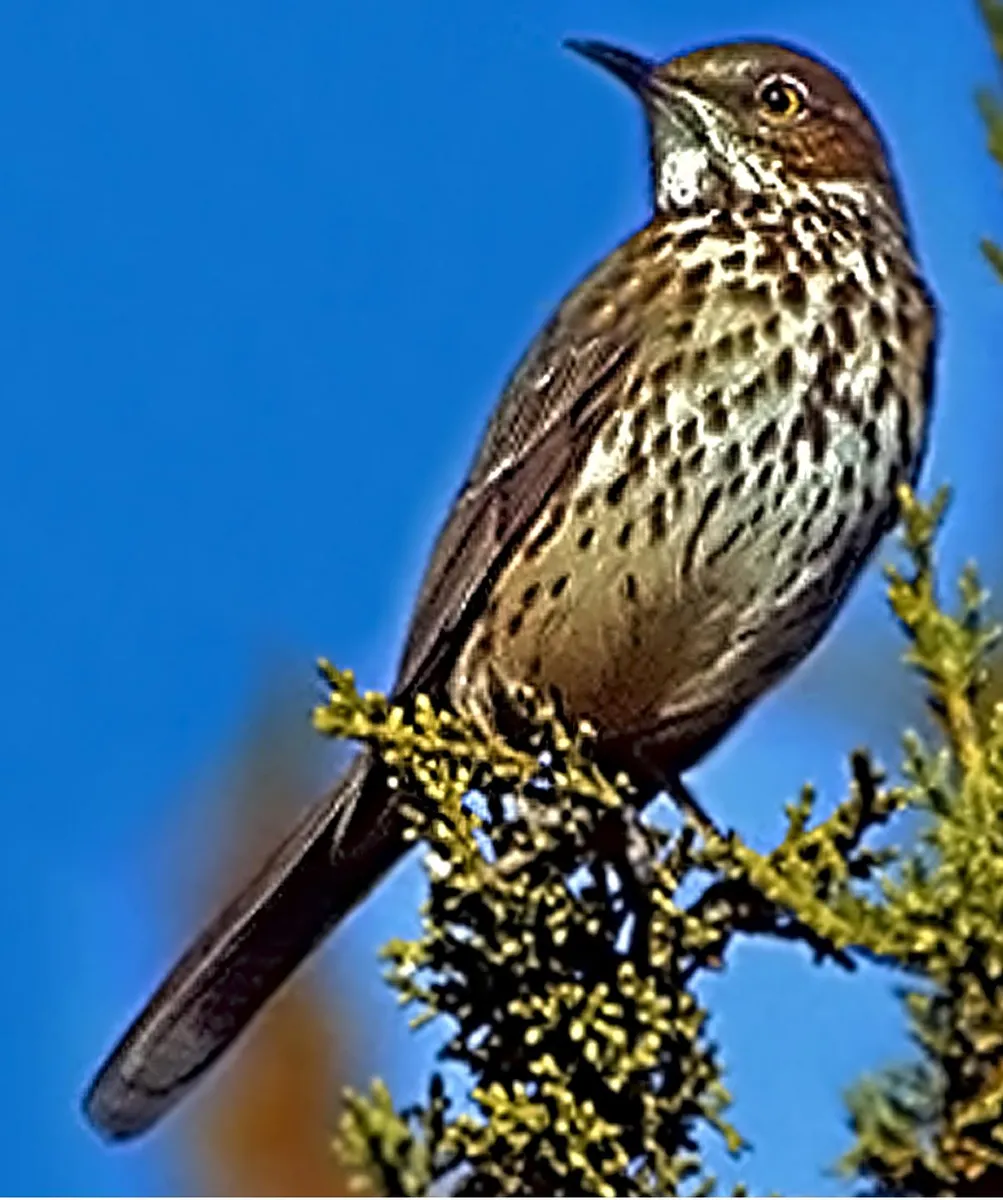
Moqueur des armoises— Quebec wildlife
Oreoscoptes montanus
MimidaeNo period published by Québec.ca
Québec.ca publishes no hunting or trapping period for this species. Check the official regulations.
Wikipedia
Moqueur des armoises
The sage thrasher (Oreoscoptes montanus) is a medium-sized passerine bird in the family Mimidae. It is the only species in the genus Oreoscoptes and the smallest of the thrashers. It is found in the regions of western North America, breeding from the Great Basin to southern British Columbia, and migrates south to southern United States and northern Mexico for winter. Sage thrashers are commonly found in shrubsteppe habitat and are strongly associated with sagebrush (Artemisia spp.) for which it relies on for nesting.
Description
The sage thrasher is a medium-sized passerine, measuring 20.0-23.0 cm in length and weighing 39.6-50.3g. Its eyes are distinctive ranging from lemon-yellow to amber coloration. Juveniles have paler upperparts and lightly streaked underparts compare to the adults. Adults display brownish-gray upperparts and white underparts marked with dark streaks. Plumage remains relatively similar throughout the year. Sage thrasher can be distinguished from other thrashers by its shorter and less curved bill, shorter tail and smaller size.
Text from Wikipedia — Sage thrasher, revision 1360733931, CC BY-SA 4.0, retrieved 2026-09-04. Encyclopedic text reused under CC BY-SA 4.0. Sentences about hunting or regulation are removed: on this site, the rule comes from Québec.ca.
Presence in Quebec
- Origin
- Indigène
- Occurrence
- Accidentel/non régulier
- Population status
- Migrateur
- Certainty
- Confirmé
Conservation
Québec.ca
Official periods
Source: Québec.ca — tables reproduced as published (retrieved 2026-08-30).
Regulations change. Always check Québec.ca before hunting or trapping.
Where this data comes from
This species is listed in an official government dataset. The identification and status shown in the data sheet are reproduced from it.
Source: List of Quebec’s vertebrate wildlife (LFVQ) — Ministère de l’Environnement, de la Lutte contre les changements climatiques, de la Faune et des Parcs. File LFVQ_25_03_2026.csv, retrieved 2026-08-30 · CC BY 4.0.
Measurements, habitat, diet and reproduction are not shown: no official source is attached to them yet.