
No period published by Québec.ca
Québec.ca publishes no hunting or trapping period for this species. Check the official regulations.
Wikipedia
Moqueur roux
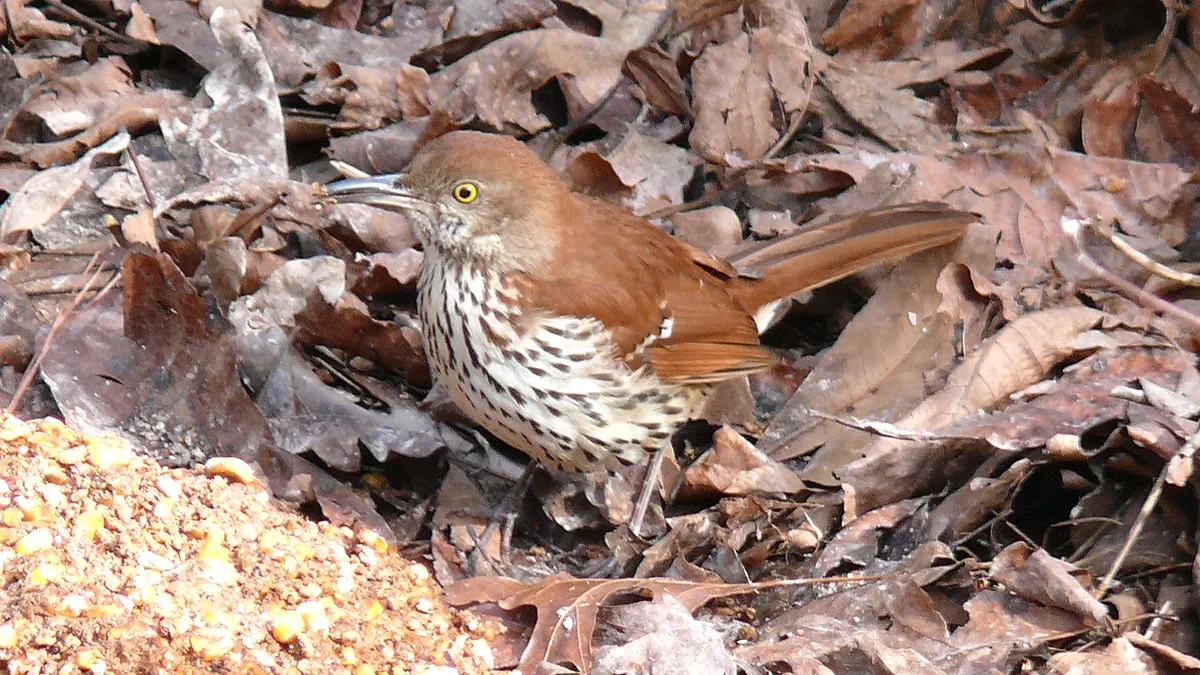
The brown thrasher (Toxostoma rufum), sometimes erroneously called the brown thrush or fox-coloured thrush, is a bird in the family Mimidae, which also includes the New World catbirds and mockingbirds. The brown thrasher is abundant throughout the eastern and central United States and southern and central Canada, and it is the only thrasher to live primarily east of the Rockies and central Texas. It is the state bird of Georgia. As a member of the genus Toxostoma, the bird is relatively large-sized among the other thrashers. It has brown upper parts with a white under part with dark streaks. Because of this, it is often confused with the smaller wood thrush (Hylocichla mustelina), among other species. The brown thrasher is noted for having over 1,000 song types, and the largest song repertoire of birds. However, each note is usually repeated in two or three phrases. The brown thrasher is an omnivore, with its diet ranging from insects to fruits and nuts. The usual nesting areas are shrubs, small trees, or at times on ground level. Brown thrashers are generally inconspicuous but territorial birds, especially when defending their nests, and will attack species as large as humans.
Description
The brown thrasher is bright reddish-brown above with thin, dark streaks on its buffy underparts. It has a whitish-colored chest with distinguished teardrop-shaped markings on its chest. Its long, rufous tail is rounded with paler corners, and eyes are a brilliant yellow. Its bill is brownish, long, and curves downward. Both male and females are similar in appearance. The juvenile appearance of the brown thrasher from the adult is not remarkably different, except for plumage texture, indiscreet upper part markings, and the irises having an olive color. The brown thrasher is a fairly large passerine, although it is generally moderate in size for a thrasher, being distinctly larger than the sage thrasher (Oreoscoptes montanus) but similar or somewhat smaller in size than the more brownish Toxostoma species found further west. Adults measure around 23.5 to 30.5 cm (9.3 to 12.0 in) long with a wingspan of 29 to 33 cm (11 to 13 in), and weigh 61 to 89 g (2.2 to 3.1 oz), with an average of 68 g (2.4 oz). Among standard measurements, the wing chord is 9.5 to 11.5 cm (3.7 to 4.5 in), the tail is 10.9 to 14.1 cm (4.3 to 5.6 in), the culmen is 2.2 to 2.9 cm (0.87 to 1.14 in) and the tarsus is 3.2 to 3.6 cm (1.3 to 1.4 in). There are two subspecies: the 'brown thrasher' (T. rufum rufum), which lies in the eastern half of Canada and the United States, and the 'western brown thrasher' (T. rufum longicauda (Baird, 1858)), which resides in the central United States east of the Rocky Mountains and southern central Canada. The western brown thrasher is distinguished by a more cinnamon upper part, whiter wing bars, and darker breast spots than T.rufum rufum.
Text from Wikipedia — Brown thrasher, revision 1367517013, CC BY-SA 4.0, retrieved 2026-09-04. Encyclopedic text reused under CC BY-SA 4.0. Sentences about hunting or regulation are removed: on this site, the rule comes from Québec.ca.
Other names
French
English
Presence in Quebec
- Origin
- Indigène
- Occurrence
- Régulier
- Population status
- Reproducteur
- Certainty
- Confirmé
Conservation
Québec.ca
Official periods
Source: Québec.ca — tables reproduced as published (retrieved 2026-08-30).
Regulations change. Always check Québec.ca before hunting or trapping.
Where this data comes from
This species is listed in an official government dataset. The identification and status shown in the data sheet are reproduced from it.
Source: List of Quebec’s vertebrate wildlife (LFVQ) — Ministère de l’Environnement, de la Lutte contre les changements climatiques, de la Faune et des Parcs. File LFVQ_25_03_2026.csv, retrieved 2026-08-30 · CC BY 4.0.
Measurements, habitat, diet and reproduction are not shown: no official source is attached to them yet.