
Moucherolle à ventre jaune— Quebec wildlife
Empidonax flaviventris
TyrannidaeNo period published by Québec.ca
Québec.ca publishes no hunting or trapping period for this species. Check the official regulations.
Wikipedia
Moucherolle à ventre jaune
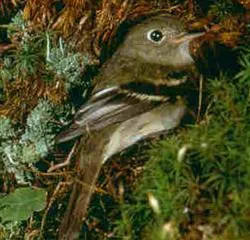
The yellow-bellied flycatcher (Empidonax flaviventris) is a small insect-eating bird of the tyrant flycatcher family.
Description
Adults have greenish upperparts and yellowish underparts (especially on the throat), with a dusky wash on the chest. They have a white or yellow eye ring that lacks the teardrop projection of the western flycatcher, white or yellowish wing bars that contrast strongly against the black wings, a broad, flat bill, and a relatively short tail when compared to other members of the genus. The upper mandible of the bill is dark, while the lower mandible is orange-pink. DNA testing in 2014 confirmed a field mark, involving the extent of buffy edging on the secondaries, to reliably distinguish this species from the western flycatcher. Measurements: Length: 5.1–5.9 in (13–15 cm) Weight: 0.3–0.6 oz (8.5–17.0 g) Wingspan: 7.1–7.9 in (18–20 cm) Yellow-bellied flycatchers wait on a perch low or in the middle of a tree and fly out to catch insects in flight, sometimes hovering over foliage. They sometimes eat berries or seeds. The yellow-bellied flycatcher's song can be transcribed as a rough, descending "tse-berk", which can be similar to the more common least flycatcher's snappier, more evenly pitched "che-bek."
Reproduction
Their breeding habitat is wet northern woods, especially spruce bogs, across Canada and the northeastern United States. They make a cup nest in sphagnum moss on or near the ground.
Text from Wikipedia — Yellow-bellied flycatcher, revision 1351898385, CC BY-SA 4.0, retrieved 2026-09-04. Encyclopedic text reused under CC BY-SA 4.0. Sentences about hunting or regulation are removed: on this site, the rule comes from Québec.ca.
Other names
French
Presence in Quebec
- Origin
- Indigène
- Occurrence
- Régulier
- Population status
- Reproducteur
- Certainty
- Confirmé
Conservation
Québec.ca
Official periods
Source: Québec.ca — tables reproduced as published (retrieved 2026-08-30).
Regulations change. Always check Québec.ca before hunting or trapping.
Where this data comes from
This species is listed in an official government dataset. The identification and status shown in the data sheet are reproduced from it.
Source: List of Quebec’s vertebrate wildlife (LFVQ) — Ministère de l’Environnement, de la Lutte contre les changements climatiques, de la Faune et des Parcs. File LFVQ_25_03_2026.csv, retrieved 2026-08-30 · CC BY 4.0.
Measurements, habitat, diet and reproduction are not shown: no official source is attached to them yet.