
No period published by Québec.ca
Québec.ca publishes no hunting or trapping period for this species. Check the official regulations.
Wikipedia
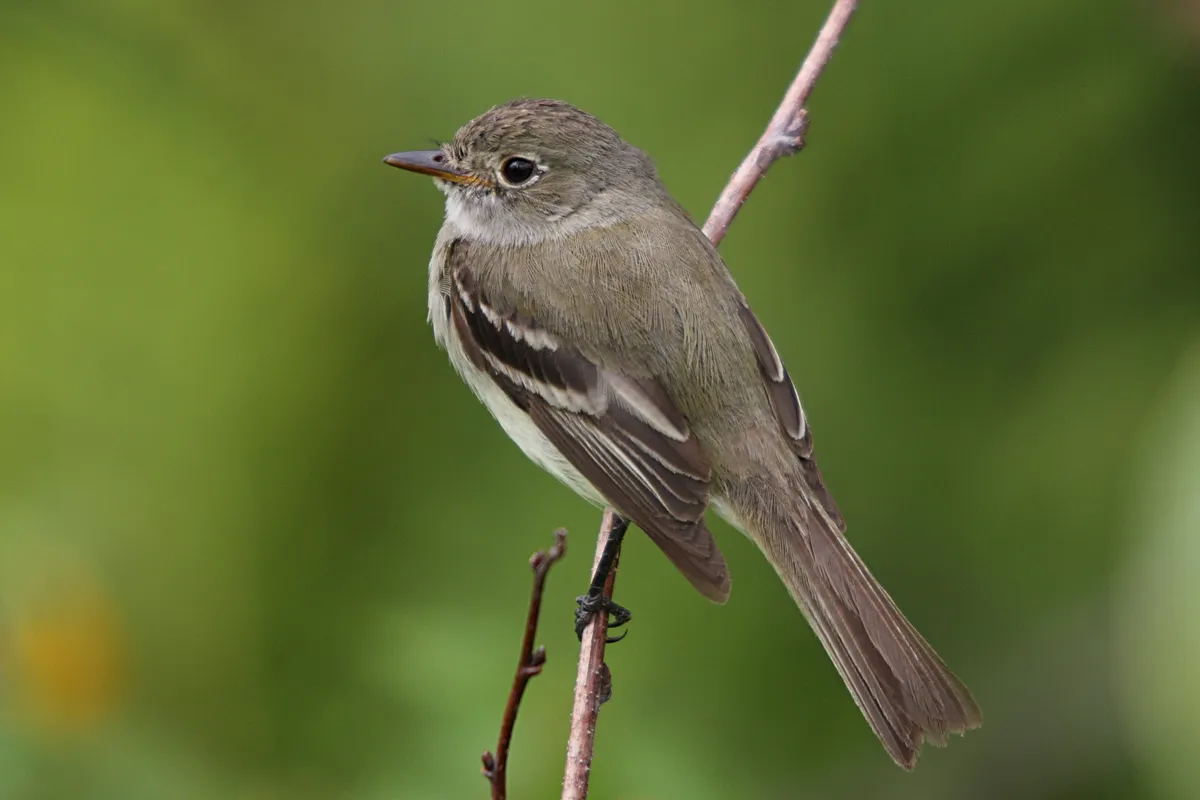
Moucherolle des aulnes
The alder flycatcher (Empidonax alnorum) is a small insect-eating bird in the tyrant flycatcher family. The genus name Empidonax is from Ancient Greek empis, "gnat", and anax, "master". The specific alnorum is Latin and means "of the alders".
Description
E. alnorum is one of the larger Empidonax species, attaining a length of 13–17 cm (5.1–6.7 in), and a weight of 12–14 g (0.42–0.49 oz). The wingspan ranges from 21–24 cm (8.3–9.4 in). The upperparts of E. alnorum are dull greenish-olive. The crown is a slightly darker olive-green than the back. The throat is white, with a darker breast band. Thin white rings surround the eyes. The bill is wide and moderate in length, with pinkish or yellow-orange lower mandible and black upper mandible. Wings are generally black, with white wing bars and white edges of the innermost secondaries (tertials). Juveniles have brownish upperparts, yellow underparts, and yellowish brown or buff wingbars. E. alnorum is similar in appearance to the eastern wood pewee (Contopus virens) and the eastern phoebe (Sayornis phoebe), as well as the nearly identical willow flycatcher (Empidonax traillii) but E. alnorum can be distinguished by its smaller size and upward tail flicking behavior. Birds in the genus Empidonax are notoriously hard to identify. Novel approaches to identification have been employed to try and increase the accuracy of species identification of mist-netted individuals, such as using ratios of and differences between the measured lengths of various body parts, including wings and beaks. Vocalizations are often relied upon for identification to species in the field when birds cannot be manipulated by hand. The ratio of the lengths of the primary feathers is a useful distinction with birds in the hand or on good quality profile photographs.
Text from Wikipedia — Alder flycatcher, revision 1345367032, CC BY-SA 4.0, retrieved 2026-09-04. Encyclopedic text reused under CC BY-SA 4.0. Sentences about hunting or regulation are removed: on this site, the rule comes from Québec.ca.
Presence in Quebec
- Origin
- Indigène
- Occurrence
- Régulier
- Population status
- Reproducteur
- Certainty
- Confirmé
Conservation
Québec.ca
Official periods
Source: Québec.ca — tables reproduced as published (retrieved 2026-08-30).
Regulations change. Always check Québec.ca before hunting or trapping.
Where this data comes from
This species is listed in an official government dataset. The identification and status shown in the data sheet are reproduced from it.
Source: List of Quebec’s vertebrate wildlife (LFVQ) — Ministère de l’Environnement, de la Lutte contre les changements climatiques, de la Faune et des Parcs. File LFVQ_25_03_2026.csv, retrieved 2026-08-30 · CC BY 4.0.
Measurements, habitat, diet and reproduction are not shown: no official source is attached to them yet.