
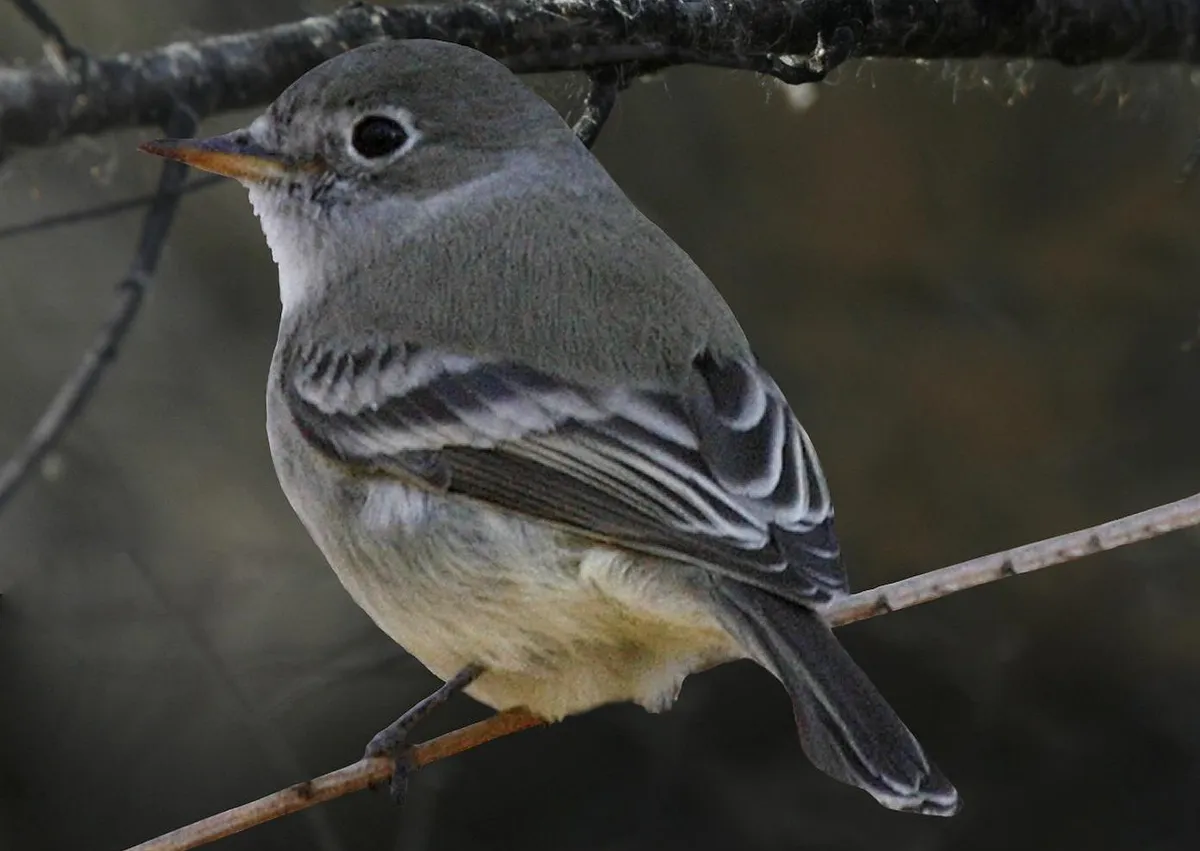
Moucherolle gris— Quebec wildlife
Empidonax wrightii
TyrannidaeNo period published by Québec.ca
Québec.ca publishes no hunting or trapping period for this species. Check the official regulations.
Wikipedia
Moucherolle gris
The American gray flycatcher, American grey flycatcher, or just gray flycatcher (Empidonax wrightii) as it is known in North America, is a small, insectivorous passerine in the tyrant flycatcher family. It is common in the arid regions of western North America, especially the Great Basin. From sagebrush steppes to pinyon-juniper woodlands and ponderosa pine forests, this flycatcher forages for insects from shrubs or low tree branches. The American gray flycatcher is one of the many species in the genus Empidonax. These species are very similar in appearance and behavior, and they are notoriously difficult to differentiate. The best characteristics for distinguishing these species are voice, breeding habitat, and range. The American gray flycatcher, however, can be identified by a unique behavior, its downward tail wag. Other Empidonax species typically exhibit a rapid upward tail flick.
Description
American gray flycatchers are small birds, but larger than most Empidonax flycatchers. A typical adult measures 15 cm (5.9 in) in length, 22 cm (8.7 in) in wingspan, and 12.5 g (0.44 oz) in mass. Adults have pale gray upperparts, darker on the wings and tail, with a faint olive tinge after molting in fall. Underparts are whitish, but washed slightly with yellow in fresh plumage. They have white wing bars and an inconspicuous white eye ring. There is a pale supraloral band stretching above the base of the bill. Relative to other North American Empidonax flycatchers, the American gray flycatcher has a long, narrow bill, a long tail, and the mandible tends to be paler for more of its length. Juveniles are similar in appearance to adults, but with stronger olive and yellow tones. Also, young birds have buffy wing bars and brownish breasts. Only the male sings. The song is a strong, two syllable note described as chuwip or wilip. A weaker, higher-pitched teeap or seep is often inserted into the song. Both sexes give a dry pit or wit call. Females call often when foraging or collecting nest materials.
Habitat and range
The American gray flycatcher breeds from southernmost British Columbia through a narrow zone in central Washington to eastern Oregon and California. The range extends east across Nevada, southern Idaho, Utah, and northern Arizona to southwestern Wyoming, western Colorado, and northwestern New Mexico. Depending on latitude, they arrive on breeding grounds mid-April to mid-May and leave between mid-August and mid-September. Migration between breeding and wintering grounds takes approximately seven weeks in both spring and autumn. Males usually arrive on breeding grounds one week prior to arrival of females. The American gray flycatcher winters in Baja California Sur, southeastern Arizona, and central Sonora to central Oaxaca. Small numbers may winter in western Texas and southern California.
Text from Wikipedia — American gray flycatcher, revision 1354831646, CC BY-SA 4.0, retrieved 2026-09-04. Encyclopedic text reused under CC BY-SA 4.0. Sentences about hunting or regulation are removed: on this site, the rule comes from Québec.ca.
Presence in Quebec
- Origin
- Indigène
- Occurrence
- Accidentel/non régulier
- Population status
- Migrateur
- Certainty
- Confirmé
Conservation
Québec.ca
Official periods
Source: Québec.ca — tables reproduced as published (retrieved 2026-08-30).
Regulations change. Always check Québec.ca before hunting or trapping.
Where this data comes from
This species is listed in an official government dataset. The identification and status shown in the data sheet are reproduced from it.
Source: List of Quebec’s vertebrate wildlife (LFVQ) — Ministère de l’Environnement, de la Lutte contre les changements climatiques, de la Faune et des Parcs. File LFVQ_25_03_2026.csv, retrieved 2026-08-30 · CC BY 4.0.
Measurements, habitat, diet and reproduction are not shown: no official source is attached to them yet.