
No period published by Québec.ca
Québec.ca publishes no hunting or trapping period for this species. Check the official regulations.
Wikipedia
Moucherolle phébi
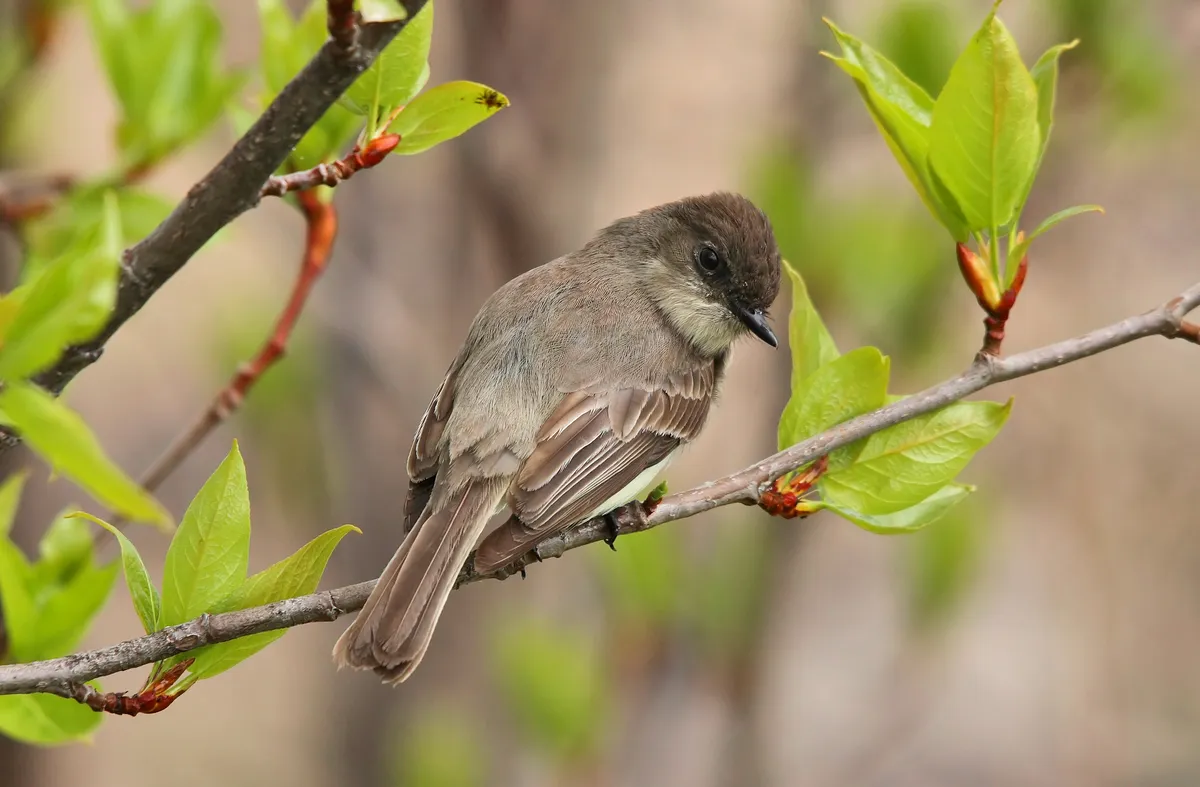
The eastern phoebe (Sayornis phoebe) is a small passerine bird. The genus name Sayornis is constructed from the specific part of Charles Lucien Bonaparte's name for Say's phoebe, Muscicapa saya, and Ancient Greek ornis, "bird". Phoebe is an alternative name for the Roman moon goddess Diana, but it may also have been chosen to imitate the bird's call.
Description
Measurements: Length: 5.5–6.7 in (14–17 cm) Weight: 0.6–0.7 oz (16–21 g) Wingspan: 10.2–11.0 in (26–28 cm) This species appears remarkably big-headed, especially if it puffs up the small crest. Its plumage is gray-brown above. It has a white throat, dirty gray breast, and buffish underparts which become whiter during the breeding season. Two indistinct buff bars are present on each wing. Its all-dark bill and lack of an eye ring and wingbars distinguish it from other North American tyrant flycatchers, and it pumps its tail up and down like other phoebes when perching on a branch. The eastern phoebe's call is a sharp chip, and the song, from which it may get its name, is fee-bee. The eastern wood pewee (Contopus virens) is extremely similar in appearance. It lacks the buff hue usually present on the lighter parts of the eastern phoebe's plumage, and thus has always clearly defined and contrasting wing-bars. It also does not bob its tail habitually, and appears on the breeding grounds much later, although it leaves for winter quarters at about the same time as the eastern phoebe. The eastern phoebe often nests on human structures such as bridges and buildings. Nesting activity may start as early as the first days of April. The nest is an open cup with a mud base and lined with moss and grass, built in a crevice in a rock or man-made site; two to six eggs are laid. Both parents feed the young and usually raise two broods per year. The eastern phoebe is occasionally host to the nest-parasitic brown-headed cowbird (Molothrus ater).
Habitat and range
Eastern phoebes are highly adaptable to urban environments. They are primarily found in wooded areas, particularly streamsides, and farmlands. Eastern phoebes tend to avoid open areas and choose spots beneath trees, brushy areas, or overhangs. However, during migration in winters or in breeding season they are frequently seen around the edges of woods and other areas where water sources are abundant.
Diet
Insects make up a great majority of its summer diet; included are many small wasps, bees, beetles, flies, true bugs, and grasshoppers. It also eats some spiders, ticks, and millipedes. Small fruits and berries are eaten often during the cooler months.
Reproduction
The eastern phoebe breeds in eastern North America, excluding the southeastern coastal United States. The breeding habitat is open woodland, farmland, and suburbs, often near water. This phoebe is insectivorous, and often perches conspicuously when seeking food items. It also eats fruits and berries in cooler weather.
Text from Wikipedia — Eastern phoebe, revision 1364192107, CC BY-SA 4.0, retrieved 2026-09-04. Encyclopedic text reused under CC BY-SA 4.0. Sentences about hunting or regulation are removed: on this site, the rule comes from Québec.ca.
Other names
French
English
Presence in Quebec
- Origin
- Indigène
- Occurrence
- Régulier
- Population status
- Reproducteur
- Certainty
- Confirmé
Conservation
Québec.ca
Official periods
Source: Québec.ca — tables reproduced as published (retrieved 2026-08-30).
Regulations change. Always check Québec.ca before hunting or trapping.
Where this data comes from
This species is listed in an official government dataset. The identification and status shown in the data sheet are reproduced from it.
Source: List of Quebec’s vertebrate wildlife (LFVQ) — Ministère de l’Environnement, de la Lutte contre les changements climatiques, de la Faune et des Parcs. File LFVQ_25_03_2026.csv, retrieved 2026-08-30 · CC BY 4.0.
Measurements, habitat, diet and reproduction are not shown: no official source is attached to them yet.