
No period published by Québec.ca
Québec.ca publishes no hunting or trapping period for this species. Check the official regulations.
Wikipedia
Moucherolle vert
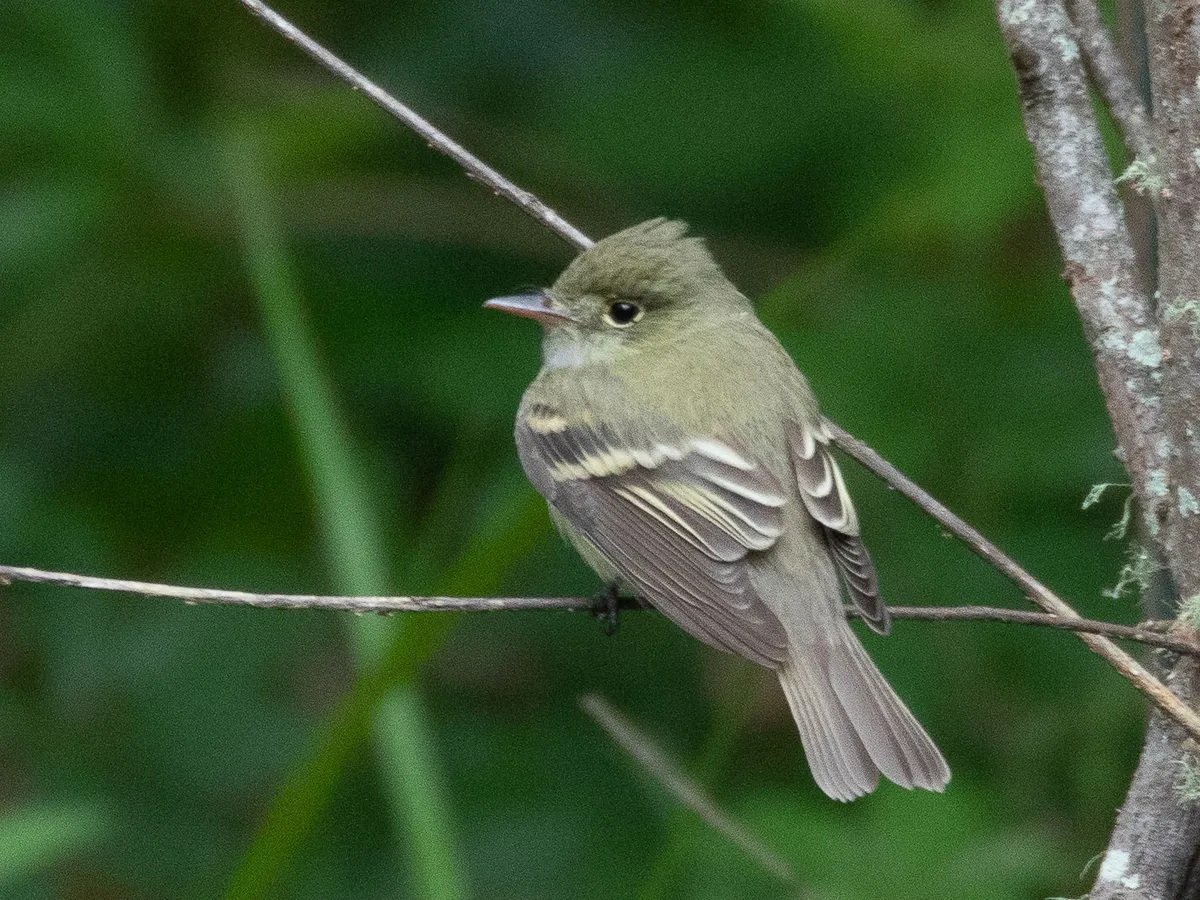
The Acadian flycatcher (Empidonax virescens) is a small insect-eating bird of the tyrant flycatcher family.
Description
Adults have olive upperparts, darker on the wings and tail, with whitish underparts; they have a white eye ring, white wing bars and a wide bill. The breast is washed with olive. The upper part of the bill is dark; the lower part is yellowish. This bird's song is an explosive peet-sa. The call is a soft peet. They also have a call similar to that of the northern flicker. A unique two-note song described as "ka-zeep" helps to identify this species. Measurements: Length: 5.5–5.9 inches (14–15 cm) Weight: 0.4–0.5 ounces (11–14 g) Wingspan: 8.7–9.1 inches (22–23 cm)
Habitat and range
Its breeding habitat is deciduous forests, often near water, across the eastern United States and southwestern Ontario. These birds migrate through eastern Mexico and the Caribbean to southern Central America and the very northwest of South America in Colombia, western Venezuela, and Ecuador. The numbers of these birds have declined somewhat in the southern parts of their range. Brown-headed cowbirds lay eggs in the nests of these birds in some areas. However, only 16% of cowbird young in Acadian flycatcher nests fledge successfully. They wait on a perch in the middle of a tree and fly out to catch insects in flight (hawking), also sometimes picking insects from foliage while hovering (gleaning). They may eat some berries and seeds. They make a loose, shallow nest in a horizontal forks of trees and shrubs, primarily in lowland forests and marshy areas. The Acadian flycatcher is an excellent flier; it is extremely maneuverable, can hover, and can even fly backward. There is no scientific information on hopping or walking by this bird. As of October 2015 there have been 2 records of Acadian flycatcher in Europe, the first being a bird found dead in Iceland in 1967, and the second a bird found on the beach at Dungeness in Kent, England in September 2015, the latter's identity being established by DNA from its droppings.
Text from Wikipedia — Acadian flycatcher, revision 1369021074, CC BY-SA 4.0, retrieved 2026-09-04. Encyclopedic text reused under CC BY-SA 4.0. Sentences about hunting or regulation are removed: on this site, the rule comes from Québec.ca.
Other names
French
Presence in Quebec
- Origin
- Indigène
- Occurrence
- Accidentel/non régulier
- Population status
- Migrateur
- Certainty
- Confirmé
Conservation
Québec.ca
Official periods
Source: Québec.ca — tables reproduced as published (retrieved 2026-08-30).
Regulations change. Always check Québec.ca before hunting or trapping.
Where this data comes from
This species is listed in an official government dataset. The identification and status shown in the data sheet are reproduced from it.
Source: List of Quebec’s vertebrate wildlife (LFVQ) — Ministère de l’Environnement, de la Lutte contre les changements climatiques, de la Faune et des Parcs. File LFVQ_25_03_2026.csv, retrieved 2026-08-30 · CC BY 4.0.
Measurements, habitat, diet and reproduction are not shown: no official source is attached to them yet.