
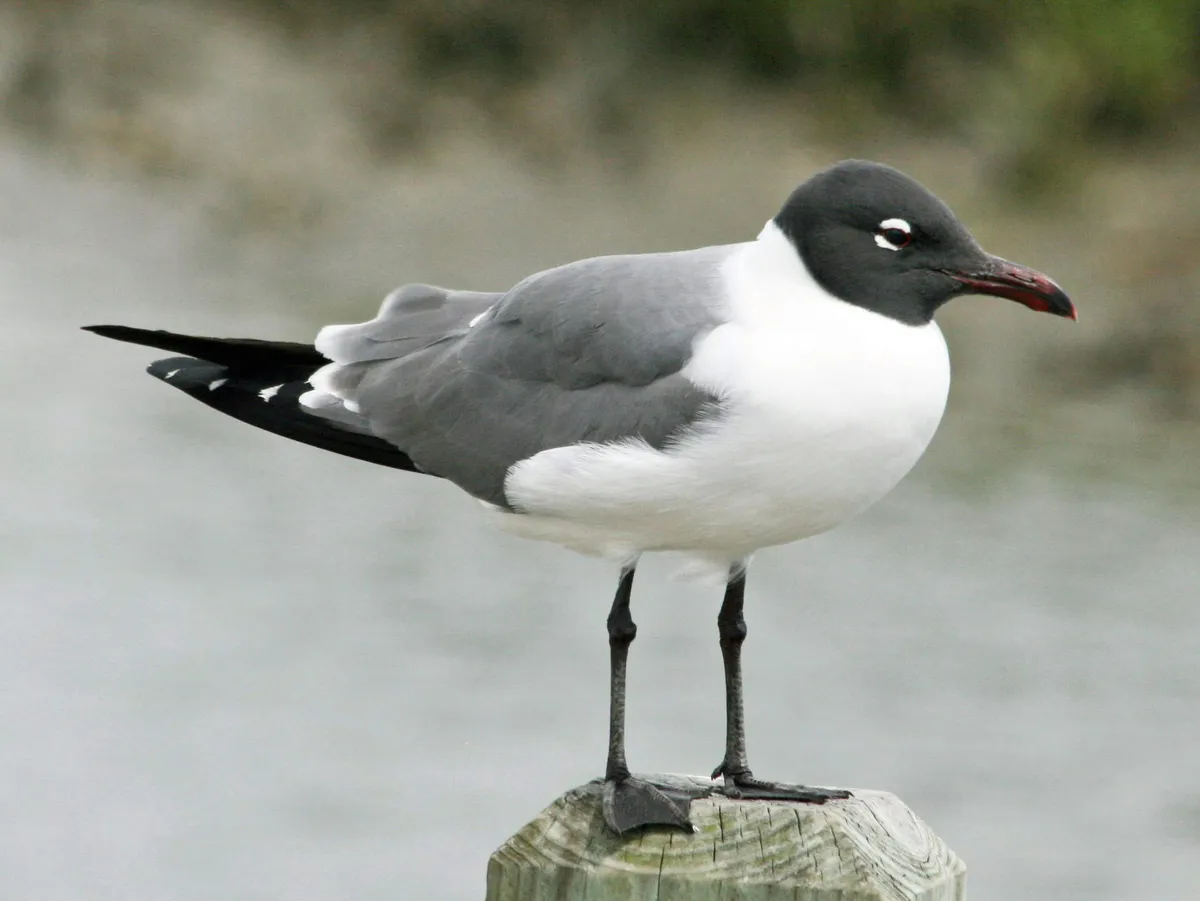
Mouette atricille— Quebec wildlife
Leucophaeus atricilla
LaridaeNo period published by Québec.ca
Québec.ca publishes no hunting or trapping period for this species. Check the official regulations.
Wikipedia
Mouette atricille
The laughing gull (Leucophaeus atricilla) is a medium-sized gull of North and South America. Named from its laugh-like call, it is an opportunistic omnivore and scavenger. It breeds in large colonies mostly along the Atlantic coast of North America, the Caribbean, and northern South America. Two subspecies are accepted, L. a. atricilla, which occurs from the West Indies to the Venezuelan islands, and L. a. megalopterus, which occurs from southeast Canada down to Central America. The laughing gull was long placed in the genus Larus until its present placement in Leucophaeus.
Description
This species is 36–41 cm (14–16 in) long with a 98–110 cm (39–43 in) wingspan and a weight range of 203–371 grams (7.2–13.1 oz). The summer adult's body is white apart from the dark grey back and wings and black head. Its wings are much darker grey than all other gulls of similar size except the smaller Franklin's gull, and they have black tips without the white crescent shown by Franklin's. The beak is long and red. The black hood is mostly lost in winter. Laughing gulls take three years to reach adult plumage. Immature birds are always darker than most similar-sized gulls other than Franklin's. First-year birds are greyer below and have paler heads than first-year Franklin's, and have an all-black tail. Second-year birds can be distinguished by the wing pattern, with more extensive black on the primary coverts, and sometimes still some black on the tail. The laughing gull's English name is derived from its raucous kee-agh call, which sounds like a high-pitched laugh "ha... ha... ha...".
Text from Wikipedia — Laughing gull, revision 1357301850, CC BY-SA 4.0, retrieved 2026-09-04. Encyclopedic text reused under CC BY-SA 4.0. Sentences about hunting or regulation are removed: on this site, the rule comes from Québec.ca.
Other names
French
English
Former scientific names
Presence in Quebec
- Origin
- Indigène
- Occurrence
- Régulier
- Population status
- Migrateur
- Certainty
- Confirmé
Conservation
Québec.ca
Official periods
Source: Québec.ca — tables reproduced as published (retrieved 2026-08-30).
Regulations change. Always check Québec.ca before hunting or trapping.
Where this data comes from
This species is listed in an official government dataset. The identification and status shown in the data sheet are reproduced from it.
Source: List of Quebec’s vertebrate wildlife (LFVQ) — Ministère de l’Environnement, de la Lutte contre les changements climatiques, de la Faune et des Parcs. File LFVQ_25_03_2026.csv, retrieved 2026-08-30 · CC BY 4.0.
Measurements, habitat, diet and reproduction are not shown: no official source is attached to them yet.