
No period published by Québec.ca
Québec.ca publishes no hunting or trapping period for this species. Check the official regulations.
Wikipedia
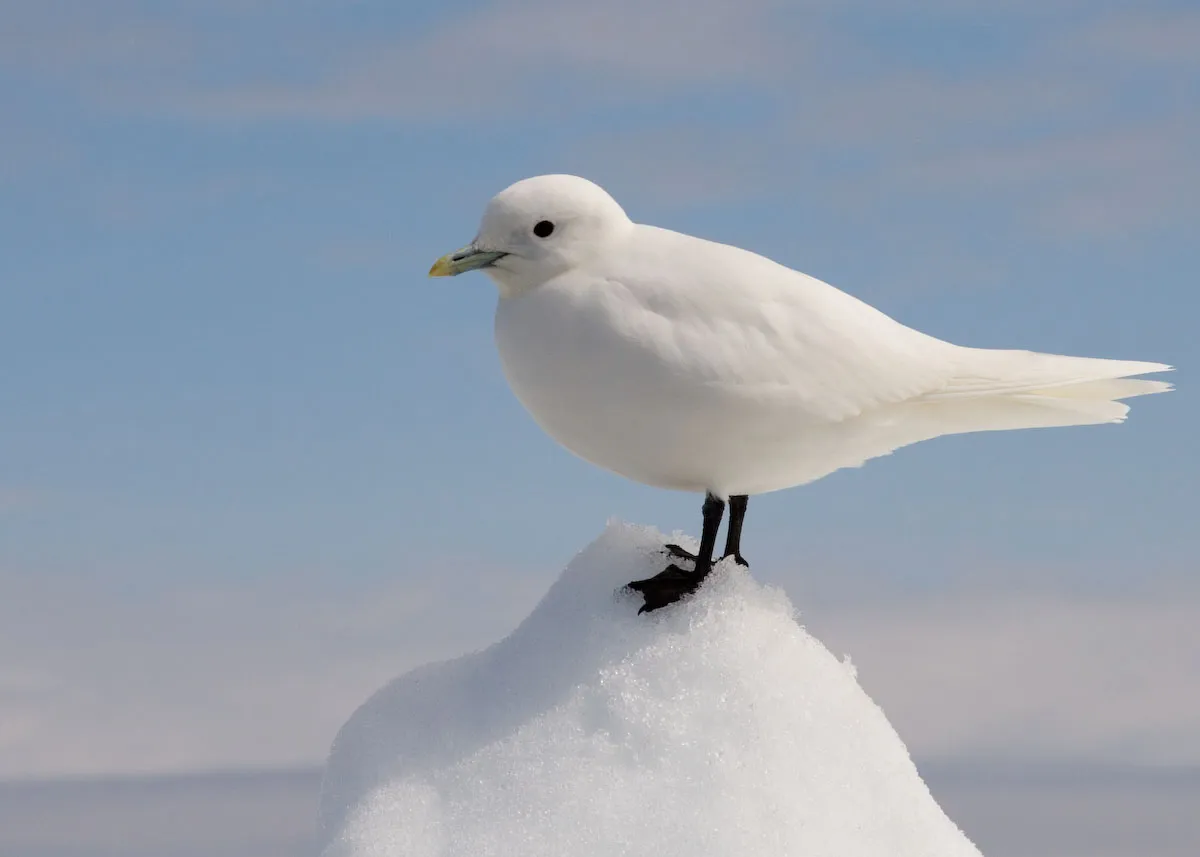
Mouette blanche
The ivory gull (Pagophila eburnea) is a small gull, the only species in the genus Pagophila. It is a resident breeding bird in the high Arctic and has a circumpolar distribution through Greenland, northernmost North America, and Eurasia.
Description
The ivory gull is 40–43 cm (16–17 in) long, with a wingspan of 108–120 cm (43–47 in); males weigh between 500–687 g (17.6–24.2 oz) and females between 448–583 g (15.8–20.6 oz). This species is easy to identify. It has a different, more pigeon-like shape compared to the Larus gulls, an impression reinforced by its short legs. The adult has completely pure white plumage, lacking the grey back of other gulls. The thick bill is blue with a yellow tip (occasionally with a reddish tip), and the legs are black. The eyes are dark, with a narrow dark red orbital ring. Juvenile and first-winter birds have a dusky face and variable amounts of black flecking in the wings and tail; they take two years to attain full adult plumage, with second-winter yearlings having an intermediate plumage with smaller dark spots and a less dusky face, though some second-winters resemble adults. In flight, it has long, broad-based wings, with a strong wingbeat reminiscent of skuas. Its flight call cry is a harsh, tern-like keeeer. It has many other calls, including a warbling "fox-call" that indicates potential predators such as an arctic fox, polar bear, glaucous gull, or human near a nest; a "long-call" given with wrists out, elongated neck and downward-pointed bill, given in elaborate display to other ivory gulls during breeding, and a plaintive begging call given in courtship by females to males, accompanied by head-tossing. There are no differences in appearance across the species' geographic range.
Text from Wikipedia — Ivory gull, revision 1359044328, CC BY-SA 4.0, retrieved 2026-09-04. Encyclopedic text reused under CC BY-SA 4.0. Sentences about hunting or regulation are removed: on this site, the rule comes from Québec.ca.
Other names
French
English
Presence in Quebec
- Origin
- Indigène
- Occurrence
- Accidentel/non régulier
- Population status
- Migrateur
- Certainty
- Confirmé
Conservation
Québec.ca
Official periods
Source: Québec.ca — tables reproduced as published (retrieved 2026-08-30).
Regulations change. Always check Québec.ca before hunting or trapping.
Where this data comes from
This species is listed in an official government dataset. The identification and status shown in the data sheet are reproduced from it.
Source: List of Quebec’s vertebrate wildlife (LFVQ) — Ministère de l’Environnement, de la Lutte contre les changements climatiques, de la Faune et des Parcs. File LFVQ_25_03_2026.csv, retrieved 2026-08-30 · CC BY 4.0.
Measurements, habitat, diet and reproduction are not shown: no official source is attached to them yet.