
No period published by Québec.ca
Québec.ca publishes no hunting or trapping period for this species. Check the official regulations.
Wikipedia
Mouette de Franklin
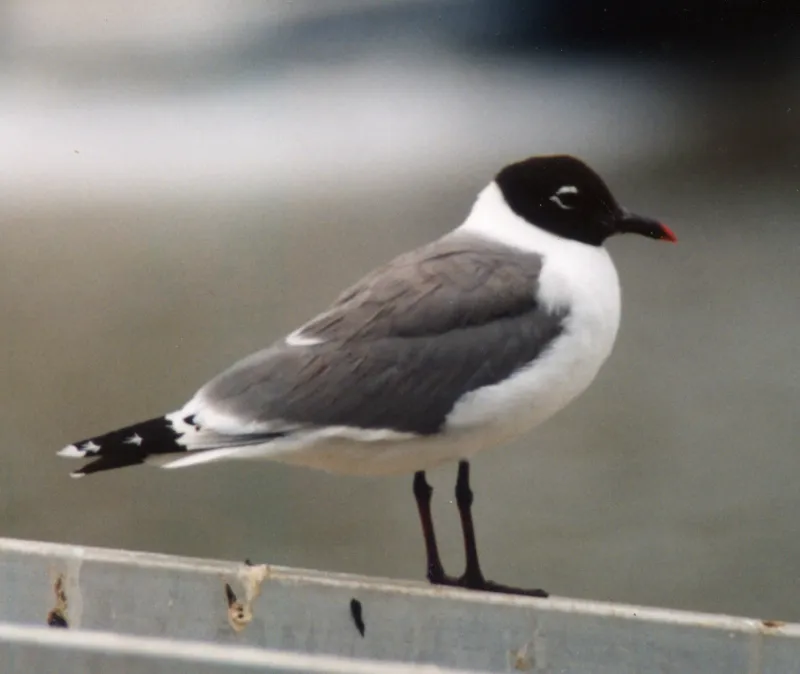
Franklin's gull (Leucophaeus pipixcan) is a small (length 12.6–14.2 in, 32–36 cm) gull. The genus name Leucophaeus is from Ancient Greek leukos, "white", and phaios, "dusky". The specific pipixcan is a Nahuatl name for a type of gull. The English common name was given to commemorate the arctic explorer Sir John Franklin, who led an expedition in 1825 on which the type was collected.
Description
It breeds in central provinces of Canada and adjacent states of the northern United States. It is a migratory bird, wintering in Argentina, the Caribbean, Chile, and Peru. The summer adult's body is white and its back and wings are much darker grey than all other gulls of similar size except the larger laughing gull. The wings have black tips with an adjacent white band. The bill and legs are red. The black hood of the breeding adult is mostly lost in winter. Young birds are similar to the adult but have less developed hoods and lack the white wing band. They take three years to reach maturity. Measurements: Length: 12.6–14.2 in (32–36 cm) Weight: 8.1–10.6 oz (230–300 g) Wingspan: 33.5–37.4 in (85–95 cm)
Habitat and range
Although the bird is uncommon on the coasts of North America, it occurs as a rare vagrant to northwest Europe, south and west Africa, Australia and Japan, with a single record from Eilat, Israel, in 2011 (Smith 2011), and a single record from Larnaca, Cyprus, July 2006. At the beginning of 2017 has been observed also in Southern Romania, southeast Europe.
Text from Wikipedia — Franklin's gull, revision 1321283488, CC BY-SA 4.0, retrieved 2026-09-04. Encyclopedic text reused under CC BY-SA 4.0. Sentences about hunting or regulation are removed: on this site, the rule comes from Québec.ca.
Other names
French
English
Former scientific names
Presence in Quebec
- Origin
- Indigène
- Occurrence
- Régulier
- Population status
- Migrateur
- Certainty
- Confirmé
Conservation
Québec.ca
Official periods
Source: Québec.ca — tables reproduced as published (retrieved 2026-08-30).
Regulations change. Always check Québec.ca before hunting or trapping.
Where this data comes from
This species is listed in an official government dataset. The identification and status shown in the data sheet are reproduced from it.
Source: List of Quebec’s vertebrate wildlife (LFVQ) — Ministère de l’Environnement, de la Lutte contre les changements climatiques, de la Faune et des Parcs. File LFVQ_25_03_2026.csv, retrieved 2026-08-30 · CC BY 4.0.
Measurements, habitat, diet and reproduction are not shown: no official source is attached to them yet.