
No period published by Québec.ca
Québec.ca publishes no hunting or trapping period for this species. Check the official regulations.
Wikipedia
Mouette de Sabine
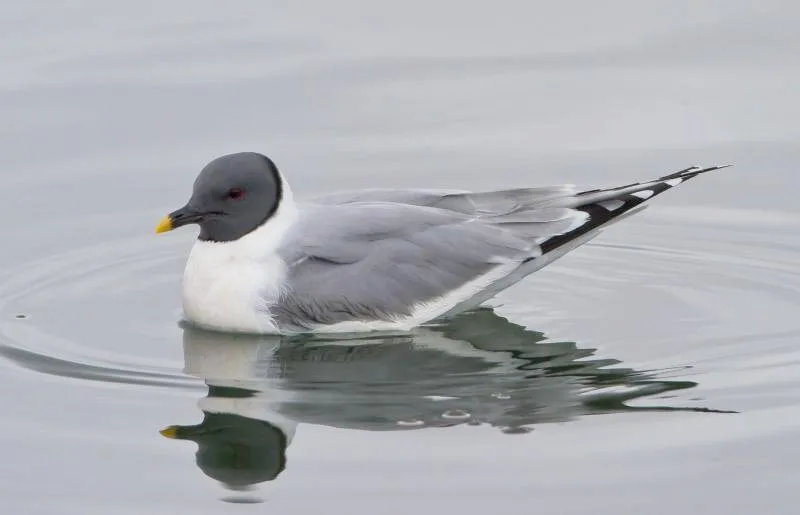
Sabine's gull ( SAY-bin; Xema sabini) is a small gull. It is usually treated as the only species placed in the genus Xema, though some authors include it with other gulls in a wide view of the genus Larus. It has also been known historically as fork-tailed gull or xeme (from the genus name). It breeds in colonies on Arctic coasts and tundra, laying two or three spotted olive-brown eggs in a ground nest lined with grass. Sabine's gull is pelagic outside the breeding season. It takes a wide variety of mainly animal food, and will eat any suitable small prey.
Description
Sabine's gull is a small gull, 27 to 33 cm (10+1⁄2–13 in) in length and weighing 135 to 225 g (4+3⁄4–8 oz). The wings are long, thin and pointed with a span of between 81 and 87 cm (32–34+1⁄2 in). The bill, which is black with a yellow tip, is around 2.5 cm (1 in) long. This species is easy to identify through its striking wing pattern, though at long range it can be confused with immature black-legged kittiwakes. The adult has a pale grey back and wing coverts, four black outer primary flight feathers, and white inner primaries and secondaries. The white tail is slightly forked. The adult's hood darkens during breeding season to dark grey with a narrow black collar at the base of the hood. Young birds have a similar tricoloured wing pattern, but the grey is replaced by brown, and the tail has a black terminal band. Juveniles take two years to attain full adult plumage. Sabine's gulls have an unusual moult pattern for gulls. Fledged birds retain their juvenile plumage through the autumn and do not start moulting into their first winter plumage until they have reached their wintering grounds. Adults have their complete moult in the spring prior to the spring migration, and have a partial moult in the autumn after returning to the wintering area, a reversal of the usual pattern for gulls. They have a very high-pitched and squeaking call.
Text from Wikipedia — Sabine's gull, revision 1363926589, CC BY-SA 4.0, retrieved 2026-09-04. Encyclopedic text reused under CC BY-SA 4.0. Sentences about hunting or regulation are removed: on this site, the rule comes from Québec.ca.
Other names
French
English
Presence in Quebec
- Origin
- Indigène
- Occurrence
- Régulier
- Population status
- Migrateur
- Certainty
- Confirmé
Conservation
Québec.ca
Official periods
Source: Québec.ca — tables reproduced as published (retrieved 2026-08-30).
Regulations change. Always check Québec.ca before hunting or trapping.
Where this data comes from
This species is listed in an official government dataset. The identification and status shown in the data sheet are reproduced from it.
Source: List of Quebec’s vertebrate wildlife (LFVQ) — Ministère de l’Environnement, de la Lutte contre les changements climatiques, de la Faune et des Parcs. File LFVQ_25_03_2026.csv, retrieved 2026-08-30 · CC BY 4.0.
Measurements, habitat, diet and reproduction are not shown: no official source is attached to them yet.