
Mouette rieuse— Quebec wildlife
Chroicocephalus ridibundus
LaridaeNo period published by Québec.ca
Québec.ca publishes no hunting or trapping period for this species. Check the official regulations.
Wikipedia
Mouette rieuse
The black-headed gull (Chroicocephalus ridibundus) is a small gull that breeds in much of the Palearctic in Europe and Asia, and also locally in smaller numbers in coastal eastern Canada. Most of the population is migratory and winters further south, but many also remain in the milder areas of northwestern Europe. It was formerly sometimes cited as "common black-headed gull" to distinguish it from "great black-headed gull" (an old name for Pallas's gull). The genus name Chroicocephalus is from the Ancient Greek words khroizo, "to colour", and kephale, "head". The specific name ridibundus is Latin for "laughing".
Description
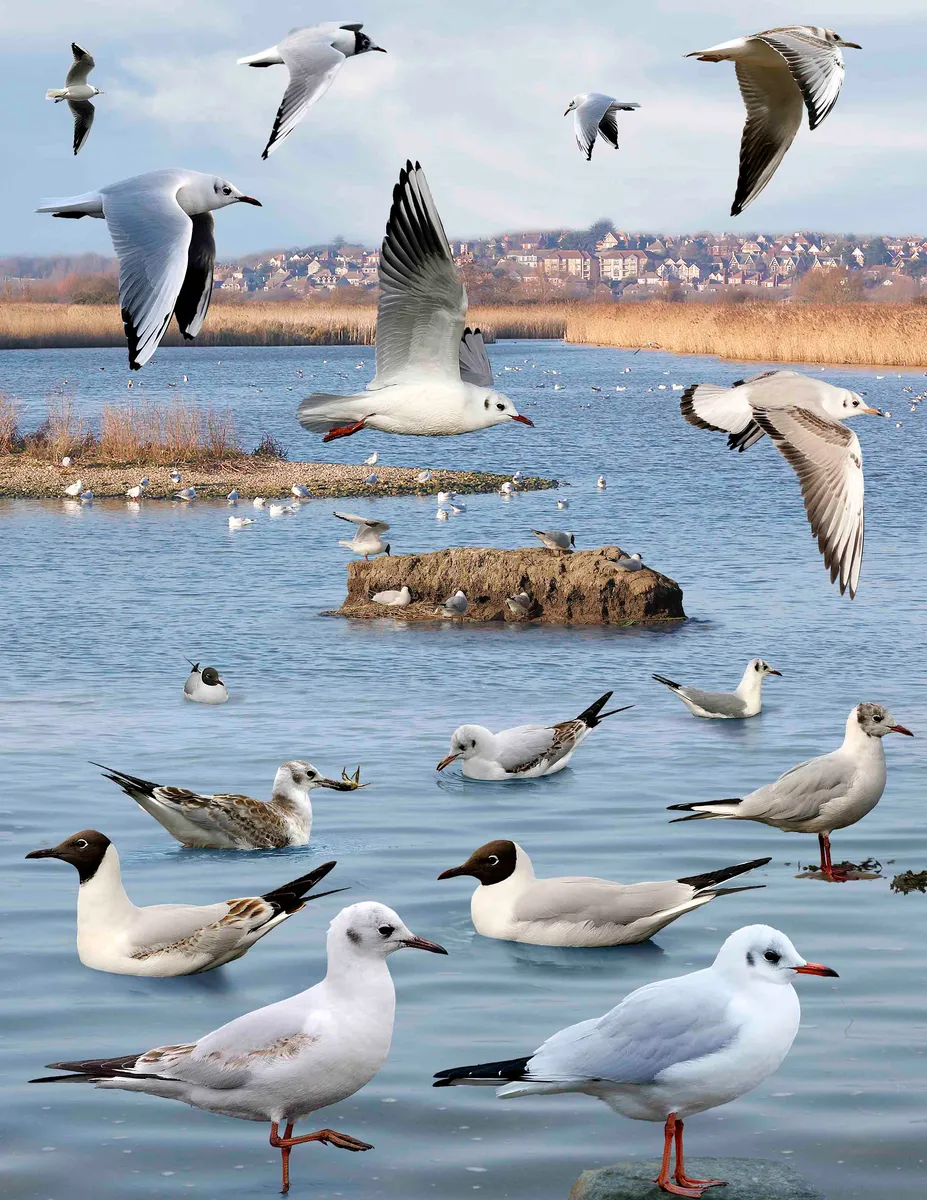
This gull is 34–39 cm (13+1⁄2–15+1⁄2 in) long with a 100–110 cm (39+1⁄2–43+1⁄2 in) wingspan and weighs 166–400 g (5+7⁄8–14+1⁄8 oz); males (186–400 g) average heavier than females (166–350 g), but with considerable overlap. In flight, the white leading edge of the outer wing (the outer primaries) is a good field mark, particularly combined with the dark underside of the inner primaries, which distinguishes it from the white underside of those feathers in its close relative the Bonaparte's gull. The summer adult has a chocolate-brown head (not black, although does look black from a distance), white neck, underparts and tail, pale grey wings and back, black tips to the primary wing feathers, and red bill and legs. The hood is lost in winter, leaving just two dark spots above and behind the eye. Summer plumage occurs from March to July (rarely from late January, and into August), winter plumage from late July until March or April. Black-headed gulls take two years to reach maturity. Juvenile birds, for the first month or two after fledging, have a mottled pattern of brown spots over most of the body, and a black band on the tail; in late summer, they moult into first-winter plumage, with a grey back, but retaining a brown carpal bar on the inner wing, blackish secondary feathers, and the black band on the tail. In their first summer (one year old), they develop a partial brown hood, the extent of which is very variable between individuals from almost no brown on the head, to a hood like a full adult's. The second winter plumage is like adult plumage, except for occasional brown marks on the wings and tail tip in some individuals. There is no difference in plumage between the sexes. It breeds in colonies in large reed beds or marshes, or on islands in lakes, nesting on the ground; colonies may range from a few (or even single) pairs up to several thousand pairs, exceptionally over 10,000 pairs. Like most gulls, it is highly gregarious in winter, both when feeding and in evening roosts. It is not a pelagic species and is rarely seen at sea far from coasts. Like most gulls, black-headed gulls are long-lived birds, with a maximum age of at least 32.9 years recorded in the wild.
Habitat and range
Black-headed gulls breed across the Palearctic over much of Europe and northern Asia, from Iceland and Ireland east to Japan and eastern China.It is abundant, with a global
Text from Wikipedia — Black-headed gull, revision 1366354308, CC BY-SA 4.0, retrieved 2026-09-04. Encyclopedic text reused under CC BY-SA 4.0. Sentences about hunting or regulation are removed: on this site, the rule comes from Québec.ca.
Other names
French
English
Former scientific names
Presence in Quebec
- Origin
- Indigène
- Occurrence
- Régulier
- Population status
- Reproducteur
- Certainty
- Confirmé
Conservation
Québec.ca
Official periods
Source: Québec.ca — tables reproduced as published (retrieved 2026-08-30).
Regulations change. Always check Québec.ca before hunting or trapping.
Where this data comes from
This species is listed in an official government dataset. The identification and status shown in the data sheet are reproduced from it.
Source: List of Quebec’s vertebrate wildlife (LFVQ) — Ministère de l’Environnement, de la Lutte contre les changements climatiques, de la Faune et des Parcs. File LFVQ_25_03_2026.csv, retrieved 2026-08-30 · CC BY 4.0.
Measurements, habitat, diet and reproduction are not shown: no official source is attached to them yet.