
Trapping periods published by Québec.ca
Official tables below — trapping units (UGAF) and dates.
Wikipedia
Mouffette rayée
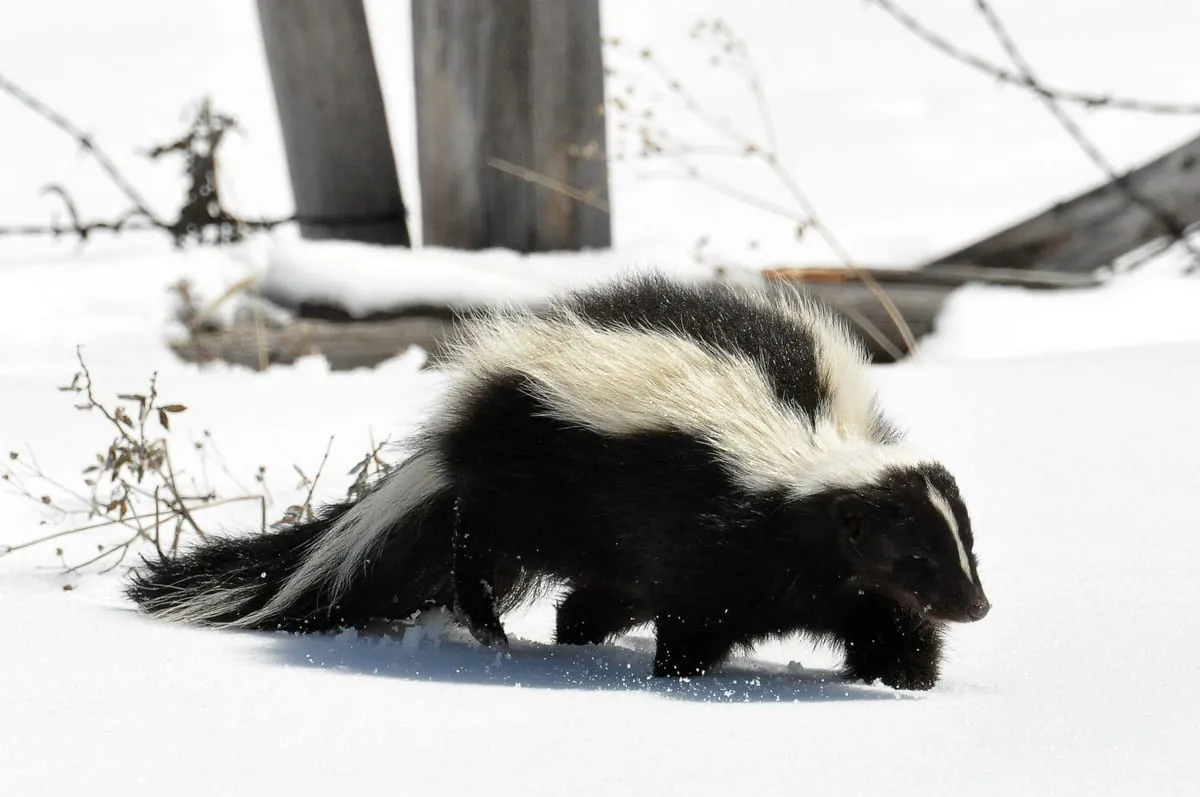
The striped skunk (Mephitis mephitis) is a skunk of the genus Mephitis that occurs across much of North America, including southern Canada, the United States, and northern Mexico. It is currently listed as least concern by the IUCN on account of its wide range and ability to adapt to human-modified environments. Striped skunks are polygamous omnivores with few natural predators, save for birds of prey. Striped skunks are mostly nocturnal. Like all skunks, they possess highly developed musk-filled scent glands to ward off predators. The striped skunk is one of the most recognizable of North America's animals, and is a popular figure in cartoons and children's books.
Description
The striped skunk is a stoutly-built, short-limbed animal with a small, conical head and a long, heavily furred tail. Adult males are 10% larger than females, with both sexes measuring between 52–77 centimetres (20–30 in) in total body length and usually weighing 1.8–4.5 kg (4.0–9.9 lb), though some may weigh 5.5 kg (12 lb). The feet are plantigrade with bare soles, and are not as broad or flat as those of hog-nosed skunks. The forefeet are armed with five long, curved claws adapted for digging, while those on the hind feet are shorter and straighter. The color patterns of the fur vary greatly, but generally consist of a black base with a white stripe extending from the head which divides along the shoulders, continuing along the flanks to the rump and tail. Some specimens have a white patch on the chest, while others bear white stripes on the outer surface of the front limbs. Brown or cream-colored mutations occasionally occur. Like all skunks, the striped skunk possesses two highly developed scent glands, one on each side of the anus, containing about 15 milliliters of musk each, which provides a chemical defense against predation. This oily, yellow-colored musk consists of a mixture of powerfully odorous thiols (sulfur analogues of alcohols, in older sources called "mercaptans"), which can be sprayed at a distance of several meters. The odor of this musk was likened by Ernest Thompson Seton to a mixture of perfume musk, essence of garlic, burning sulfur and sewer gas "magnified a thousand times", though Clinton Hart Merriam claimed that it is not "one tenth" as offensive as that produced by minks and weasels. If sprayed on the eyes, this compound can cause a temporary burning sensation.
Text from Wikipedia — Striped skunk, revision 1371940210, CC BY-SA 4.0, retrieved 2026-09-04. Encyclopedic text reused under CC BY-SA 4.0. Sentences about hunting or regulation are removed: on this site, the rule comes from Québec.ca.
Other names
French
Presence in Quebec
- Origin
- Indigène
- Occurrence
- Régulier
- Population status
- Toute l'année
- Certainty
- Confirmé
Conservation
Québec.ca
Official periods
Source: Québec.ca — tables reproduced as published (retrieved 2026-08-30).
Trapping
Striped skunk and raccoon
| UGAF | Periods |
|---|---|
| 1, 2, 3, 4, 5, 6, 7, 11, 13, 17, 31, 32, 39, 41, 42, 43, 44, 45, 46, 47, 48, 49, 50, 51, 52, 53 | From October 18 to March 1 |
| 8, 9, 10, 12, 14, 15, 18, 19, 20, 21, 22, 23, 26, 27, 28, 29, 30, 33, 34, 35, 36, 37, 38, 40 | From October 25 to February 15 |
| 16, 70, 71, 72, 73, 74, 75, 76, 77, 78, 79, 80, 81, 82 | From October 25 to February 1 |
| 24, 25, 83, 84, 85, 86 | From October 25 to March 1 |
| 54, 55, 56, 57, 58, 59, 60, 61, 62, 63, 64, 65, 66 | From October 18 to March 15 |
Regulations change. Always check Québec.ca before hunting or trapping.
Where this data comes from
This species is listed in an official government dataset. The identification and status shown in the data sheet are reproduced from it.
Source: List of Quebec’s vertebrate wildlife (LFVQ) — Ministère de l’Environnement, de la Lutte contre les changements climatiques, de la Faune et des Parcs. File LFVQ_25_03_2026.csv, retrieved 2026-08-30 · CC BY 4.0.
Measurements, habitat, diet and reproduction are not shown: no official source is attached to them yet.