
No period published by Québec.ca
Québec.ca publishes no hunting or trapping period for this species. Check the official regulations.
Wikipedia
Musaraigne cendrée
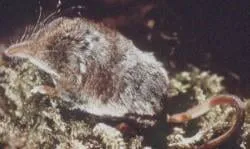
The cinereus shrew or masked shrew (Sorex cinereus) is a small shrew found in Alaska, Canada, and the northern United States. This is the most widely distributed shrew in North America, where it is also known as the common shrew.
Description
It is grey-brown in colour with a light grey underside and a pointed snout. It has a long tail that is brown on top and pale underneath with a dark tip. Its body is about 9 cm (3.5 in) in length including a 4 cm (1.6 in) long tail. It weighs about 5 g (0.18 oz). It has darker colouring than other shrews. Masked shrews can live up to two years, but, on average, only survive eighteen months. In a long-term study done in Alaska, Yom-Tov and colleagues (2005) found that the masked shrew's body size contradicts Bergmann's rule. The study, done on 650 specimens and spanning from 1950 to 2003, examined body size in relation to ambient temperature. Measurements of body weight and the length of the tail, ear, hind foot, and body were taken. Results yielded that the masked shrew's body size decreased with high latitudes and with lower mean January temperatures, a trend that opposed Bergmann's Rule. It was suggested that this may be a coping mechanism to limit total energy requirements due to decreased food availability in winter months. Additionally, it was shown that body and tail length increased with rising temperatures during the second half of the twentieth century. This may be due to higher temperatures increasing the availability of the shrew's main diet.
Habitat and range
The masked shrew is the most widely distributed shrew. Its range covers most of northern North America extending south as far down to Maryland, along the Rocky Mountains in the west, and to the Appalachians in the east. This species was introduced into Newfoundland in the late 1950s. It can be found in many types of habitat like arid grasslands, moist areas, woodland, and tundra. The masked shrew mostly lives in humid areas and with high levels of vegetation to hide in. Moisture determines the abundance of this shrew.
Reproduction
Masked shrews living at high latitudes are born in late spring and summer, reach adult size by the time they leave their nests, and complete their life cycle within a year. They are born during spring or summer, remain immature in winter, and breed the following spring. Masked shrews breed from May to September. Females have one litter of 6 to 7 young during the breeding season. The young are born hairless and clawless and have translucent abdominal walls. Body mass increases and peaks at twenty days, then decreases when the young leave the nest after about 27 days. Masked shrews have a high chance of mortality during their first two months of life and most die during the first year. Masked shrews become sexually mature at two months, but wait until their first spring to breed.
Text from Wikipedia — Cinereus shrew, revision 1364140312, CC BY-SA 4.0, retrieved 2026-09-04. Encyclopedic text reused under CC BY-SA 4.0. Sentences about hunting or regulation are removed: on this site, the rule comes from Québec.ca.
Other names
English
Presence in Quebec
- Origin
- Indigène
- Occurrence
- Régulier
- Population status
- Toute l'année
- Certainty
- Confirmé
Conservation
Québec.ca
Official periods
Source: Québec.ca — tables reproduced as published (retrieved 2026-08-30).
Regulations change. Always check Québec.ca before hunting or trapping.
Where this data comes from
This species is listed in an official government dataset. The identification and status shown in the data sheet are reproduced from it.
Source: List of Quebec’s vertebrate wildlife (LFVQ) — Ministère de l’Environnement, de la Lutte contre les changements climatiques, de la Faune et des Parcs. File LFVQ_25_03_2026.csv, retrieved 2026-08-30 · CC BY 4.0.
Measurements, habitat, diet and reproduction are not shown: no official source is attached to them yet.