
No period published by Québec.ca
Québec.ca publishes no hunting or trapping period for this species. Check the official regulations.
Wikipedia
Musaraigne de Gaspé
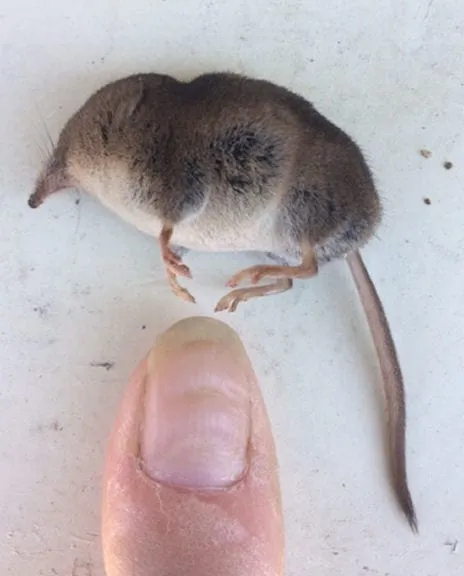
The long-tailed shrew or rock shrew (Sorex dispar) is a small shrew found in Atlantic Canada and the Northeastern United States. This shrew is slate grey in color with a pointed snout, a long tail, and lighter underparts. It is found on rocky slopes in mountainous areas along the Atlantic coast from Gaspé Peninsula, Quebec, and Cape Breton Island, Nova Scotia, to northern Georgia. It eats insects and spiders. Predators include hawks, owls, and snakes.
Habitat and range
The long-tailed shrew generally inhabits two types of environments: near mountain streams, or under and among rocks. The species can be found in mountainous, forested areas that could be deciduous or evergreen, and in rocky, damp areas where deep crevices are abundant that can be covered by leaf mold and roots. In numerous descriptions of the species habitat, rocks are an important component of the habitat, giving the species the name rock shrew.
Diet
The long-tailed shrew has an extremely narrow skull, as well as large incisors which give it the ability to extract insects, spiders, worms and centipedes from the rocky crevices of its environment.
Reproduction
Reproduction in the long-tailed shrew occurs in spring and summer; the breeding time ranges possibly late April to August. The long-tailed shrew produces one or two litters from May through August, with two to five young per litter. As a result of its short lifespan, sexual maturity is reached in less than a year.
Text from Wikipedia — Long-tailed shrew, revision 1314913473, CC BY-SA 4.0, retrieved 2026-09-04. Encyclopedic text reused under CC BY-SA 4.0. Sentences about hunting or regulation are removed: on this site, the rule comes from Québec.ca.
Other names
French
Presence in Quebec
- Origin
- Indigène
- Occurrence
- Régulier
- Population status
- Toute l'année
- Certainty
- Confirmé
Conservation
Québec.ca
Official periods
Source: Québec.ca — tables reproduced as published (retrieved 2026-08-30).
Regulations change. Always check Québec.ca before hunting or trapping.
Where this data comes from
This species is listed in an official government dataset. The identification and status shown in the data sheet are reproduced from it.
Source: List of Quebec’s vertebrate wildlife (LFVQ) — Ministère de l’Environnement, de la Lutte contre les changements climatiques, de la Faune et des Parcs. File LFVQ_25_03_2026.csv, retrieved 2026-08-30 · CC BY 4.0.
Measurements, habitat, diet and reproduction are not shown: no official source is attached to them yet.