
No period published by Québec.ca
Québec.ca publishes no hunting or trapping period for this species. Check the official regulations.
Wikipedia
Musaraigne fuligineuse
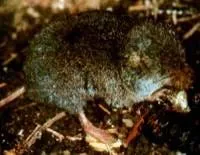
The smoky shrew (Sorex fumeus) is a medium-sized North American shrew found in eastern Canada and the northeastern United States and further south along the Appalachian Mountains.
Description
The smoky shrew is active year-round. It is dull grey in colour with lighter underparts and a long tail which is brown on top and yellowish underneath. During winter, its fur is grey. Its body is about 11 centimetres (4.3 in) in length including a 4 centimetres (1.6 in) long tail and it weighs roughly 5 grams (0.18 oz).
Reproduction
Smoky shrews start mating in late March, and females give birth to their first litters in April or May, about 20 days after mating. They mate again as soon as the first litter is born, and they may have two more litters, each about a month apart, if the female lives long enough. Each litter has two to eight pups, normally six. In one month, the offspring weigh around 4 grams which is half of the adult weight. Male smoky shrews do not take care of their offspring, only the female does. Females make nests in leaf litter where they give birth. The offspring are blind, helpless, and have no fur. Females nurse and protect their offspring for a short time (less than 20 days).
Text from Wikipedia — Smoky shrew, revision 1320531330, CC BY-SA 4.0, retrieved 2026-09-04. Encyclopedic text reused under CC BY-SA 4.0. Sentences about hunting or regulation are removed: on this site, the rule comes from Québec.ca.
Presence in Quebec
- Origin
- Indigène
- Occurrence
- Régulier
- Population status
- Toute l'année
- Certainty
- Confirmé
Conservation
Québec.ca
Official periods
Source: Québec.ca — tables reproduced as published (retrieved 2026-08-30).
Regulations change. Always check Québec.ca before hunting or trapping.
Where this data comes from
This species is listed in an official government dataset. The identification and status shown in the data sheet are reproduced from it.
Source: List of Quebec’s vertebrate wildlife (LFVQ) — Ministère de l’Environnement, de la Lutte contre les changements climatiques, de la Faune et des Parcs. File LFVQ_25_03_2026.csv, retrieved 2026-08-30 · CC BY 4.0.
Measurements, habitat, diet and reproduction are not shown: no official source is attached to them yet.