
Migratory game bird — federal regulations
Seasons and bag limits are set by Environment and Climate Change Canada.
Wikipedia
Oie cendrée
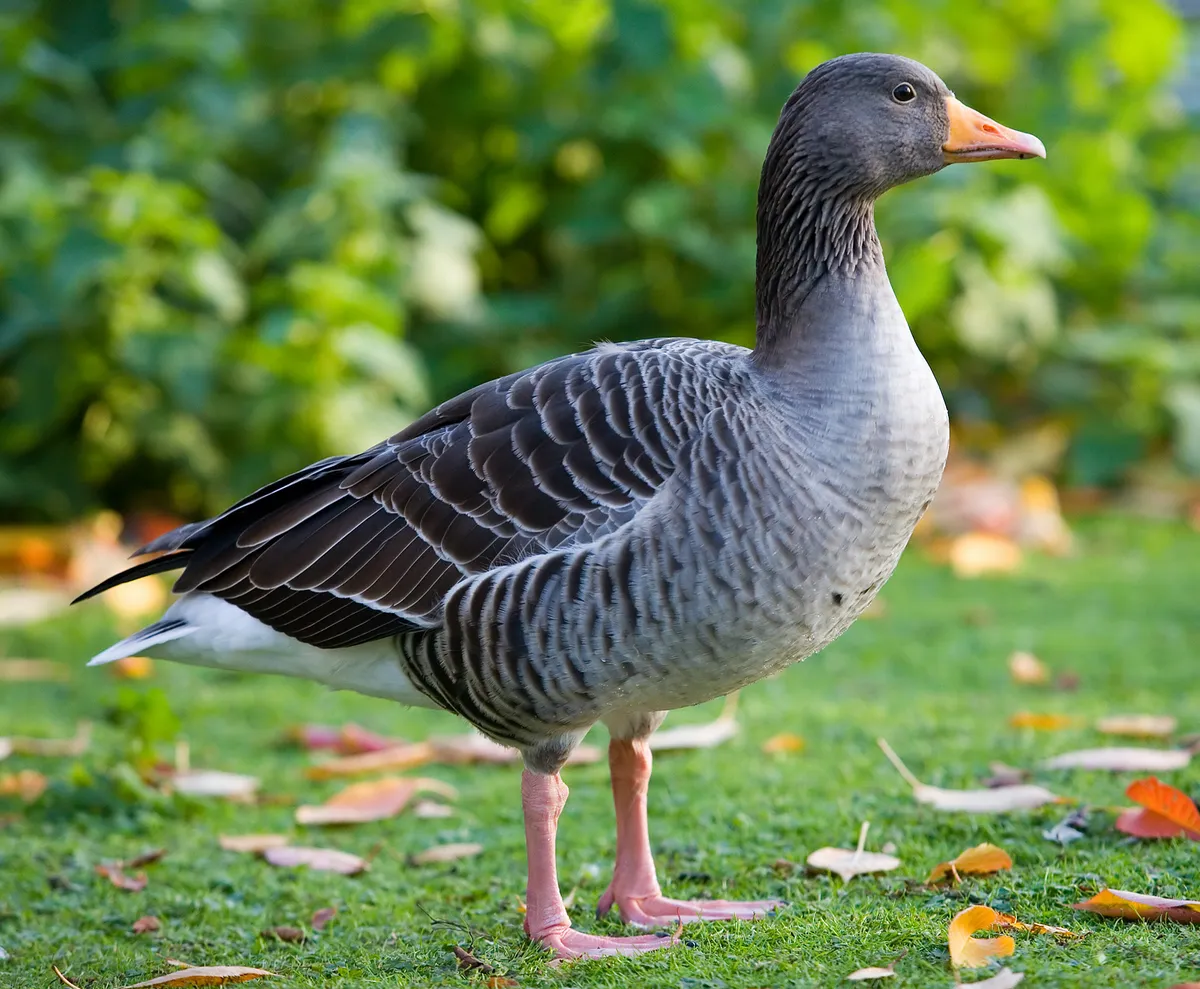
The greylag goose (Anser anser) is a species of large goose in the waterfowl family Anatidae and the type species of the genus Anser. It has mottled and barred grey and white plumage and an orange beak and pink legs. A large bird, it measures between 74 and 91 centimetres (29 and 36 in) in length, with an average weight of 3.3 kilograms (7 lb 4 oz). Its distribution is widespread, with birds from the north of its range in Europe and Asia often migrating southwards to spend the winter in warmer places, although many populations are resident, even in the north. It is the ancestor of most breeds of domestic goose, having been domesticated at least as early as 1360 BCE. The genus name and specific epithet are from anser, the Latin for "goose". In the USA, its name has been spelled "graylag". Greylag geese travel to their northerly breeding grounds in spring, nesting on moorlands, in marshes, around lakes and on coastal islands. They normally mate for life and nest on the ground among vegetation. A clutch of three to five eggs is laid; the female incubates the eggs and both parents defend and rear the young. The birds stay together as a family group, migrating southwards in autumn as part of a flock, and separating the following year. During the winter they occupy semi-aquatic habitats, estuaries, marshes and flooded fields, feeding on grass and often consuming agricultural crops. Some populations, such as those in southern England and in urban areas across the species' range, are primarily resident and occupy the same area year-round.
Description
The greylag is the largest and bulkiest of the grey geese of the genus Anser, but is more lightly built and agile than its domestic relative. It has a rotund, bulky body, a thick and long neck, and a large head and bill. It has pink legs and feet, and an orange or pink bill with a white or brown nail (hard horny material at tip of upper mandible). It is 74 to 91 centimetres (29 to 36 in) long with a wing length of 41.2 to 48 centimetres (16+1⁄4 to 19 in). It has a tail 6.2 to 6.9 centimetres (2+7⁄16 to 2+11⁄16 in), a bill of 6.4 to 6.9 centimetres (2+1⁄2 to 2+11⁄16 in) long, and a tarsus of 7.1 to 9.3 centimetres (2+13⁄16 to 3+11⁄16 in). It weighs 2.16 to 4.56 kilograms (4 lb 12 oz to 10 lb 1 oz), with a mean weight of around 3.3 kilograms (7 lb 4 oz). The wingspan is 147 to 180 centimetres (58 to 71 in). Males are generally larger than females, with the sexual dimorphism more pronounced in the eastern subspecies A. a. rubirostris, which is larger than the nominate subspecies on average. The plumage of the greylag goose is greyish brown, with a darker head and paler breast and belly with a variable amount of black spotting. It has a pale grey forewing and rump which are noticeable when the bird is in flight or stretches its wings on the ground. It has a white line bordering its upper flanks, and its wing coverts are light coloured, contrasting with its darker flight feathers.
Text from Wikipedia — Greylag goose, revision 1360403207, CC BY-SA 4.0, retrieved 2026-09-04. Encyclopedic text reused under CC BY-SA 4.0. Sentences about hunting or regulation are removed: on this site, the rule comes from Québec.ca.
Presence in Quebec
- Origin
- Indigène
- Occurrence
- Accidentel/non régulier
- Population status
- Migrateur
- Certainty
- Confirmé
Conservation
Official remark
Présence de l'espèce plutôt imprévisible; elle peut ne pas être observée pendant de longues périodes. Certaines présences de cette espèce sont attribuables à des oiseaux échappés de captivité ou relâchés.
Québec.ca
Official periods
Source: Québec.ca — tables reproduced as published (retrieved 2026-08-30).
Regulations change. Always check Québec.ca before hunting or trapping.
Where this data comes from
This species is listed in an official government dataset. The identification and status shown in the data sheet are reproduced from it.
Source: List of Quebec’s vertebrate wildlife (LFVQ) — Ministère de l’Environnement, de la Lutte contre les changements climatiques, de la Faune et des Parcs. File LFVQ_25_03_2026.csv, retrieved 2026-08-30 · CC BY 4.0.
Measurements, habitat, diet and reproduction are not shown: no official source is attached to them yet.