
Migratory game bird — federal regulations
Seasons and bag limits are set by Environment and Climate Change Canada.
Wikipedia
Oie de la toundra
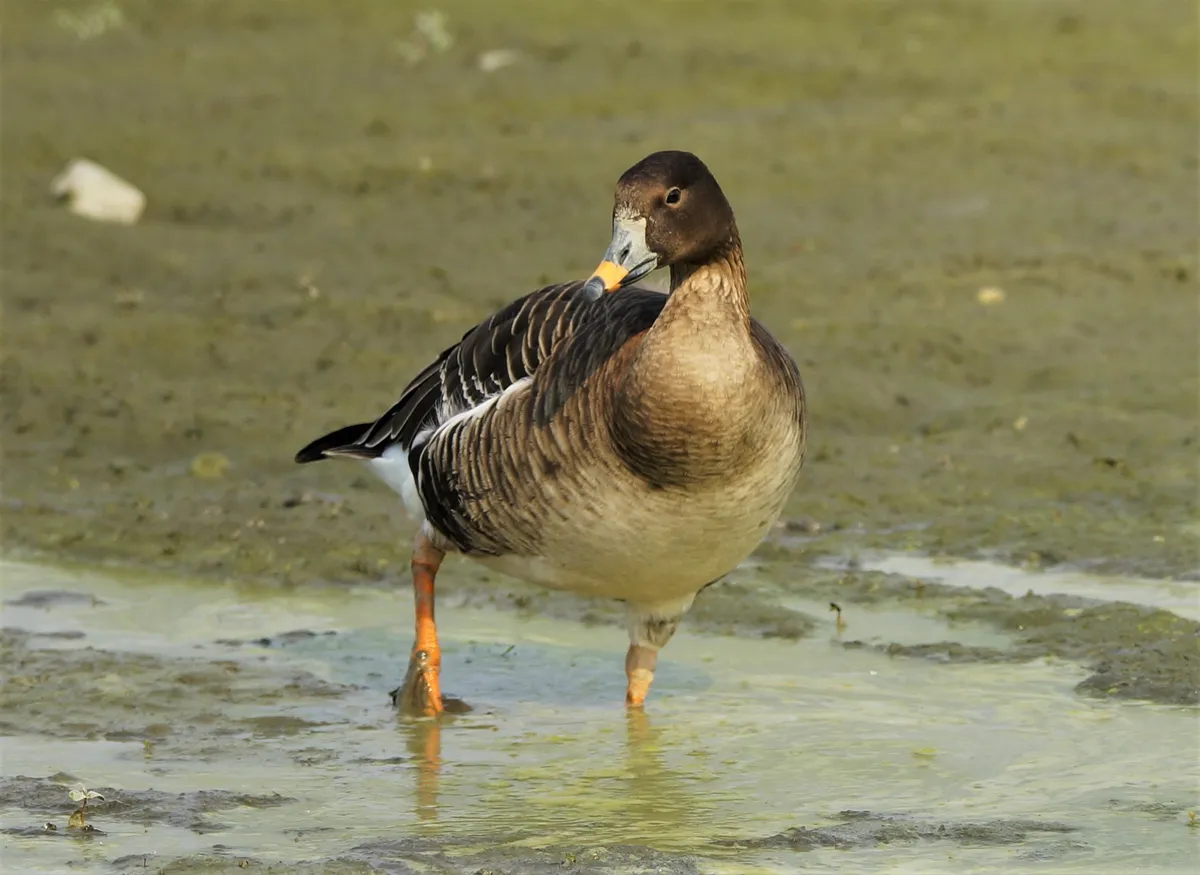
The tundra bean goose (Anser serrirostris) is a goose that breeds in northern Siberia. This and the taiga bean goose are recognised as separate species by the American Ornithological Society and International Ornithologists' Union, but are considered a single species by other authorities (collectively called bean goose). It is migratory and winters further south in Asia. The taiga and tundra bean goose diverged about 2.5 million years ago and established secondary contact ca. 60,000 years ago, resulting in extensive gene flow.
Description
The length ranges from 68 to 90 cm (27–35 in), wingspan from 140 to 174 cm (55–69 in) and weight from 1.7–4 kg (3.7–8.8 lb). In the nominate subspecies, males average 3.2 kg (7.1 lb) and females average 2.84 kg (6.3 lb). The bill is black at the base and tip, with an orange band across the middle; the legs and feet are also bright orange. The upper wing-coverts are dark brown, as in the white-fronted goose (Anser albifrons) and the lesser white-fronted goose (A. erythropus), but differing from these in having narrow white fringes to the feathers. The voice is a loud honking, higher pitched in the smaller subspecies. The closely related pink-footed goose (A. brachyrhynchus) has the bill short, bright pink in the middle, and the feet also pink, the upper wing-coverts being nearly of the same bluish-grey as in the greylag goose.
Habitat and range
The tundra bean goose has no regular wintering sites, but is found in small groups among other grey goose species – among the most regular localities are WWT Slimbridge, Gloucestershire and Holkham Marshes, Norfolk.
Text from Wikipedia — Tundra bean goose, revision 1339902184, CC BY-SA 4.0, retrieved 2026-09-04. Encyclopedic text reused under CC BY-SA 4.0. Sentences about hunting or regulation are removed: on this site, the rule comes from Québec.ca.
Presence in Quebec
- Origin
- Indigène
- Occurrence
- Accidentel/non régulier
- Population status
- Migrateur
- Certainty
- Confirmé
Conservation
Québec.ca
Official periods
Source: Québec.ca — tables reproduced as published (retrieved 2026-08-30).
Regulations change. Always check Québec.ca before hunting or trapping.
Where this data comes from
This species is listed in an official government dataset. The identification and status shown in the data sheet are reproduced from it.
Source: List of Quebec’s vertebrate wildlife (LFVQ) — Ministère de l’Environnement, de la Lutte contre les changements climatiques, de la Faune et des Parcs. File LFVQ_25_03_2026.csv, retrieved 2026-08-30 · CC BY 4.0.
Measurements, habitat, diet and reproduction are not shown: no official source is attached to them yet.