
Migratory game bird — federal regulations
Seasons and bag limits are set by Environment and Climate Change Canada.
Wikipedia
Grande oie des neiges
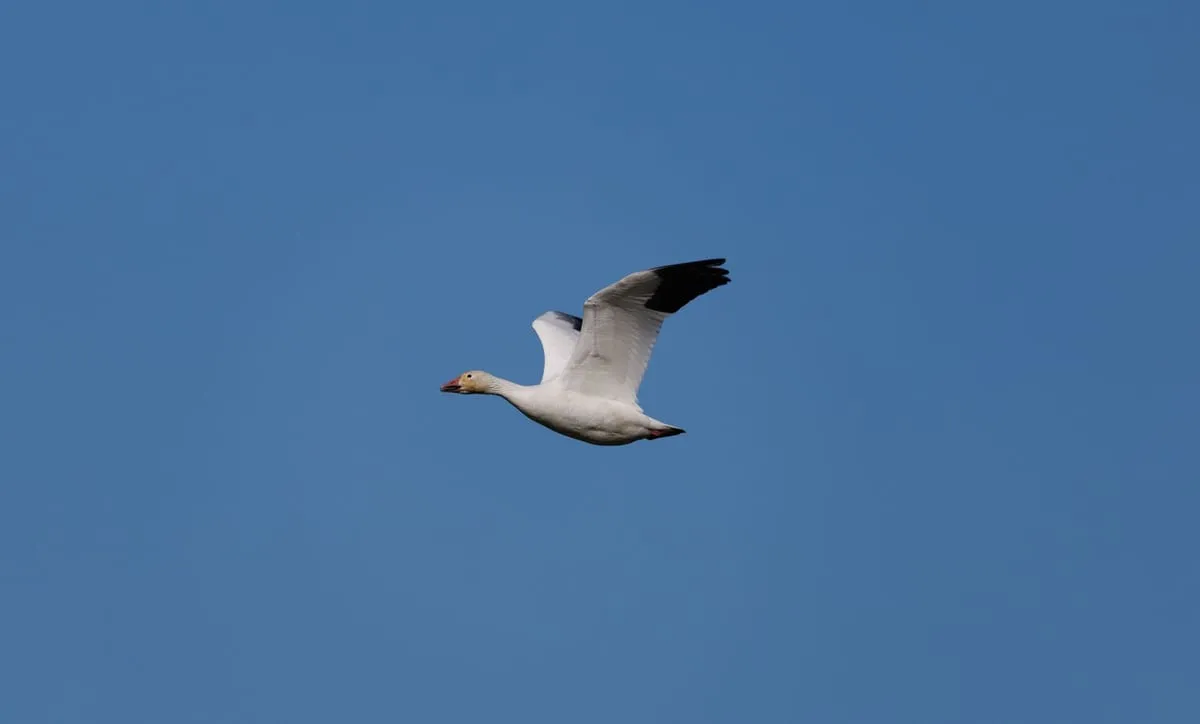
The snow goose (Anser caerulescens) is a species of goose native to North America. Both white and dark morphs exist, the latter often known as blue goose. Its name derives from the typically white plumage. The species was previously placed in the genus Chen, but is now typically included in the "gray goose" genus Anser. Snow geese breed north of the timberline in Greenland, Canada, Alaska, and the northeastern tip of Siberia, and spend winters in warm parts of North America from southwestern British Columbia through parts of the United States to Mexico.
Description
The snow goose has two color plumage morphs, white (snow) or gray/blue (blue), thus the common description as "snows" and "blues". White-morph birds are white except for black wing tips, but blue-morph geese have bluish-gray plumage replacing the white except on the head, neck, and tail tip. The immature blue phase is drab or slate-gray with little to no white on the head, neck, or belly. Both snow and blue phases have rose-red feet and legs and pink bills with black tomia ("cutting edges"), giving them a black "grin patch". These colors distinguish the species from white domesticated geese. The colors are not as bright on the feet, legs, and bill of immature birds. The head can be stained rusty brown from minerals in the soil where they feed. They are very vocal and can often be heard from more than a mile away. White- and blue-morph birds interbreed, and the offspring may be of either morph. These two colors of geese were once thought to be separate species; since they interbreed and are found together throughout their ranges, they are now considered two color phases of the same species. The color phases are genetically controlled. The dark phase results from a single dominant gene, and the white phase is homozygous recessive. When choosing a mate, young birds most often select a mate that resembles their parents' coloring. If the birds were hatched into a mixed pair, they mate with either color phase. The species is divided into two subspecies on the basis of size and geography. Size overlap has caused some to question the division. The smaller subspecies, the lesser snow goose (C. c. caerulescens), lives from central northern Canada to the Bering Straits area. The lesser snow goose stands 64 to 79 cm (25 to 31 in) tall and weighs 2.05 to 2.70 kg (4.5 to 6.0 lb). The larger subspecies, the greater snow goose (C. c. atlanticus), nests in northeastern Canada. It averages about 3.2 kg (7.1 lb) and 79 cm (31 in), but can weigh up to 4.5 kg (9.9 lb). The wingspan for both subspecies ranges from 135 to 165 cm (53 to 65 in).
Reproduction
Long-term pair bonds are usually formed in the second year, although breeding does not usually start until the third year. Females are strongly philopatric, meaning they return to the place they hatched to breed. Snow geese often nest in colonies. Nesting usually begins at the end of May to the first few days of June, depending on snow conditions.
Text from Wikipedia — Snow goose, revision 1367546718, CC BY-SA 4.0, retrieved 2026-09-04. Encyclopedic text reused under CC BY-SA 4.0. Sentences about hunting or regulation are removed: on this site, the rule comes from Québec.ca.
Other names
French
Former scientific names
Presence in Quebec
- Origin
- Indigène
- Occurrence
- Régulier
- Population status
- Migrateur
- Certainty
- Confirmé
Conservation
Québec.ca
Official periods
Source: Québec.ca — tables reproduced as published (retrieved 2026-08-30).
Regulations change. Always check Québec.ca before hunting or trapping.
SIT Québec register
Outfitters hunting this species
25 outfitters list this species among the game they hunt.
On this site
Related articles
Where this data comes from
This species is listed in an official government dataset. The identification and status shown in the data sheet are reproduced from it.
Source: List of Quebec’s vertebrate wildlife (LFVQ) — Ministère de l’Environnement, de la Lutte contre les changements climatiques, de la Faune et des Parcs. File LFVQ_25_03_2026.csv, retrieved 2026-08-30 · CC BY 4.0.
Measurements, habitat, diet and reproduction are not shown: no official source is attached to them yet.