
Migratory game bird — federal regulations
Seasons and bag limits are set by Environment and Climate Change Canada.
Wikipedia
Oie rieuse
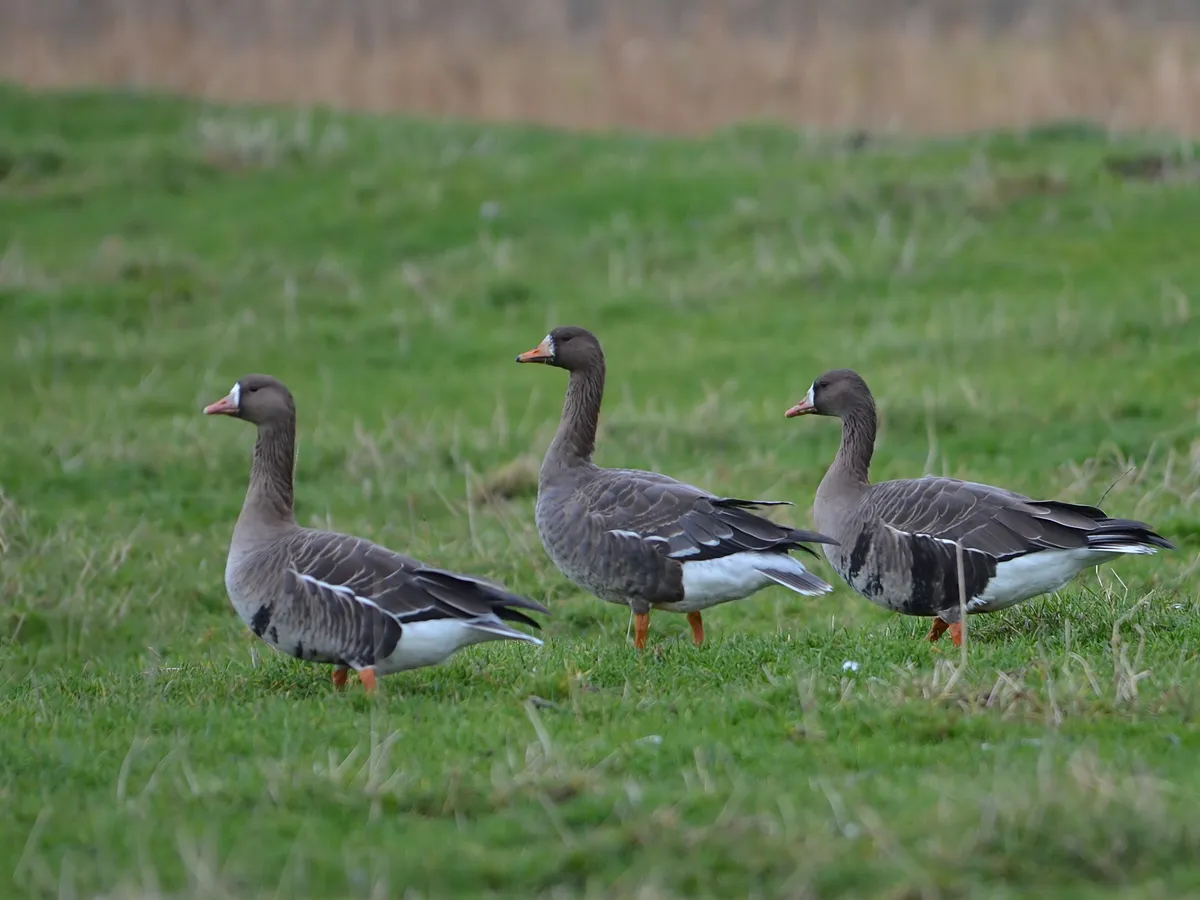
The greater white-fronted goose (Anser albifrons) is a species of goose, closely related to the smaller lesser white-fronted goose (A. erythropus). The greater white-fronted goose is migratory, breeding in northern Canada, Alaska, Greenland, and Russia, and winters farther south in North America, Europe, and Asia. It is named for the patch of white feathers bordering the base of its bill; its specific name albifrons comes from the Latin albus "white" and frons "forehead". In the United Kingdom and Ireland, it has been known as the white-fronted goose; in North America, it is known as the greater white-fronted goose (or "greater whitefront"), and this name is also increasingly adopted internationally. Even more distinctive are the salt-and-pepper markings on the breast of adult birds, which is why the goose is colloquially called the "specklebelly" in North America.
Description
Greater white-fronted geese are 64–81 cm (25–32 in) in length, have a 130–165 cm (51–65 in) wingspan, and weigh 1.93–3.31 kg (4 lb 4 oz – 7 lb 5 oz). They have bright orange legs and mouse-coloured upper wing coverts. They are smaller than greylag geese. The greater white-fronted goose is larger than and lacks the yellow eye ring of the lesser white-fronted goose, and its white facial blaze does not extend upwards so far as in the lesser. The male is typically larger in size, but both sexes are similar in appearance—greyish brown birds with light grey breasts dappled with dark brown to black blotches and bars. Both males and females also have a pinkish bill. Greater white-fronted geese make a variation of sounds, but notably the most recognizable is their high-pitched cackle that can be imitated by the sounds "he-he". A distinct breaking of the note occurs from the first cackle to the second.
Habitat and range
The North American midcontinent birds of the subspecies A. a. gambeli – which in 2010 had a fall population around 710,000 birds – breeds from the Alaska North Slope across the western and central Canadian Arctic. The Pacific white-fronted goose of the American Pacific coast, which in 2010 numbered approximately 650,000 birds, and the tule geese, which are estimated to number 10,000 birds, nest in western Alaska. The midcontinent geese gather in early fall on the prairies of western Saskatchewan and eastern Alberta, spending several weeks feeding before heading to wintering areas near the Gulf of Mexico, into northern Mexico. The Pacific birds migrate south along the Pacific coast, staging primarily in the Klamath Basin of southern Oregon and northern California and wintering, eventually, in California's Central Valley. The tule goose is somewhat rare and has been since the latter half of the 19th century; presumably it was affected by destruction of its wintering habitat due to human settlement. In the British Isles, two subspecies overwinter: Greenland birds in Scotland and Ireland, and Russian birds in England and Wales.
Text from Wikipedia — Greater white-fronted goose, revision 1365150756, CC BY-SA 4.0, retrieved 2026-09-04. Encyclopedic text reused under CC BY-SA 4.0. Sentences about hunting or regulation are removed: on this site, the rule comes from Québec.ca.
Presence in Quebec
- Origin
- Indigène
- Occurrence
- Régulier
- Population status
- Migrateur
- Certainty
- Confirmé
Conservation
Québec.ca
Official periods
Source: Québec.ca — tables reproduced as published (retrieved 2026-08-30).
Regulations change. Always check Québec.ca before hunting or trapping.
Where this data comes from
This species is listed in an official government dataset. The identification and status shown in the data sheet are reproduced from it.
Source: List of Quebec’s vertebrate wildlife (LFVQ) — Ministère de l’Environnement, de la Lutte contre les changements climatiques, de la Faune et des Parcs. File LFVQ_25_03_2026.csv, retrieved 2026-08-30 · CC BY 4.0.
Measurements, habitat, diet and reproduction are not shown: no official source is attached to them yet.