
No period published by Québec.ca
Québec.ca publishes no hunting or trapping period for this species. Check the official regulations.
Wikipedia
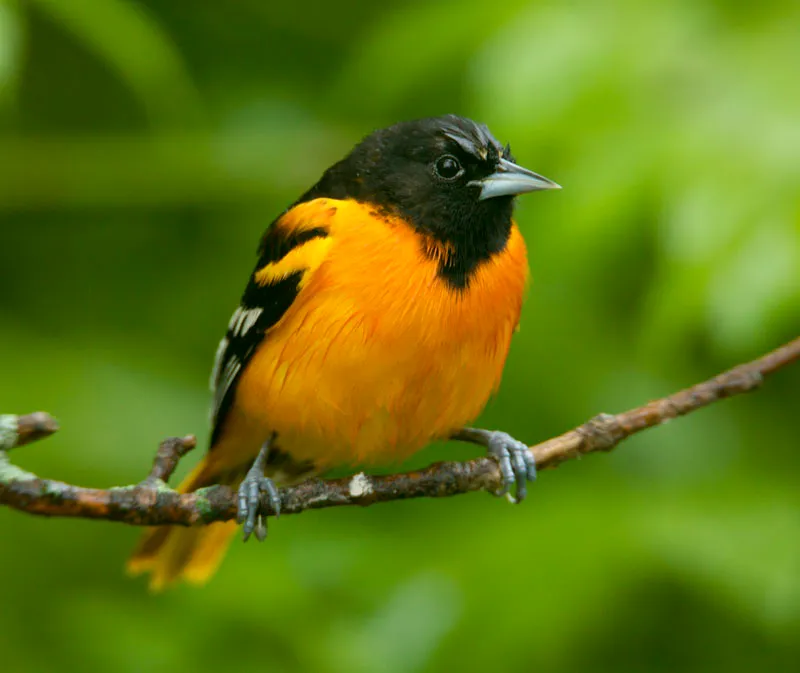
Oriole de Baltimore
The Baltimore oriole (Icterus galbula) is a small icterid blackbird common in eastern North America as a migratory breeding bird. It received its common name from the resemblance of the male's colors to those on the coat-of-arms of 17th-century Lord Baltimore. Observations of interbreeding between the Baltimore oriole and the western Bullock's oriole Icterus bullockii, led to both being classified as a single species, called the northern oriole, from 1973 to 1995. Research by James Rising, a professor of zoology at the University of Toronto, and others showed that the two birds actually did not interbreed significantly. The Baltimore oriole is the state bird of Maryland, and the namesake and mascot for the Baltimore Orioles baseball team.
Description
This medium-sized passerine measures 17–22 cm (6.7–8.7 in) in length and spans 23–32 cm (9.1–12.6 in) across the wings. Their build is typical of icterids, as they have a sturdy body, a longish tail, fairly long legs and a thick, pointed bill. The body weight averages 33.8 g (1.19 oz), with a range of weights from 22.3 to 42 g (0.79 to 1.48 oz). The male oriole is slightly larger than the female, although the size dimorphism is minimal by icterid standards. Adults always have white bars on the wings. The adult male is orange on the underparts, shoulder patch, and rump, with some birds appearing a very deep flaming orange and others appearing yellowish orange. All of the rest of the male's plumage is black. The adult female is yellow brown on the upper parts with darker wings, and dull orange yellow on the breast and belly. The juvenile oriole is similar looking to the female, with males taking until the fall of their second year to reach adult plumage.
Text from Wikipedia — Baltimore oriole, revision 1370824858, CC BY-SA 4.0, retrieved 2026-09-04. Encyclopedic text reused under CC BY-SA 4.0. Sentences about hunting or regulation are removed: on this site, the rule comes from Québec.ca.
Other names
French
English
Presence in Quebec
- Origin
- Indigène
- Occurrence
- Régulier
- Population status
- Reproducteur
- Certainty
- Confirmé
Conservation
Québec.ca
Official periods
Source: Québec.ca — tables reproduced as published (retrieved 2026-08-30).
Regulations change. Always check Québec.ca before hunting or trapping.
Where this data comes from
This species is listed in an official government dataset. The identification and status shown in the data sheet are reproduced from it.
Source: List of Quebec’s vertebrate wildlife (LFVQ) — Ministère de l’Environnement, de la Lutte contre les changements climatiques, de la Faune et des Parcs. File LFVQ_25_03_2026.csv, retrieved 2026-08-30 · CC BY 4.0.
Measurements, habitat, diet and reproduction are not shown: no official source is attached to them yet.