
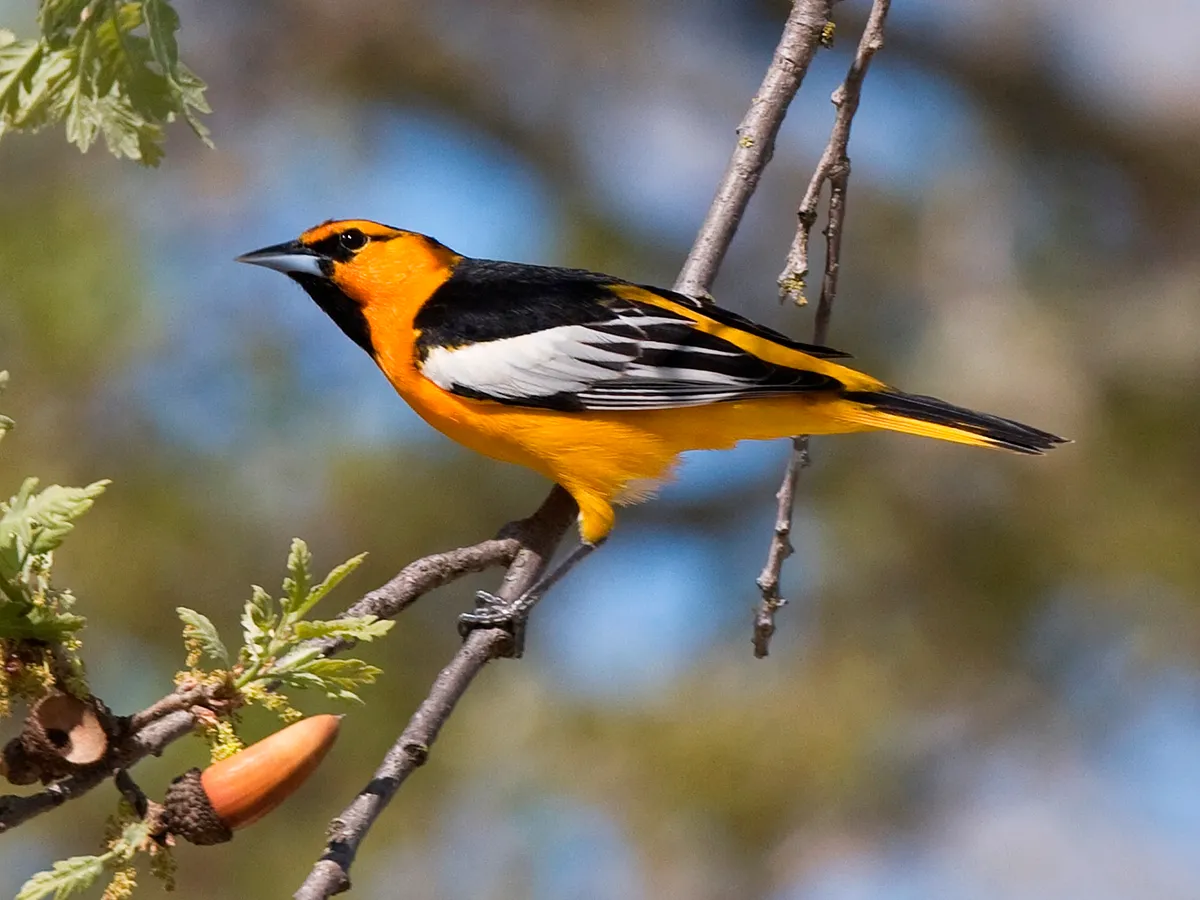
Oriole de Bullock— Quebec wildlife
Icterus bullockii
IcteridaeNo period published by Québec.ca
Québec.ca publishes no hunting or trapping period for this species. Check the official regulations.
Wikipedia
Oriole de Bullock
Bullock's oriole (Icterus bullockiorum, also known as Icterus bullockii) is a small New World blackbird. At one time, this species and the Baltimore oriole were considered to be a single species, the northern oriole. This bird is named after William Bullock, an English amateur naturalist.
Description
Bullock's orioles are sexually dimorphic, with males being more brightly colored than females. In addition, adult males tend to be slightly larger and heavier than females. Measurements: Length: 6.7–7.5 inches (17–19 cm) Weight: 1.0–1.5 ounces (28–43 g) Wingspan: 12.2 inches (31 cm) Adults have a pointed bill with a straight culmen. In adult males, the tail is long, square, and jet black. All exposed skin is black, as are the claws and bill, though the base of the lower mandible lightens to bluish-gray. Adult males are characterized by contrasting yellow-orange and black plumage, a black throat patch, and a white wing patch on the wing coverts. The underparts, breast, and face are orange or yellow; by contrast, the back, wings, and tail are black. A black line extends from each eye to the black crown. Adult females, by contrast, have gray-brown upperparts, duller yellow on the breast and underparts, and an olive crown. Some females may also have a dark throat patch, similar to (but less extensive than) the one found in adult males; in all cases, females lack the black eye-line present in adult males. Females with throat patches are thought to be older individuals. Following the general pattern observed among icterids, the overall plumage pattern seen in immature male Bullock's orioles closely resembles that seen in adult females. Juveniles resemble adult females, but have darker wings, fresh wing coverts, and a pink or whitish bill. Sexual dimorphism is not obvious in juveniles.
Habitat and range
Bullock's orioles are native to western North America, though they are sometimes found as vagrants in the eastern half of the continent. During the breeding season, they are found as far west as the eastern foothills of the Cascade Range. Their breeding range stretches east to the Dakotas, Kansas, and northern Central Texas. This species can be found as far north as British Columbia in Canada and as far south as Sonora or Durango in Mexico. It is common throughout its range, but is absent in parts of Arizona and Idaho, where a combination of extreme elevation and an arid climate make for poor living conditions. During winter, this species retreats to Mexico and northern Central America. Its winter range extends south and east from Sinaloa to Oaxaca.
Reproduction
Bullock's orioles are seasonally monogamous. The breeding season typically lasts from May until July. The exact timing of the beginning of the breeding season tends to vary geographically; in general, breeding begins later in the northernmost and westernmost portions of its geographic range.
Text from Wikipedia — Bullock's oriole, revision 1351626601, CC BY-SA 4.0, retrieved 2026-09-04. Encyclopedic text reused under CC BY-SA 4.0. Sentences about hunting or regulation are removed: on this site, the rule comes from Québec.ca.
Presence in Quebec
- Origin
- Indigène
- Occurrence
- Accidentel/non régulier
- Population status
- Migrateur
- Certainty
- Confirmé
Conservation
Québec.ca
Official periods
Source: Québec.ca — tables reproduced as published (retrieved 2026-08-30).
Regulations change. Always check Québec.ca before hunting or trapping.
Where this data comes from
This species is listed in an official government dataset. The identification and status shown in the data sheet are reproduced from it.
Source: List of Quebec’s vertebrate wildlife (LFVQ) — Ministère de l’Environnement, de la Lutte contre les changements climatiques, de la Faune et des Parcs. File LFVQ_25_03_2026.csv, retrieved 2026-08-30 · CC BY 4.0.
Measurements, habitat, diet and reproduction are not shown: no official source is attached to them yet.