
No period published by Québec.ca
Québec.ca publishes no hunting or trapping period for this species. Check the official regulations.
Wikipedia
Oriole des vergers
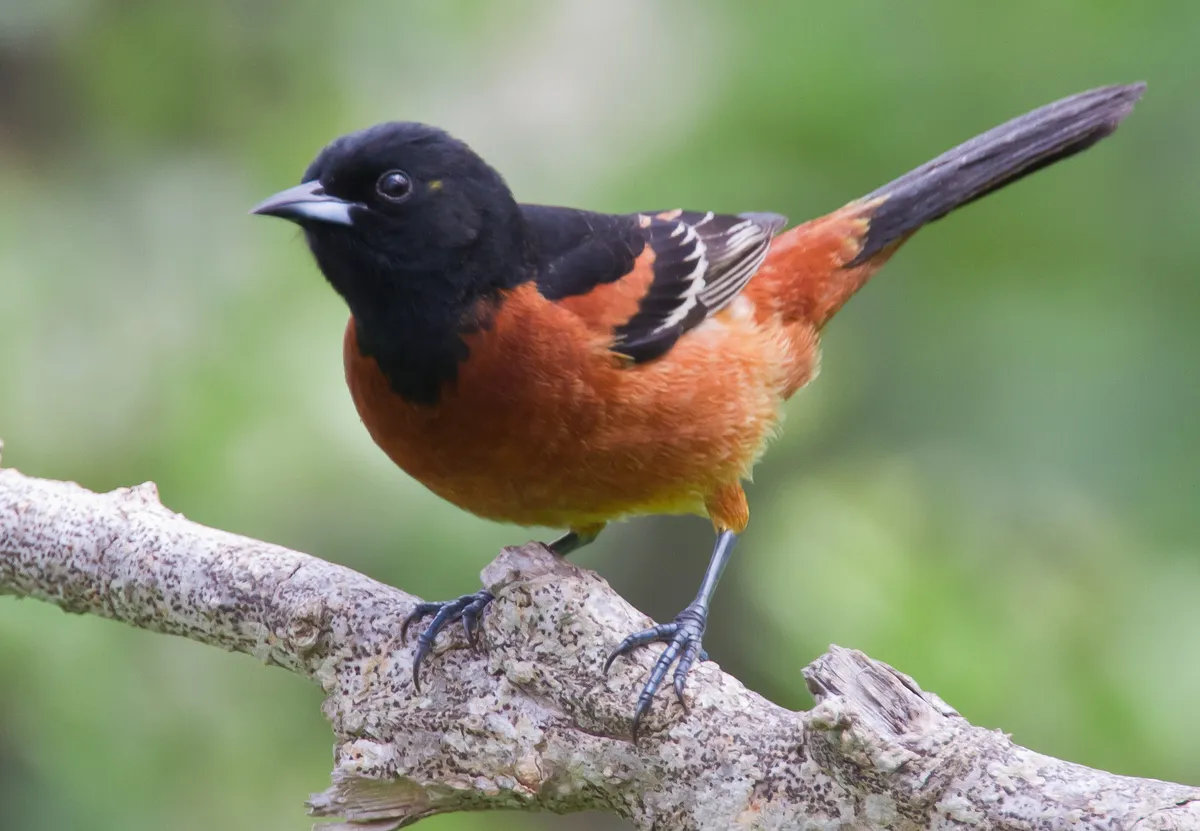
The orchard oriole (Icterus spurius) is the smallest species of icterid. The subspecies of the Caribbean coast of Mexico, I. s. fuertesi, is sometimes considered a separate species, the ochre oriole or Fuertes's oriole. The orchard oriole is a small bird with a length of 5.9-7.1 inches, a weight of 0.6-1.0 ounces, and a wingspan of 9.8 inches. Adult males have chestnut or ochre underparts, while adult females and juveniles have olive-green upper parts and yellowish breasts and bellies. They inhabit semi-open areas with deciduous trees in eastern North America, southern Tamaulipas, and Veracruz. Their winter range extends from central Sinaloa and southern Veracruz to northern Colombia and northwestern Venezuela. Orchard orioles prefer living near lakes and streams, nesting in tightly woven pouches attached to horizontal tree branches. They are nocturnal migrants and feed on insects, spiders, fruit, nectar, and seeds depending on the season. During flight, they usually swoop close to the ground and fly at or below treetop level. Courtship displays include bowing, seesawing, and begging. The species name "spurius" refers to their original misidentification as female Baltimore orioles, and they are sometimes mistaken for New World warblers.
Description
Measurements: Length: 5.9–7.1 in (15–18 cm) Weight: 0.6–1.0 oz (16–28 g) Wingspan: 9.8 in (25 cm) The bill is pointed and black with some blue-gray at the base of the lower mandible. The adult male of the nominate subspecies has chestnut on the underparts, shoulder, and rump, with the rest of the plumage black. In the subspecies I. s. fuertesi, the chestnut is replaced with ochre. The adult female and the juvenile of both subspecies have olive-green on the upper parts and yellowish on the breast and belly. All adults have pointed bills and white wing bars. (Orchard orioles are considered to be adults after their second year.) One-year-old males are yellow-greenish with black lores and bib.
Diet
While in breeding season, they eat insects and spiders. When the season changes, their diet also includes ripe fruit, which quickly passes through their digestive tract. During the winter, their diet consists of fruit, nectar, insects and seeds.
Text from Wikipedia — Orchard oriole, revision 1361280074, CC BY-SA 4.0, retrieved 2026-09-04. Encyclopedic text reused under CC BY-SA 4.0. Sentences about hunting or regulation are removed: on this site, the rule comes from Québec.ca.
Other names
French
English
Presence in Quebec
- Origin
- Indigène
- Occurrence
- Régulier
- Population status
- Reproducteur
- Certainty
- Confirmé
Conservation
Québec.ca
Official periods
Source: Québec.ca — tables reproduced as published (retrieved 2026-08-30).
Regulations change. Always check Québec.ca before hunting or trapping.
Where this data comes from
This species is listed in an official government dataset. The identification and status shown in the data sheet are reproduced from it.
Source: List of Quebec’s vertebrate wildlife (LFVQ) — Ministère de l’Environnement, de la Lutte contre les changements climatiques, de la Faune et des Parcs. File LFVQ_25_03_2026.csv, retrieved 2026-08-30 · CC BY 4.0.
Measurements, habitat, diet and reproduction are not shown: no official source is attached to them yet.