
Paruline à ailes blanches— Quebec wildlife
Myioborus pictus
ParulidaeNo period published by Québec.ca
Québec.ca publishes no hunting or trapping period for this species. Check the official regulations.
Wikipedia
Paruline à ailes blanches
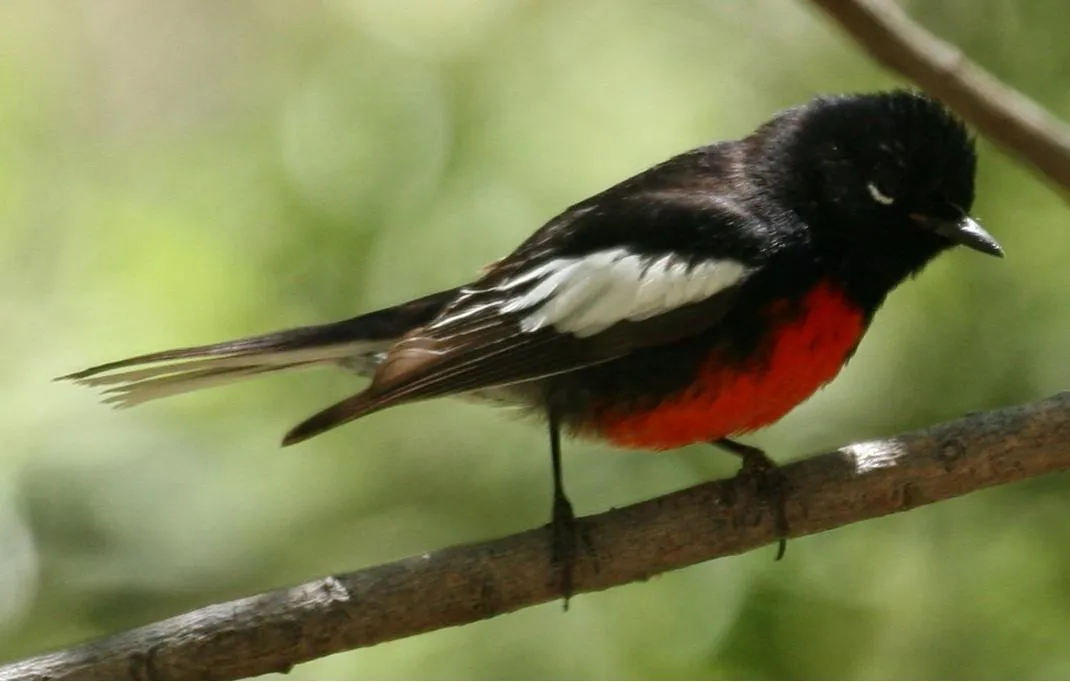
The painted redstart or painted whitestart (Myioborus pictus) is a species of New World warbler found in mountainous areas across inland Central America. They are among the largest warblers, reaching the length of 6 inches (150 mm), tail included. Adult birds have glossy black plumage, with white strips on the wing and a bright red belly. Female and male birds have similar appearance. Unusually for warblers, females are known to be as proficient at singing as their male counterparts.
Description
The painted redstart is the largest species of Myioborus, measuring 5.1–5.9 in (13–15 cm) in length, 8.3 inches (21 cm) in wingspan and having a weight of 0.3–0.4 oz (8.5–11.3 g). The sexes are the same in plumage, though males average slightly larger than females. The adult is mostly black, with a bright red lower breast and belly, large white wing patches, white outer tail feathers and white crescents below its eyes. The bill and legs are blackish. The juvenile painted redstart lacks the red belly and glossy black plumage of the adult. It is brownish-gray overall, with a paler belly and undertail coverts, and a pale cream or buff tinge to its wing patches. The young have a deep yellow-orange mouth lining.
Reproduction
Their nesting is done on the ground, and they create their nests so that they will be hidden among rocks, roots, or tufts of grass on steeply sloping ground. Their nests are large and shallow, constructed of strips of bark, plant fibers, leaves, and grass. The female will lay 3 or 4 white to cream-colored eggs that are speckled with fine brown and reddish spots. Incubation lasts about 14 days, but other nesting details are largely unknown.
Text from Wikipedia — Painted redstart, revision 1352881130, CC BY-SA 4.0, retrieved 2026-09-04. Encyclopedic text reused under CC BY-SA 4.0. Sentences about hunting or regulation are removed: on this site, the rule comes from Québec.ca.
Presence in Quebec
- Origin
- Indigène
- Occurrence
- Accidentel/non régulier
- Population status
- Migrateur
- Certainty
- Confirmé
Conservation
Official remark
Présence de l'espèce plutôt imprévisible; elle peut ne pas être observée pendant de longues périodes. Une mention confirmée en 2017.
Québec.ca
Official periods
Source: Québec.ca — tables reproduced as published (retrieved 2026-08-30).
Regulations change. Always check Québec.ca before hunting or trapping.
Where this data comes from
This species is listed in an official government dataset. The identification and status shown in the data sheet are reproduced from it.
Source: List of Quebec’s vertebrate wildlife (LFVQ) — Ministère de l’Environnement, de la Lutte contre les changements climatiques, de la Faune et des Parcs. File LFVQ_25_03_2026.csv, retrieved 2026-08-30 · CC BY 4.0.
Measurements, habitat, diet and reproduction are not shown: no official source is attached to them yet.