
No period published by Québec.ca
Québec.ca publishes no hunting or trapping period for this species. Check the official regulations.
Wikipedia
Paruline à ailes bleues
The blue-winged warbler (Vermivora cyanoptera) is a fairly common migratory New World warbler, 11.5 cm (4.5 in) long and weighing 8.5 g (0.30 oz). It breeds in eastern North America in southern Ontario and the eastern United States and winters in southern Central America. Its breeding range is extending northwards, where it is replacing the very closely related golden-winged warbler (Vermivora chrysoptera).
Description
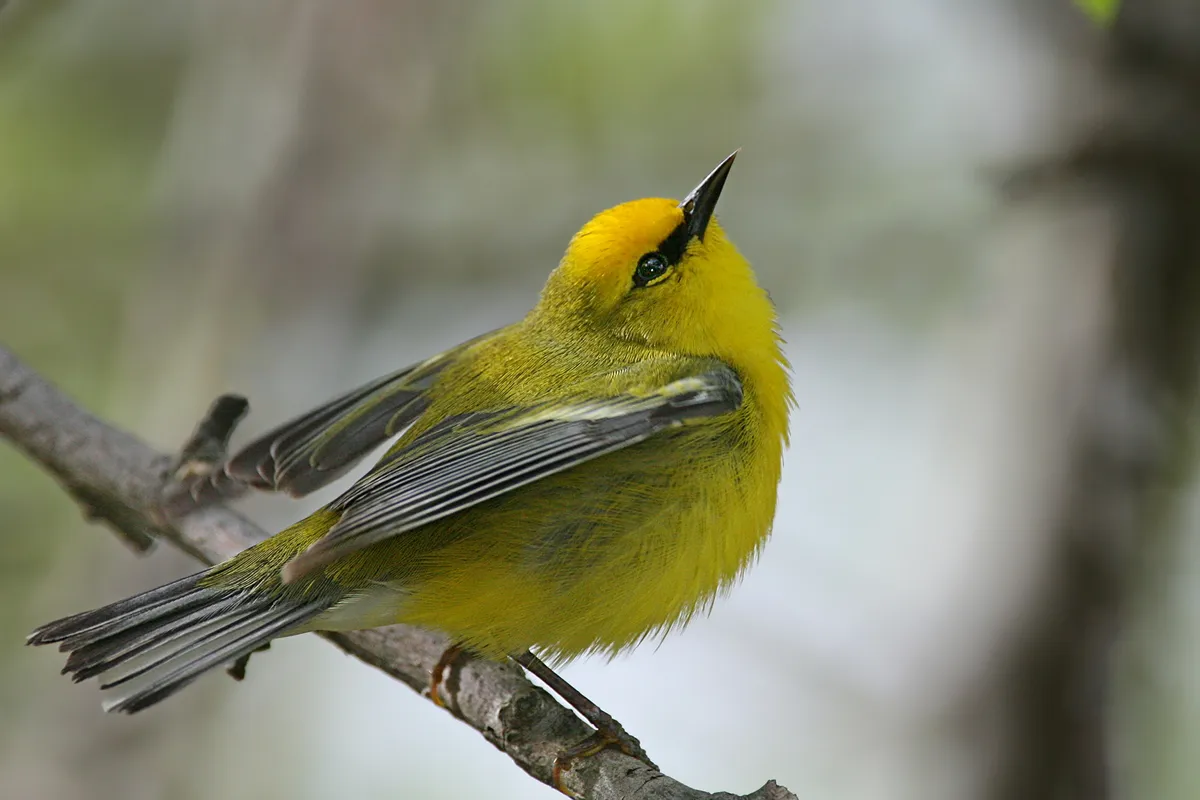
The blue-winged warbler is a small warbler at 11.4–12.7 cm (4.5–5.0 in) long, with a wingspan of 17–19.5 cm (6.7–7.7 in). The breeding plumage of the male consists of a bright yellow head, breast and underparts. There is no streaking of the underparts of the bird. It has a narrow black line though the eyes and light blueish gray with two white wing-bars, which are diagnostic field marks. The blue winged warblers are generally small in size with a well-proportioned body, and heavy pointed bill. They roughly measure 4.3 to 4.7 inches long with a wingspan of around 5.9 inches. An average Blue-Winged Warbler weighs around 0.3 oz. The female is duller overall with less yellow on the crown. Immatures are olive green with wings similar to the adults. The color of their plumage tends to vary depending on the sex of the species. For males, the feathers are of bright yellow and olive green. The males often have bluish-gray wings that come with white wing bars and a distinctive black eye lining, making their heads look pointier compared to other male warbler species. Blue-winged warbler females exhibit a yellow plumage that looks a bit lighter in color. The females also have a much less prominent eye lining which mostly looks grey and light, rather than black as seen in the males. Immature or juvenile blue-winged warblers are smaller compared to adults and will show a pinkish bill and almost invisible wing bars. The song is a series of buzzing notes. The call is a sharp chip.
Text from Wikipedia — Blue-winged warbler, revision 1353366141, CC BY-SA 4.0, retrieved 2026-09-04. Encyclopedic text reused under CC BY-SA 4.0. Sentences about hunting or regulation are removed: on this site, the rule comes from Québec.ca.
Other names
French
English
Presence in Quebec
- Origin
- Indigène
- Occurrence
- Régulier
- Population status
- Reproducteur
- Certainty
- Confirmé
Conservation
Québec.ca
Official periods
Source: Québec.ca — tables reproduced as published (retrieved 2026-08-30).
Regulations change. Always check Québec.ca before hunting or trapping.
Where this data comes from
This species is listed in an official government dataset. The identification and status shown in the data sheet are reproduced from it.
Source: List of Quebec’s vertebrate wildlife (LFVQ) — Ministère de l’Environnement, de la Lutte contre les changements climatiques, de la Faune et des Parcs. File LFVQ_25_03_2026.csv, retrieved 2026-08-30 · CC BY 4.0.
Measurements, habitat, diet and reproduction are not shown: no official source is attached to them yet.