
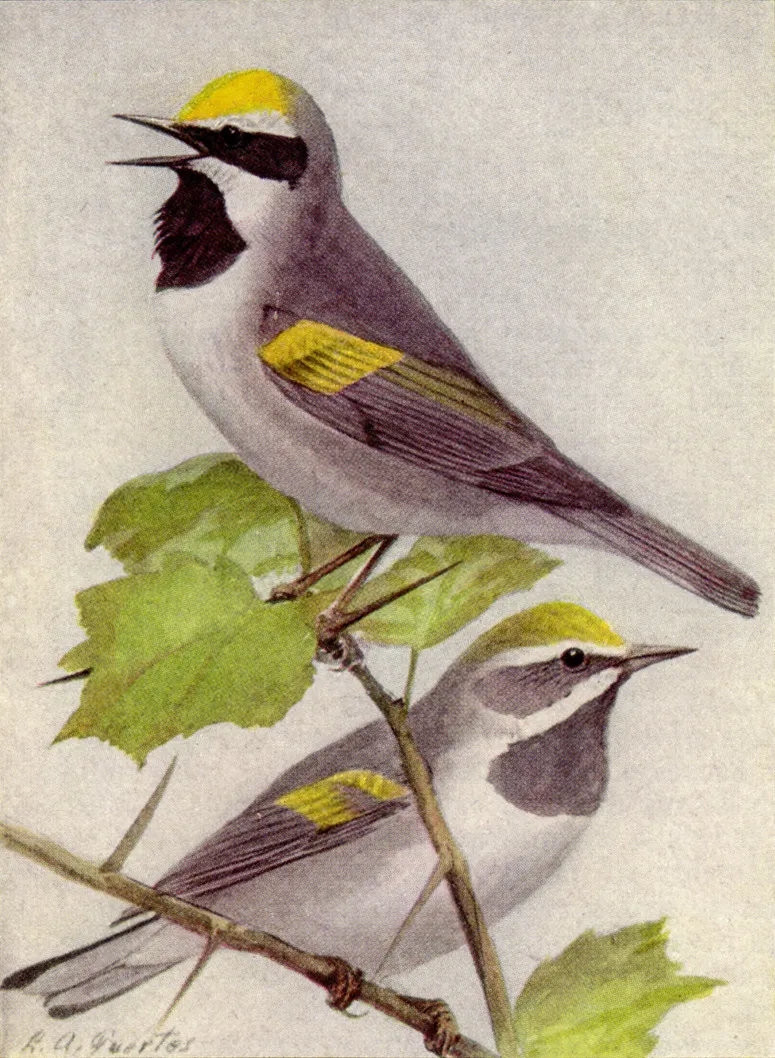
Paruline à ailes dorées— Quebec wildlife
Vermivora chrysoptera
ParulidaeNo period published by Québec.ca
Québec.ca publishes no hunting or trapping period for this species. Check the official regulations.
Wikipedia
Paruline à ailes dorées
The golden-winged warbler (Vermivora chrysoptera) is a small migratory insectivorous bird in the New World warbler family Parulidae. It breeds in southeastern and south-central Canada and in the Appalachian Mountains in the northeastern to north-central United States. The majority (~70%) of the global population breeds in Wisconsin, Minnesota, and Manitoba. Golden-winged warbler populations are slowly expanding northwards but are generally declining across its range. This is most likely as a result of habitat loss and competition/interbreeding with the very closely related blue-winged warbler, Vermivora cyanoptera, albeit the latter point has been debated. Populations are now restricted to two regions: the Great Lakes and the Appalachian Mountains.
Description
The golden-winged warbler is a small songbird, typically measuring 11.6 cm (4.6 in) long, weighing 8–10 g (0.28–0.35 oz), and having a wingspan of about 20 cm. The male has a black throat and a black mask bordered in white. Females resemble males but have a light gray throat and mask. Both sexes display a yellow crown, a yellow patch on the wing, and extensive white on the tail, which is conspicuous from below. The grayish white underparts contrast the darker gray back, and the bill is long and slender. Juvenile individuals appear similar to females, regardless of sex. Their song is variable, but is most often perceived as a trilled bzzzzzzz buzz buzz buzz. Their call is a buzzy chip or zip.
Text from Wikipedia — Golden-winged warbler, revision 1370871620, CC BY-SA 4.0, retrieved 2026-09-04. Encyclopedic text reused under CC BY-SA 4.0. Sentences about hunting or regulation are removed: on this site, the rule comes from Québec.ca.
Other names
French
English
Presence in Quebec
- Origin
- Indigène
- Occurrence
- Régulier
- Population status
- Reproducteur
- Certainty
- Confirmé
Conservation
Québec.ca
Official periods
Source: Québec.ca — tables reproduced as published (retrieved 2026-08-30).
Regulations change. Always check Québec.ca before hunting or trapping.
Where this data comes from
This species is listed in an official government dataset. The identification and status shown in the data sheet are reproduced from it.
Source: List of Quebec’s vertebrate wildlife (LFVQ) — Ministère de l’Environnement, de la Lutte contre les changements climatiques, de la Faune et des Parcs. File LFVQ_25_03_2026.csv, retrieved 2026-08-30 · CC BY 4.0.
Measurements, habitat, diet and reproduction are not shown: no official source is attached to them yet.