
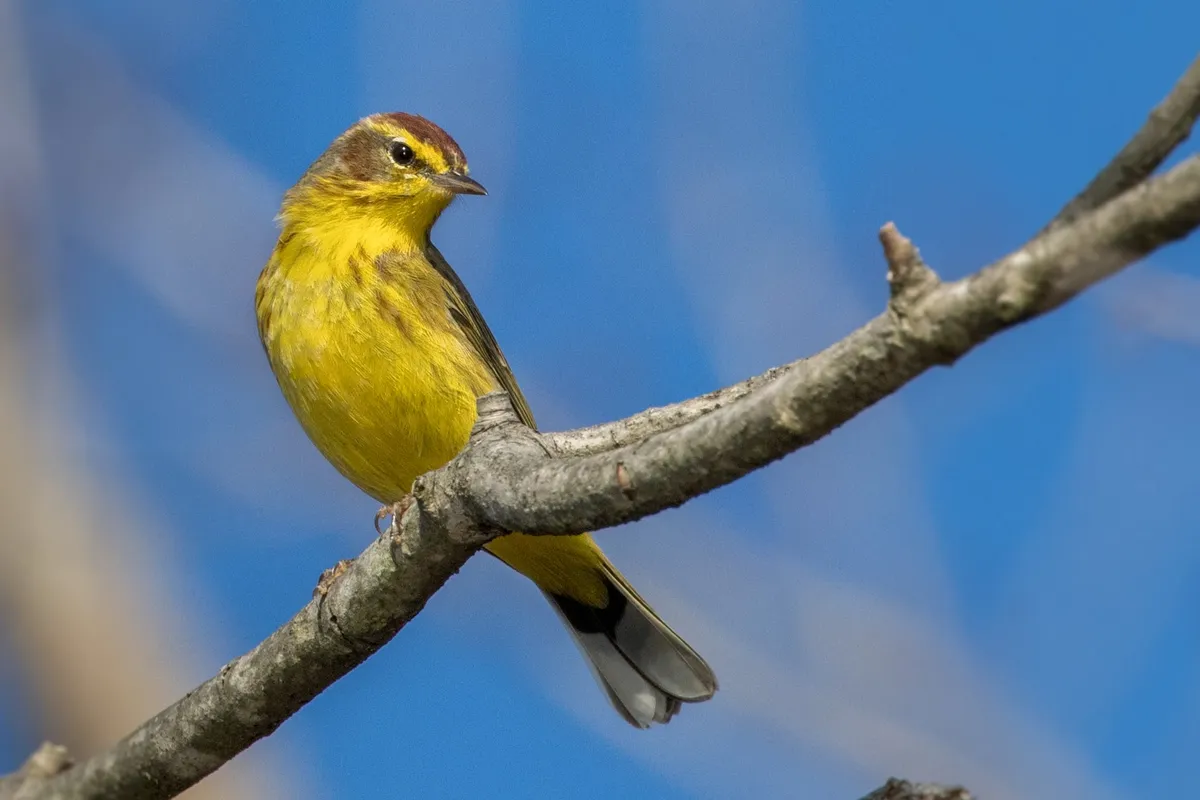
Paruline à couronne rousse— Quebec wildlife
Setophaga palmarum
ParulidaeNo period published by Québec.ca
Québec.ca publishes no hunting or trapping period for this species. Check the official regulations.
Wikipedia
Paruline à couronne rousse
The palm warbler (Setophaga palmarum) is a small songbird in the New World warbler family.
Description
Measurements: Length: 12–14 cm (4.7–5.5 in) Wingspan: 20–21 cm (7.9–8.3 in) Weight: 8.5–14.2 g (0.30–0.50 oz)
Habitat and range
Palm warblers breed in open coniferous bogs and edge east of the Continental Divide, across Canada and the northeastern United States. The bird breeds in the United States, Canada and Saint Pierre and Miquelon, and is also found in non-breeding populations throughout eastern North America, Central America and the Caribbean, as far south as Panama. There have also been occasional vagrant occurrences in parts of South America, Bermuda, Iceland and the United Kingdom. The palm warbler's habitat includes shrublands, forests, grasslands, wetlands, and human-modified environments. These birds migrate to the southeastern United States, the Yucatán Peninsula, islands of the Caribbean, and eastern Nicaragua south to Panama to winter. They are one of the earlier migrants to return to their breeding grounds in the spring, often completing their migration almost two months before most other warblers. Unlike most Setophaga species, the palm warbler's winter range includes much of the Atlantic coast of North America, extending as far north as southern Nova Scotia. Every year since 1900 the palm warbler has been observed during Christmas Bird Count activities in Massachusetts, and consistently since 1958 in Nova Scotia. For the interval 1966–2015 the palm warbler population increased throughout much of its northernmost breeding range. The palm warbler has been recorded as a vagrant to Iceland.
Text from Wikipedia — Palm warbler, revision 1368659173, CC BY-SA 4.0, retrieved 2026-09-04. Encyclopedic text reused under CC BY-SA 4.0. Sentences about hunting or regulation are removed: on this site, the rule comes from Québec.ca.
Other names
French
English
Former scientific names
Presence in Quebec
- Origin
- Indigène
- Occurrence
- Régulier
- Population status
- Reproducteur
- Certainty
- Confirmé
Conservation
Québec.ca
Official periods
Source: Québec.ca — tables reproduced as published (retrieved 2026-08-30).
Regulations change. Always check Québec.ca before hunting or trapping.
Where this data comes from
This species is listed in an official government dataset. The identification and status shown in the data sheet are reproduced from it.
Source: List of Quebec’s vertebrate wildlife (LFVQ) — Ministère de l’Environnement, de la Lutte contre les changements climatiques, de la Faune et des Parcs. File LFVQ_25_03_2026.csv, retrieved 2026-08-30 · CC BY 4.0.
Measurements, habitat, diet and reproduction are not shown: no official source is attached to them yet.