
No period published by Québec.ca
Québec.ca publishes no hunting or trapping period for this species. Check the official regulations.
Wikipedia
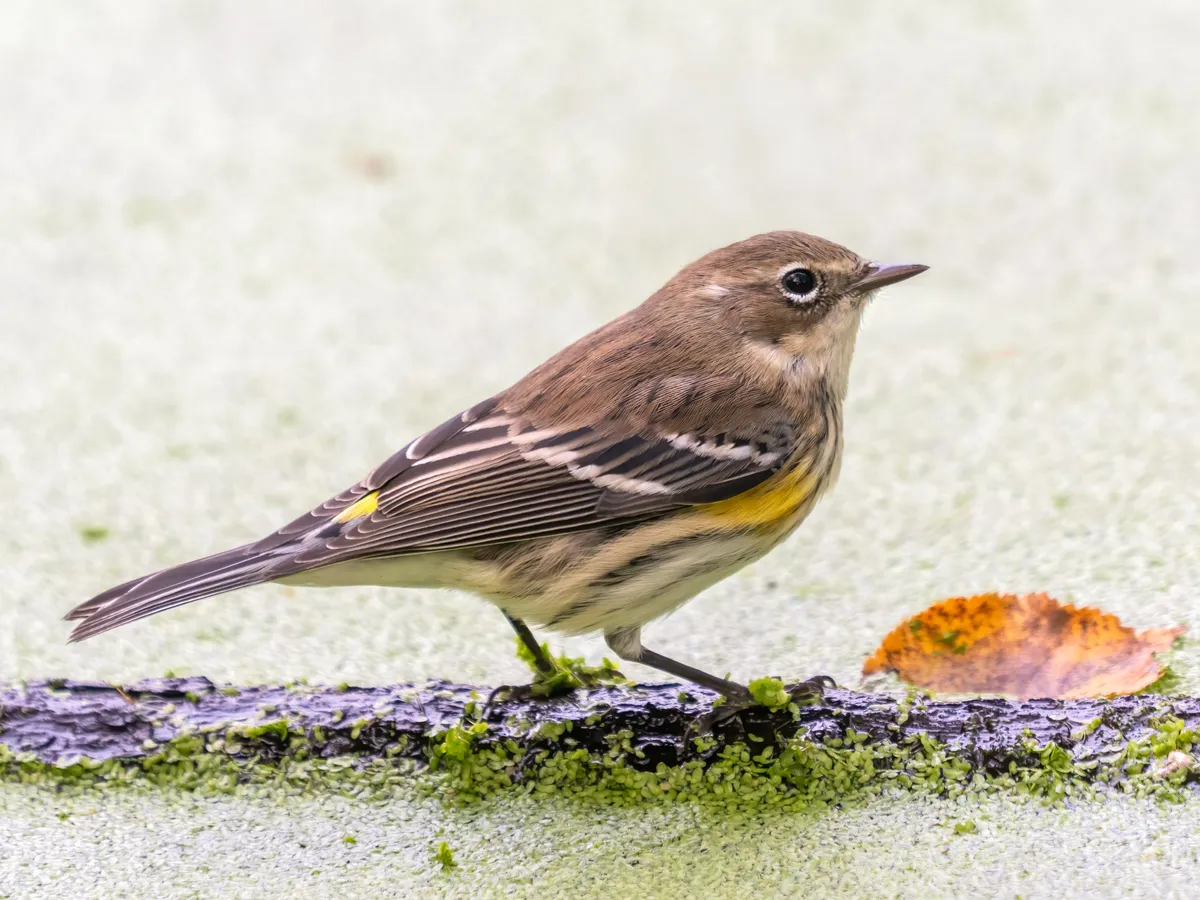
Paruline à croupion jaune
The yellow-rumped warbler (Setophaga coronata) is a North American bird species that can be commonly observed all across the continent. Its extensive range connects both the Pacific and Atlantic coasts of the U.S. as well as Canada and Central America, with the population concentrated in the continent's northern reaches during the breeding season and migrating southwards to southern North and Central America in the winter. It generally prefers coniferous forests or mixed coniferous-deciduous forests as its breeding habitat, while during the winter it can be found inhabiting more open areas such as shrublands that offer food resources. The yellow-rumped warbler is primarily insectivorous, though the species eats fruit such as juniper berries, especially in winter. The species combines four closely related forms: the eastern myrtle warbler (spp. coronata); its western counterpart, Audubon's warbler (spp. group auduboni); the northwest Mexican black-fronted warbler (spp. nigrifrons); and the Guatemalan Goldman's warbler (spp. goldmani). All subspecies of the yellow-rumped warbler are characterized by the yellow rump as its name implies, while intra-group and inter-group variations in appearance exist in spite of many similarities. The myrtle and Audubon's groups, as two major subspecies, are distinguished by noticeable features such as differing throat colorations.
Description
The yellow-rumped warbler has an average length of 14 cm and weight of 12.5 g, its appearance is different across its subspecies groups, especially the two major ones: the coronata group (myrtle warbler) and the auduboni group (Audubon's warbler); intra-group variations are also observed. In spite of varying appearances, the yellow rump (as suggested by its name) is present in all subspecies and thus characterizes the yellow-rumped warbler. Within the myrtle warbler group, adult males during the breeding season have gray backs with dark streaks, while females have brown backs; male and female myrtle warblers can also be distinguished by their different cheek colors, with the former's being black and the latter having brown or gray cheeks. The Audubon's subspecies group is not very dissimilar to the myrtle: in summers, males of both forms have streaked backs of black on slate blue, white wing patches, a streaked breast, and conspicuous yellow patches on the crown, flank, and rump (the latter giving rise to the species's nickname "butter butt" among birdwatchers). Yet the color of the coronata and auduboni groups' throat patches differs and distinguishes them, as the Audubon's warbler sports a yellow throat patch while the myrtle warbler has a white throat and eye stripe, and a contrasting black cheek patch. Females of both forms are more dull, with brown streaking front and back, but still have noticeable yellow rumps.
Habitat and range
The yellow-rumped warbler breeds from eastern North America west to the Pacific, and southward from there into Western Mexico.Goldman's yellow-rumped warbler is a non-migrato
Text from Wikipedia — Yellow-rumped warbler, revision 1358571859, CC BY-SA 4.0, retrieved 2026-09-04. Encyclopedic text reused under CC BY-SA 4.0. Sentences about hunting or regulation are removed: on this site, the rule comes from Québec.ca.
Other names
French
English
Former scientific names
Presence in Quebec
- Origin
- Indigène
- Occurrence
- Régulier
- Population status
- Reproducteur
- Certainty
- Confirmé
Conservation
Québec.ca
Official periods
Source: Québec.ca — tables reproduced as published (retrieved 2026-08-30).
Regulations change. Always check Québec.ca before hunting or trapping.
Where this data comes from
This species is listed in an official government dataset. The identification and status shown in the data sheet are reproduced from it.
Source: List of Quebec’s vertebrate wildlife (LFVQ) — Ministère de l’Environnement, de la Lutte contre les changements climatiques, de la Faune et des Parcs. File LFVQ_25_03_2026.csv, retrieved 2026-08-30 · CC BY 4.0.
Measurements, habitat, diet and reproduction are not shown: no official source is attached to them yet.